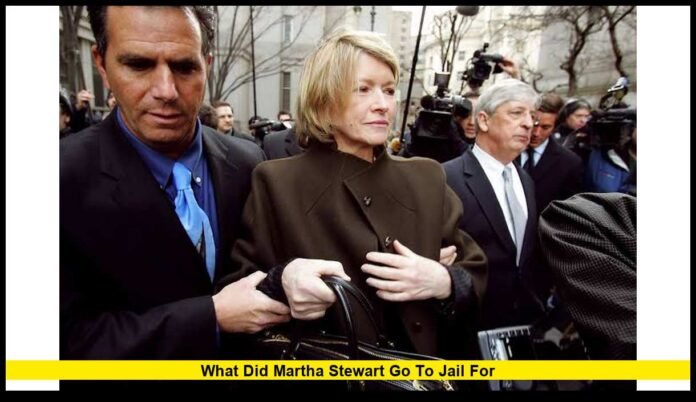

What did Martha Stewart go to jail for? Martha Stewart went to federal prison in 2004 after a jury convicted her of conspiracy, obstruction of justice, and making false statements during a federal investigation into her sale of ImClone Systems stock. Although the case centered on a stock transaction that raised insider-trading concerns, Stewart was not convicted of insider trading in her criminal trial. The jury found her guilty of offenses connected to the investigation that followed the sale.
The case became one of the most widely recognized legal controversies involving an American business personality. It began in December 2001, when Stewart sold thousands of shares in ImClone Systems shortly before news about a regulatory setback sent the company’s stock price lower.
Investigators examined the timing of the transaction and the information Stewart received from her stockbroker. They also questioned the explanations she gave about why she sold the shares. Those questions eventually became the central issue in her criminal prosecution.
A jury returned its guilty verdict in March 2004. Several months later, a federal judge sentenced Stewart to five months in prison, five months of home confinement, two years of supervised release, and a $30,000 fine.
Stewart reported to federal prison in October 2004 and left in March 2005. Her case did not end with her release, however. A separate civil proceeding brought by the Securities and Exchange Commission resulted in a settlement in 2006.
Understanding the difference between the stock-sale allegations and the criminal convictions is essential to answering why Stewart went to prison. The court punished her for crimes involving the investigation, while the separate civil case addressed allegations related to securities trading.
The ImClone Stock Sale That Started the Investigation
The events that led to Stewart’s conviction began with ImClone Systems, a biotechnology company developing a cancer treatment called Erbitux. Investors closely followed the company’s efforts to obtain regulatory approval for the drug.
On December 27, 2001, Stewart sold 3,928 shares of ImClone stock through her brokerage account. The next day, the company announced that the U.S. Food and Drug Administration had declined to accept its application for Erbitux for filing.
The announcement disappointed investors, and ImClone’s stock price fell. Stewart avoided approximately $45,673 in losses through the timing of her sale, according to the SEC’s civil case.
The timing immediately attracted scrutiny. ImClone founder and chief executive Samuel Waksal and members of his family had also attempted to sell shares around the same period.
Investigators wanted to determine whether Stewart had received confidential information about those transactions before she sold her stock. They also examined communications between Stewart and her broker, Peter Bacanovic.
The stock sale became the starting point for a much broader inquiry. Authorities looked beyond the transaction itself and examined what Stewart knew, what she had been told, and how she later described the circumstances.
That distinction explains why the case developed into a criminal prosecution even though the jury did not convict Stewart of insider trading.
Why Investigators Questioned Martha Stewart
Federal investigators examined whether Stewart had received information from Bacanovic about the Waksals’ efforts to sell their shares.
Bacanovic worked as Stewart’s stockbroker at Merrill Lynch. His role placed him at the center of questions about the information Stewart received and the reasons she gave for selling her holdings.
The government challenged the explanation that Stewart had a prior arrangement to sell ImClone stock if its price fell below $60 per share. Investigators examined whether that explanation accurately reflected the events surrounding the December 27 transaction.
They also scrutinized statements about Stewart’s knowledge of the Waksals’ stock sales. Prosecutors argued that Stewart and Bacanovic attempted to create a misleading account of the transaction after authorities began investigating it.
The investigation therefore focused on several related questions:
- What information did Stewart receive before selling her shares?
- Why did she decide to sell the stock on December 27, 2001?
- Did her account of the transaction match the available evidence?
- Did she and Bacanovic attempt to mislead investigators?
- Did their conduct interfere with the government’s inquiry?
These questions shaped the criminal charges. Prosecutors had to prove the specific offenses they brought against Stewart rather than rely solely on suspicions surrounding the stock sale.
The jury ultimately found that the government had proved four criminal counts. Those findings formed the legal basis for her prison sentence.
The Four Criminal Counts That Led to Her Conviction
In March 2004, a federal jury convicted Stewart on four counts connected to the investigation. The verdict included conspiracy, obstruction of justice, and two counts of making false statements.
Each offense addressed a different aspect of the government’s case.
1. Conspiracy
The conspiracy count concerned an agreement to engage in conduct intended to obstruct the investigation or mislead authorities.
Prosecutors argued that Stewart and Bacanovic worked together to support an account of the stock sale that did not accurately reflect what happened. The jury accepted the government’s case on the conspiracy charge.
A conspiracy conviction does not require the government to prove that the underlying plan achieved every intended result. Instead, the prosecution must establish the elements of the charged agreement under the applicable law.
2. Obstruction of Justice
The obstruction count concerned conduct that interfered with the federal investigation.
Authorities were trying to establish how Stewart learned about the ImClone stock situation and why she sold her shares. Prosecutors maintained that efforts to conceal the circumstances of the sale obstructed that process.
The jury found Stewart guilty of obstruction. This conviction became one of the central reasons she received a federal prison sentence.
3. Making False Statements
Stewart also faced two counts involving false statements to federal investigators.
The government challenged her explanations about the stock transaction and the information surrounding her decision to sell. Prosecutors argued that her statements were not truthful and were material to the investigation.
The jury convicted her on both counts. These verdicts showed that the case concerned more than the timing of the stock sale itself.
4. The Securities Fraud Charge
The jury did not convict Stewart on the separate securities fraud count. That distinction is important because it separates the criminal offenses established at trial from the broader allegations surrounding the transaction.
Her criminal record from this case reflects the four counts on which the jury returned guilty verdicts. It does not include a criminal conviction for insider trading.
Was Martha Stewart Guilty of Insider Trading?
The answer depends on whether the question refers to the criminal verdict or the separate civil proceedings.
Stewart was not convicted of insider trading in her 2004 criminal trial. The jury convicted her of conspiracy, obstruction of justice, and two false-statement offenses.
However, federal authorities did pursue allegations concerning the stock sale itself.
In June 2003, the SEC brought a civil case alleging that Stewart had traded on confidential information connected to ImClone. The commission’s case differed from the criminal prosecution, even though both proceedings arose from the same transaction.
In August 2006, Stewart agreed to settle the SEC’s civil insider-trading case. The settlement included disgorgement, interest, and a civil penalty. It also imposed restrictions on her ability to hold certain positions at public companies.
The settlement did not constitute a criminal jury conviction for insider trading. Stewart agreed to the civil judgment without admitting or denying the allegations.
This distinction is important when describing the case accurately. Saying that Stewart went to prison for insider trading incorrectly identifies the criminal offense that led to her sentence.
The more precise explanation is that the stock sale triggered an investigation, and the jury convicted her of crimes involving her conduct during that investigation.
How Long Was Martha Stewart Sentenced to Prison?
A federal judge sentenced Stewart in July 2004. The punishment included several components that extended beyond incarceration.
| Penalty | Sentence |
|---|---|
| Federal prison | Five months |
| Home confinement | Five months |
| Supervised release | Two years |
| Criminal fine | $30,000 |
The five-month prison term represented only one part of the court’s sentence. Stewart also had to complete home confinement and comply with the conditions of supervised release.
The judge imposed the sentence after the jury found her guilty of the four criminal counts. The punishment reflected the offenses established at trial, not a criminal conviction for insider trading.
Her case attracted considerable attention because federal prosecutors had pursued charges against a prominent entrepreneur whose name was familiar to millions of Americans.
The sentence also highlighted the seriousness of obstruction and false statements during federal investigations. A person who becomes the subject of an inquiry can face separate criminal liability if prosecutors prove that the person interfered with the investigation or deliberately provided false information.
When Did Martha Stewart Enter Federal Prison?
Stewart reported to Alderson Federal Prison Camp in West Virginia on October 8, 2004.
Alderson was a minimum-security federal facility for women. Stewart served approximately five months there before authorities released her on March 4, 2005.
Her release marked the end of the prison portion of the sentence, but she still had to complete five months of home confinement. She also remained subject to two years of supervised release.
The transition from prison to home confinement meant that Stewart could not immediately return to unrestricted daily life. She had to comply with the conditions imposed by the court and the applicable supervision requirements.
Her release received widespread attention, bringing the prison chapter of the case to a close. Yet the criminal conviction remained part of her legal history, and the separate SEC case still had to be resolved.
The dates also help clarify a common misunderstanding. Stewart did not spend years in prison for the ImClone case. Her federal prison term lasted approximately five months, followed by additional restrictions.
How Much Did Martha Stewart Pay in Penalties?
The criminal sentence included a $30,000 fine. Separately, Stewart faced financial consequences through the SEC’s civil enforcement action.
Under the 2006 settlement, her payments included:
- $45,673 in disgorgement, representing the amount associated with losses she avoided through the stock sale.
- $12,389 in prejudgment interest.
- $137,019 in civil penalties.
Those civil payments totaled $195,081.
The SEC settlement also imposed a five-year restriction on Stewart’s ability to serve as a director of a public company and limitations on certain roles as an officer or employee.
These civil consequences were separate from her criminal sentence. The $30,000 fine came from the criminal court, while the $195,081 total came from the SEC settlement.
The distinction matters because the two proceedings served different legal purposes. The criminal case addressed the offenses established at trial. The civil action addressed the SEC’s allegations concerning securities laws and the stock transaction.
What Happened to Peter Bacanovic?
Peter Bacanovic, Stewart’s former stockbroker, faced his own prosecution arising from the ImClone investigation.
Investigators examined his communications with Stewart and his role in explaining the stock sale. Prosecutors argued that he helped support an inaccurate account of the transaction.
A jury convicted Bacanovic on charges connected to the investigation. His case proceeded separately from Stewart’s, although both prosecutions involved questions about the same stock sale and subsequent explanations.
Bacanovic’s role was significant because he was the financial professional involved in the transaction. Investigators needed to understand what information passed between the broker and his client and whether their later statements accurately described those communications.
Nevertheless, Stewart’s criminal responsibility rested on the evidence and verdict in her own case. Her conviction concerned conspiracy, obstruction, and false statements.
The separate prosecutions also illustrate how investigators can examine the conduct of multiple people involved in a single transaction without treating their legal outcomes as identical.
Why the Case Became a Major Legal Controversy
Stewart’s prosecution drew national attention because it involved a recognizable business figure and a stock sale that occurred shortly before damaging company news.
The controversy also raised questions about how federal investigators handle financial misconduct allegations. The timing of a trade can attract suspicion, but criminal convictions require proof of specific legal violations.
In Stewart’s case, the jury’s verdict focused on her conduct during the investigation. That outcome created a lasting distinction between the original stock-sale controversy and the offenses for which she received a prison sentence.
The case also showed that obstruction and false statements can carry serious consequences independent of whether prosecutors secure a conviction on the original financial allegation.
For readers, this is the central lesson: the criminal charges and the civil securities allegations should not be treated as interchangeable. They arose from related events, but they involved different legal proceedings and different outcomes.
What Is the Current Status of Martha Stewart’s Case?
Stewart completed her prison sentence in 2005, including the incarceration period followed by home confinement. Her criminal conviction remains part of the historical record.
The SEC’s separate civil case reached a settlement in 2006. That agreement addressed the commission’s allegations concerning the ImClone stock sale and included financial penalties and restrictions on certain public-company roles.
No later development changes the central facts of the 2004 criminal verdict: the jury convicted Stewart of conspiracy, obstruction of justice, and two counts of making false statements. It did not convict her of insider trading in that criminal trial.
For anyone researching the case today, the most important details remain the December 2001 stock sale, the subsequent federal investigation, the March 2004 verdict, and the sentence imposed in July 2004.
Those events explain why the case remains a frequent subject of public interest. The legal record provides a clearer answer than the shorthand descriptions often used to summarize the controversy.
Frequently Asked Questions
What did Martha Stewart go to jail for?
Martha Stewart went to federal prison after a jury convicted her of conspiracy, obstruction of justice, and two counts of making false statements during the investigation into her ImClone Systems stock sale.
Did Martha Stewart go to jail for insider trading?
No. The criminal jury did not convict Stewart of insider trading. Her prison sentence followed convictions involving the investigation. The SEC later settled a separate civil insider-trading case with her in 2006.
How many months did Martha Stewart spend in prison?
She served approximately five months at Alderson Federal Prison Camp in West Virginia. Her sentence also required five months of home confinement and two years of supervised release.
What stock did Martha Stewart sell?
Stewart sold 3,928 shares of ImClone Systems on December 27, 2001. The company’s stock declined after it announced a regulatory setback involving its cancer drug, Erbitux.
When was Martha Stewart released from prison?
She left federal prison on March 4, 2005. She then completed the home-confinement portion of her sentence.
How much money did Martha Stewart pay?
The criminal court imposed a $30,000 fine. Her separate SEC settlement included $195,081 in disgorgement, prejudgment interest, and civil penalties.
Was Martha Stewart convicted of securities fraud?
The jury did not convict her on the separate securities fraud count. It convicted her on four counts involving conspiracy, obstruction, and false statements.
Why did the government investigate Martha Stewart?
Investigators examined her sale of ImClone stock shortly before negative company news became public. They also investigated whether her explanations about the transaction accurately reflected what happened.
Did Martha Stewart’s broker face charges?
Yes. Her former broker, Peter Bacanovic, faced criminal charges connected to the investigation and was convicted on charges in his own case.
What is the main difference between the criminal and civil cases?
The criminal case resulted in Stewart’s prison sentence for offenses involving the investigation. The separate SEC case addressed civil allegations concerning the stock transaction and ended in a settlement in 2006.
Martha Stewart’s case remains a reminder that the precise charges matter as much as the controversy that first attracts attention. Share your thoughts in the comments and follow future updates for more factual explanations of notable legal cases.
Beyond her legal history, many readers are curious about Martha Stewart’s family and personal life. Find out more in our article exploring whether Martha Stewart has children.