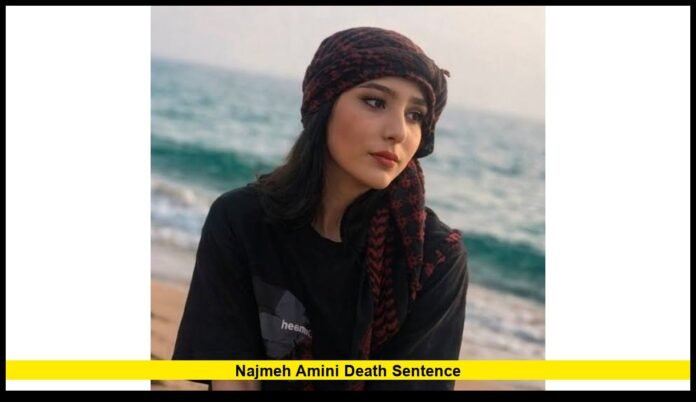

The Najmeh Amini death sentence has drawn international attention after Iranian courts sentenced the 23-year-old accounting student to death for allegedly insulting the Prophet Muhammad in a social media post. As of October 14, 2026, human rights organizations report that Amini remains imprisoned in Vakilabad Prison in Mashhad, Iran. Her death sentence, reportedly issued on September 16, remains subject to appeal and has not been confirmed as final by Iran’s Supreme Court. A separate case resulted in a prison term of 12 years, six months, and one day.
The case has raised serious concerns about freedom of expression, fair-trial protections, and Iran’s use of capital punishment. Amini was arrested during the January 2026 protests, according to human rights monitors. Authorities later pursued separate criminal and national-security proceedings against her.
Her case is particularly significant because the death sentence concerns an alleged online expression rather than a publicly reported act of physical violence. However, the full contents of the social media post have not been publicly disclosed, limiting independent assessment of the allegation.
What Is the Latest Update on the Najmeh Amini Death Sentence?
The latest reports available on October 14 indicate that Amini has received a death sentence in a blasphemy case. Iran Human Rights, Hengaw, and the Human Rights Activists News Agency have reported on the proceedings and her imprisonment.
According to these organizations, the court convicted Amini of sabb al-nabi, a charge associated with insulting the Prophet Muhammad under Iranian law. The ruling remains appealable.
The main developments confirmed by human rights reporting include:
- Death sentence: Amini was sentenced to death in a case involving an alleged social media post.
- Reported sentencing date: September 16, 2026.
- Separate prison sentence: A total of 12 years, six months, and one day in a national-security and propaganda case.
- Current reported detention: Vakilabad Prison in Mashhad, northeastern Iran.
- Appeal status: The death sentence remains subject to judicial review, with no confirmed Supreme Court decision reported in the latest available accounts.
- Public appeal for help: An audio message attributed to Amini calls for international attention and a fair review of her case.
These developments do not establish that an execution is scheduled or imminent. A death sentence and an execution are different legal events, and the latest reporting does not confirm that Iranian authorities have carried out her execution.
Who Is Najmeh Amini?
Najmeh Amini is a 23-year-old Iranian accounting student from Mashhad, according to human rights organizations covering her case.
She became the subject of international concern after reports emerged that she had been arrested during the January 2026 protests and later faced multiple criminal charges. Her cases subsequently proceeded through different courts in Mashhad.
Information about Amini’s private life remains limited. Public reporting has concentrated on her arrest, legal proceedings, prison conditions, and efforts to seek a review of the sentences.
Her case has attracted attention from rights advocates because the reported punishment is exceptionally severe and involves an allegation related to online expression.
Amini has also become a focus of wider concerns about the treatment of people detained during Iran’s protests. Rights groups have questioned whether defendants in politically sensitive cases receive adequate access to legal representation and the procedural protections required for a fair trial.
It is important to distinguish those concerns from established findings about every aspect of her individual case. Some details come from advocacy organizations and sources connected to detainees rather than publicly accessible court records.
When Was Najmeh Amini Arrested?
Human rights organizations report that security forces arrested Amini on January 31, 2026, in the Ferdowsi Bazaar area of Mashhad.
According to reports from Hengaw and HRANA, she was transferred to Vakilabad Prison following her arrest. The organizations have also reported that she spent approximately three months in solitary confinement in a security ward.
Those reports describe her detention as part of the wider crackdown following the January protests. However, the precise circumstances of her arrest and the treatment she received have not been independently established in every detail.
Earlier accounts focused on allegations involving national security and the possibility of capital punishment. In August, reporting described court proceedings involving accusations of assembly and collusion against national security and insulting sacred figures.
By September, human rights organizations reported that two separate sentences had been issued: a death sentence in the blasphemy case and a lengthy prison term in the national-security case.
The sequence matters because the death sentence did not arise from the same proceeding as the separate 12-year prison term.
Why Was Najmeh Amini Sentenced to Death?
The reported basis for the death sentence is the charge of sabb al-nabi, commonly translated as insulting or blaspheming against the Prophet Muhammad.
Iranian law provides for capital punishment for certain offenses classified as insulting the Prophet. The application of these provisions has long raised concerns among international human rights advocates, particularly when cases involve speech, religious expression, or online activity.
In Amini’s case, reports indicate that the allegation concerned a social media post. Authorities have not publicly released the complete contents of that post in the reporting reviewed for this article.
That limitation is important. Without the original post, the full case file, and the court’s complete reasoning, readers cannot independently evaluate the underlying evidence or the court’s interpretation of the alleged statement.
Human rights monitors say the court rejected arguments related to the circumstances in which Amini allegedly made the remarks. Reports describe her defense as arguing that the statement was a slip of the tongue made while she was experiencing the effects of psychedelic mushrooms.
The reported court decision did not accept that defense. The precise legal reasoning, however, should be assessed through the court record rather than inferred from brief summaries.
The distinction between an allegation and independently verified evidence remains essential. The charge explains the reported legal basis for the sentence; it does not independently establish every factual claim made in the proceedings.
What Does the Charge of Sabb al-Nabi Mean?
Sabb al-nabi is an Arabic-derived legal and religious term used for insulting the Prophet Muhammad. Iranian authorities apply the offense within the country’s criminal-law framework.
The charge differs from ordinary criticism of government policy. It concerns an alleged insult to a central figure in Islam and can carry the death penalty under Iranian law.
The severity of the potential punishment makes the legal process especially consequential. Questions about intent, evidence, the defendant’s statements, and the interpretation of the alleged conduct can have life-or-death implications.
In Amini’s case, human rights groups have criticized the use of capital punishment over alleged online expression. They argue that imposing the death penalty in such circumstances threatens freedom of expression and may discourage people from speaking openly.
For U.S. readers, the case also illustrates a major difference between Iran’s legal framework and the constitutional protections governing speech in the United States. The First Amendment generally restricts government punishment of speech, although U.S. law contains specific exceptions. Iran’s legal system operates under a different constitutional and religious framework.
That comparison does not resolve the factual questions in Amini’s case. Her conviction, the evidence presented, and any subsequent appellate decision must be considered on their own documented record.
Najmeh Amini’s Separate 12-Year Prison Sentence
The death sentence is only one part of Amini’s reported legal situation.
On August 27, 2026, Hengaw reported that the First Branch of the Mashhad Revolutionary Court had sentenced her to 12 years, six months, and one day in prison. The ruling concerned charges described as operational action against national security and propaganda against the state.
HRANA also reported in September that Amini faced separate proceedings in the Revolutionary Court and Criminal Court in Mashhad.
The separate cases are important for understanding her overall legal exposure. The criminal court handled the charge associated with the death sentence, while the Revolutionary Court imposed the lengthy prison term.
The reported sentences are therefore not interchangeable. The prison term does not replace the death sentence, and the death sentence does not mean the separate conviction has disappeared.
Publicly available accounts do not establish that the sentences have been overturned. Nor do they establish a final Supreme Court decision upholding the death sentence.
Until reliable reporting confirms a change, the most accurate description is that Amini has been reported sentenced to death and to a separate lengthy prison term, with the capital sentence still subject to appeal.
What Did Najmeh Amini Say in Her Audio Message?
Amini’s reported audio message from prison has become a central element of public attention surrounding her case.
According to HRANA and other human rights reporting, she said that the judiciary had issued her death sentence and appealed for international support. She called for lawyers, activists, the United Nations, and human rights organizations to examine her case.
The message was reportedly circulated after the sentencing. Its contents have been described by organizations reporting on her detention.
In the recording, Amini presents herself as innocent and asks others to help make her situation known. Her appeal reflects the limited public information available about her proceedings and the difficulty of independently examining a case involving a detained defendant.
The recording should not be confused with an official court announcement. It is a statement attributed to Amini and reported by rights organizations. Its claims help explain her position, but they do not independently establish every detail of the court proceedings.
Nevertheless, the message has helped bring wider attention to the reported sentence and the need for clarity about the appeal process.
Is Najmeh Amini’s Death Sentence Final?
The latest available reporting does not establish that the death sentence has become final through confirmation by Iran’s Supreme Court.
Human rights organizations have described the sentence as appealable. Reports published around October 14 continue to characterize the ruling as subject to further judicial review.
That distinction is crucial. A trial court can issue a death sentence without the legal process having reached its final stage. An appeal may challenge the conviction, the interpretation of the law, the evidence, or the punishment.
At present, the available reports do not provide a confirmed Supreme Court ruling that resolves Amini’s case. They also do not establish a scheduled execution date.
The next major developments to watch are:
- Whether Amini or her legal representatives formally appeal the death sentence.
- Whether Iran’s Supreme Court reviews or confirms the ruling.
- Whether a higher court overturns the conviction or changes the punishment.
- Whether authorities provide additional information about the evidence and legal reasoning.
- Whether credible human rights organizations report a change in her detention or legal status.
These are developments to monitor, not predictions about what the courts will decide.
What Iranian Law Says About the Death Sentence
Iran’s Islamic Penal Code contains provisions that allow capital punishment for certain blasphemy offenses. Article 262 addresses insulting the Prophet Muhammad and specifies the death penalty for conduct covered by the provision.
Article 263 also establishes circumstances in which a defendant may avoid the death penalty, including certain claims involving coercion, inadvertence, error, intoxication, anger, or a slip of the tongue. The legal effect depends on the circumstances and the court’s application of the law.
These provisions are central to understanding Amini’s case. Her reported defense relied on the circumstances surrounding the alleged post and whether she acted with deliberate intent.
According to Iran Human Rights, the court rejected the defense’s arguments. The organization has criticized the ruling and called for the sentence to be overturned.
The available reporting does not provide the complete judgment or every item of evidence considered by the court. Therefore, a detailed legal assessment of the verdict would require access to the full case file.
For now, the reported outcome shows how a charge involving online expression can carry the most severe criminal penalty under Iranian law.
Human Rights Groups Respond to Najmeh Amini’s Death Sentence
Human rights organizations have expressed concern about the severity of the sentence and the circumstances of Amini’s prosecution.
Iran Human Rights has described the case as alarming because it involves a young woman facing execution over an alleged social media post. Its director, Mahmood Amiry-Moghaddam, has warned that such cases could broaden the use of capital punishment against expression.
HRANA has reported the two separate sentences and Amini’s continued detention. Hengaw has also documented the death sentence and the lengthy prison term imposed by the Revolutionary Court.
These organizations have called attention to the need for fair-trial protections and a review of the case. Their reporting has helped bring details of the proceedings to an international audience.
However, readers should understand the distinction between independent monitoring and an official judicial record. Human rights groups gather information from detainees, relatives, legal representatives, and other sources. Their reporting can be important, particularly when court documents are difficult to obtain, but some details may remain unverified.
In Amini’s case, the reporting from multiple organizations broadly agrees on the central facts: her age, imprisonment in Mashhad, the death sentence associated with blasphemy, and the separate prison term.
The most consequential unresolved issue is the final legal status of the death sentence.
Why the Case Matters to a U.S. Audience
For readers in the United States, the Najmeh Amini death sentence raises questions about the relationship between online speech, criminal law, and the use of capital punishment.
The First Amendment to the U.S. Constitution protects freedom of speech against many forms of government restriction. American law does not operate under Iran’s religious criminal-law framework, and the two countries approach alleged blasphemy very differently.
The comparison is particularly relevant because the allegation against Amini reportedly concerns a social media post. Digital platforms allow individuals to express opinions and share information across borders, but the legal consequences of online activity vary significantly between countries.
Amini’s case also illustrates the importance of distinguishing a conviction from a final judgment. Even after a trial court imposes a death sentence, appellate proceedings may affect the legal outcome.
For U.S. readers following international human rights developments, the next reliable update will be one that establishes whether an appeal has proceeded, whether the Supreme Court has issued a decision, or whether authorities have changed her detention status.
Until such information emerges, claims that an execution has been scheduled or that the sentence has been overturned would go beyond the available evidence.
Timeline of the Najmeh Amini Case
The following timeline summarizes the principal developments reported by human rights organizations.
| Date | Reported development |
|---|---|
| January 31, 2026 | Amini was arrested in Mashhad during the January protests, according to HRANA. |
| August 2026 | Court proceedings concerning national-security and religious-related allegations were reported. |
| August 27, 2026 | Hengaw reported a sentence of 12 years, six months, and one day in the separate Revolutionary Court case. |
| September 16, 2026 | Amini reportedly said in an audio message that the judiciary had issued her death sentence on this date. |
| September 25, 2026 | Hengaw published a report describing the death sentence and the separate prison term. |
| October 9, 2026 | Iran Human Rights reported that the death sentence remained subject to appellate review. |
| October 14, 2026 | International reporting continued to describe the sentence as appealable, with no confirmed Supreme Court decision reported. |
The timeline reflects the dates reported by the organizations covering the case. The September 16 sentencing date comes from the account attributed to Amini and reporting by HRANA; Iran Human Rights noted that the official report did not specify the date on which the verdict was issued.
What Happens Next in Najmeh Amini’s Case?
The next decisive development would be confirmation of an appellate decision or another formal change in the case.
Iran Human Rights and other organizations have reported that the death sentence remains open to appeal before the Supreme Court. A review could address the conviction, the court’s interpretation of the law, the defense’s arguments, or the punishment.
At this stage, the available information does not establish the outcome of any completed Supreme Court review. It also does not establish that authorities have scheduled an execution.
Several developments would clarify the situation:
- An appeal decision: A confirmed ruling would establish whether the death sentence stands, changes, or is overturned.
- A published judgment: The full reasoning would help clarify how the court assessed the alleged post and the defense’s arguments.
- A statement from legal representatives: Verified information from Amini’s lawyers could clarify the status of any appeal.
- A confirmed change in detention: Reliable reporting from a credible organization could establish whether her location or detention conditions have changed.
Until one of these developments is confirmed, responsible coverage should avoid treating an unresolved sentence as an accomplished execution.
The case also demonstrates why precise language matters in reporting on capital punishment. Saying that a person has been sentenced to death does not mean the person has been executed. Likewise, an appealable judgment should not be described as a final Supreme Court ruling without evidence that the higher court has acted.
Frequently Asked Questions About Najmeh Amini’s Death Sentence
1. Who is Najmeh Amini?
Najmeh Amini is a 23-year-old Iranian accounting student from Mashhad. Human rights organizations report that she is being held in Vakilabad Prison and has received a death sentence in a blasphemy case.
2. Why was Najmeh Amini sentenced to death?
According to human rights reporting, a criminal court sentenced Amini to death for sabb al-nabi, a charge associated with insulting the Prophet Muhammad. The allegation reportedly concerns a social media post whose full contents have not been publicly disclosed.
3. When was Najmeh Amini’s death sentence issued?
Amini reportedly stated in an audio message that the sentence was issued on September 16, 2026. HRANA published this account on September 20, and subsequent reports discussed the ruling.
4. Has Iran’s Supreme Court confirmed the death sentence?
The latest available reporting as of October 14, 2026, does not confirm that Iran’s Supreme Court has upheld the sentence. Human rights organizations describe it as subject to appeal.
5. Is Najmeh Amini still in prison?
Yes. The latest reports available for this article identify Amini as being held in Vakilabad Prison in Mashhad, Iran.
6. Did Najmeh Amini receive another prison sentence?
Yes. Human rights organizations report that the Mashhad Revolutionary Court sentenced her to 12 years, six months, and one day in a separate case involving national-security and propaganda charges.
7. What did Najmeh Amini request in her audio message?
According to HRANA, Amini called on the United Nations, lawyers, activists, and human rights organizations to examine her case. She also appealed for a fair trial.
8. Has an execution date been announced?
The latest reports reviewed for this article do not confirm an execution date. Her reported death sentence remains subject to appeal, and it would be inaccurate to state that an execution has been scheduled without reliable confirmation.
9. What does sabb al-nabi mean?
Sabb al-nabi refers to insulting the Prophet Muhammad. Iranian law treats the offense as a capital crime under Article 262 of the Islamic Penal Code, subject to the relevant legal provisions and defenses.
10. Where can readers find reliable updates on the case?
Readers can look for new reports from established human rights monitoring organizations, including Iran Human Rights, HRANA, and Hengaw. The most useful updates will confirm an appellate ruling, a change in detention status, or another specific legal development rather than repeat unverified claims.
Conclusion
The Najmeh Amini death sentence remains a significant human rights case because it involves a 23-year-old student, an alleged social media post, and a punishment that could result in execution. Reports available on October 14, 2026, indicate that she remains detained in Mashhad and faces a separate prison term exceeding 12 years. Her death sentence has not been confirmed as final by Iran’s Supreme Court in the latest reporting reviewed here.
The full contents of the alleged post and the complete court judgment remain unavailable in the reporting examined for this article. Those limitations make it important to separate documented developments from allegations and advocacy claims.
The next major milestone will be a verified update on the appeal or another formal change in Amini’s legal status. Until then, the case should be described accurately as an appealable death sentence, not a confirmed execution.
What are your thoughts on the Najmeh Amini case? Share your perspective in the comments and follow verified updates as her legal situation develops.