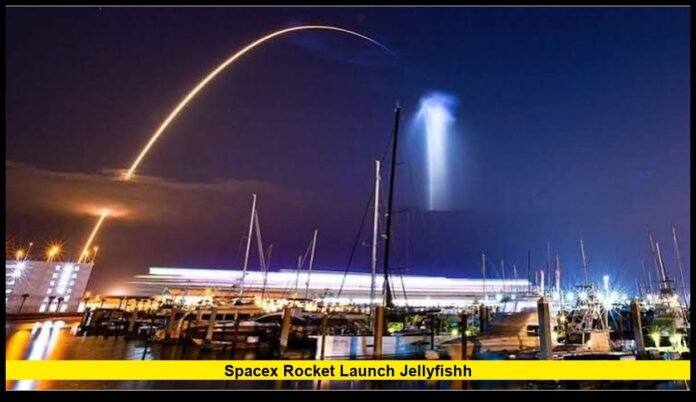

The spacex rocket launch jellyfish phenomenon has become one of the most fascinating sights associated with modern rocket launches, and another opportunity to witness the effect is emerging as SpaceX prepares the Bandwagon-5 mission from Florida. The early-morning launch timing could create the unusual combination of a dark sky near the ground and sunlight illuminating the rocket’s exhaust at high altitude, potentially producing a glowing formation that resembles a giant jellyfish.
SpaceX launches have increasingly become more than engineering events. For people living hundreds of miles from Florida’s Space Coast, certain missions can transform the predawn sky into a spectacular display of light. The effect can appear suddenly, spread across a large section of the sky and disappear within minutes.
The Bandwagon-5 mission is particularly interesting because its planned launch time falls within a period that can be favorable for this type of visual phenomenon.
What Is the SpaceX Jellyfish Effect?
The so-called space jellyfish is not a separate object, spacecraft or unusual atmospheric creature. It is a visual effect created by rocket exhaust under specific lighting conditions.
When a Falcon 9 launches before sunrise, people on the ground may still be surrounded by darkness. The rocket, however, quickly climbs to much higher altitudes. At those elevations, the exhaust plume can encounter direct sunlight even though the launch site remains relatively dark.
Sunlight reflecting through the expanding exhaust creates a bright, glowing structure in the sky. The plume can spread outward while streams of exhaust trail behind it, producing a shape that can look remarkably similar to a jellyfish.
The appearance can vary considerably from one launch to another. Some plumes appear almost circular, while others develop long tendrils stretching across the sky.
Why Early-Morning Launches Can Create Dramatic Displays
The timing of a rocket launch plays a major role in whether the effect becomes visible.
During a normal daytime launch, sunlight is already illuminating the surrounding atmosphere. The exhaust plume may still be impressive, but there is less contrast between the plume and the bright sky.
A predawn launch creates a very different situation.
The sky near the surface can remain dark while the upper atmosphere is already receiving sunlight. As the Falcon 9 climbs, its exhaust can therefore become brightly illuminated against a much darker background.
This contrast makes the plume appear significantly brighter and larger than it might during daylight.
The same principle can apply around sunset, although the visual effect depends on the rocket’s trajectory, altitude and the position of the Sun.
Bandwagon-5 Provides Another Potential Viewing Opportunity
SpaceX’s Bandwagon-5 mission is scheduled to launch from Space Launch Complex 40 at Cape Canaveral Space Force Station in Florida.
The launch window is scheduled to open at approximately 6:30 a.m. EDT on October 20.
That timing places the mission in the early-morning period when sunlight can potentially illuminate the Falcon 9’s exhaust at altitude.
There is no guarantee that a spectacular jellyfish will appear. Weather, cloud cover, atmospheric transparency, the exact launch time and the rocket’s trajectory all influence the final appearance.
Nevertheless, the timing has attracted attention from skywatchers who remember the striking displays produced by earlier SpaceX missions.
The Launch Was Already Affected by Weather
The Bandwagon-5 mission faced a delay during its initial launch attempt because of weather conditions associated with the Falcon 9’s recovery operations.
SpaceX’s launch decisions consider more than conditions at the launchpad. The company also has to evaluate weather along the flight path and at the planned landing area for the reusable first stage.
For a Falcon 9 mission, safe booster recovery is an important part of the operation. The first stage is expected to return to a droneship positioned in the Atlantic Ocean following separation from the upper stage.
A weather-related delay does not necessarily indicate a technical problem with the rocket. Launch opportunities can be postponed simply because environmental conditions do not meet the required safety criteria.
What Is Bandwagon-5 Carrying?
Bandwagon-5 is a rideshare mission carrying numerous payloads into orbit.
Instead of dedicating an entire Falcon 9 to a single customer, rideshare missions allow multiple spacecraft and technology payloads to share the same launch.
The mission is expected to carry dozens of payloads, including small satellites and other space hardware.
Rideshare launches have become increasingly important for companies, research organizations and satellite developers that need access to orbit but do not require an entire rocket.
SpaceX’s Falcon 9 provides an established platform for these missions while maintaining the company’s high launch frequency.
The Falcon 9 Booster Is Also Part of the Story
The visual spectacle may attract most public attention, but the reusable booster is one of the most significant technological elements of the mission.
SpaceX has demonstrated that Falcon 9 first stages can fly repeatedly, dramatically changing the economics and operational rhythm of orbital launches.
The booster assigned to Bandwagon-5 has already supported previous missions.
After lifting the payload toward orbit, the first stage separates and begins a controlled return toward the Atlantic Ocean. It uses its engines, aerodynamic control surfaces and landing systems to guide itself toward the recovery platform.
If the landing is successful, the booster can eventually be inspected, refurbished and prepared for another mission.
That reusable architecture allows SpaceX to maintain a launch cadence that would be difficult to achieve if every mission required a completely new first stage.
Why the Previous October Launch Attracted Attention
Interest in another possible jellyfish display follows a particularly striking SpaceX launch earlier in October.
The CRS-35 mission launched from Florida during the early morning, creating favorable conditions for sunlight to illuminate the rocket’s expanding exhaust.
The resulting plume was photographed from locations far from Cape Canaveral.
Images showed a luminous structure spreading across the dark sky, with long, wispy trails creating the recognizable jellyfish-like appearance.
The display demonstrated why rocket launches from Florida can become visible far beyond the immediate Space Coast.
People who are not close enough to see the rocket itself can sometimes see the illuminated upper-stage or first-stage exhaust as it climbs into the atmosphere.
How Far Away Can the Phenomenon Be Seen?
One of the most surprising aspects of these displays is their viewing range.
A rocket itself may be relatively small when viewed from a distant location, but its exhaust plume can expand dramatically as it reaches higher altitudes.
The height of the plume, its brightness and the contrast against the dark sky can allow people hundreds of miles away to notice it.
Geographic location still matters. Trees, buildings, mountains and other obstructions can block portions of the sky.
Clouds and atmospheric haze can also make the display difficult or impossible to see.
For that reason, two people watching the same launch from different locations may have completely different experiences.
What Causes the Exhaust to Spread Out?
As a rocket climbs, atmospheric pressure decreases.
Rocket exhaust leaving the engines expands as it encounters the increasingly thin atmosphere. At high altitude, the plume can become much broader than the rocket itself.
That expansion contributes to the unusual shape seen from the ground.
The plume is also constantly changing as the rocket accelerates and moves farther away. The combination of expansion, motion, changing sunlight and perspective creates a rapidly evolving visual pattern.
What appears to be a stationary glowing object in a photograph is therefore actually a fast-moving and constantly changing exhaust cloud.
Is the Jellyfish Shape Predictable?
Not completely.
Engineers can predict a rocket’s trajectory and calculate the approximate position of the vehicle at different points during flight. However, the exact visual appearance of the plume depends on several atmospheric and lighting variables.
Humidity, high-altitude winds, cloud layers and atmospheric transparency can all influence how the plume looks.
The timing of liftoff is also important. A launch occurring several minutes earlier or later can change the relationship between the rocket and the Sun.
This is why one launch may produce an enormous glowing structure while another mission with a similar schedule produces only a faint plume.
How to Watch the Potential Display
People hoping to see the Bandwagon-5 launch should prepare before the scheduled opening of the launch window.
An unobstructed outdoor location is preferable. A clear view of the sky provides the best chance of spotting the rocket and any illuminated exhaust.
Because the launch is scheduled for the early morning, observers should also check local weather conditions before heading outside.
It is important to remember that the actual liftoff time can change. Launch operations can be affected by weather, technical checks, range restrictions and other operational considerations.
Anyone specifically interested in the visual effect should be ready before the launch window begins rather than waiting until the scheduled liftoff minute.
Why the Sky May Look Different From Different Locations
The appearance of a rocket plume is strongly influenced by perspective.
Someone close to Cape Canaveral may see the rocket climb rapidly from the horizon. A viewer farther away could see the illuminated plume appear in a completely different part of the sky.
The same plume can therefore produce different shapes depending on the observer’s location.
Photographs can also make the phenomenon look more dramatic than it appears to the naked eye. Camera sensors can capture faint light over longer exposures, revealing colors and details that are difficult to see directly.
This is one reason photographs of SpaceX launches often show enormous glowing structures that seem almost unreal.
Why SpaceX Launches Have Become Major Skywatching Events
SpaceX has dramatically increased the frequency of orbital launches, giving the public more opportunities to observe rockets from outside traditional launch-viewing areas.
The company’s Florida launch sites are particularly well positioned for large audiences because launches can sometimes be seen across broad portions of the southeastern United States.
Social media has also contributed to the popularity of the phenomenon.
A person watching from one location can quickly share a photograph or video, prompting people elsewhere to look toward the sky. Within minutes, images from multiple locations can reveal how far the plume was visible.
That combination of frequent launches and widespread visibility has turned certain SpaceX missions into unexpected regional sky events.
SpaceX Rocket Launch Jellyfish Is About More Than a Visual Effect
The spacex rocket launch jellyfish phenomenon may look mysterious, but its underlying explanation is rooted in familiar principles of rocket propulsion, atmospheric expansion and sunlight.
What makes it extraordinary is the timing.
The rocket rises through a dark lower atmosphere while its exhaust reaches sunlight at much higher altitude. The result is an illuminated plume that can become one of the most striking sights associated with a modern launch.
For observers, the phenomenon offers an unusual connection between spaceflight and everyday skywatching.
For SpaceX, however, the visual spectacle remains secondary to the mission itself. The primary objective is to deploy the payloads safely and complete the planned flight profile.
Could More Jellyfish Displays Happen in the Future?
Almost certainly.
SpaceX regularly conducts launches at times that can create favorable lighting conditions, although spectacular displays remain dependent on circumstances.
Other launch providers can also produce similar effects when their rockets lift off under comparable conditions.
As launch activity increases worldwide, skywatchers may see more unusual rocket-plume displays.
The phenomenon also serves as a reminder that spaceflight does not always have to be observed through a telescope. Under the right conditions, a rocket can create a dramatic spectacle visible across a large portion of the sky.
What to Expect From the October 20 Launch
The Bandwagon-5 mission has several elements worth watching.
The Falcon 9 is expected to launch from Cape Canaveral during the early morning, carry its rideshare payloads toward orbit and attempt to recover its reusable first stage.
For people on the ground, the most visually interesting moment could occur shortly after liftoff, when the rocket climbs into the upper atmosphere and its exhaust potentially becomes illuminated by sunlight.
Whether the resulting plume becomes a dramatic jellyfish shape will depend on the final launch timing and atmospheric conditions.
Even without the spectacular visual effect, the mission represents another example of the rapidly increasing pace of commercial spaceflight.
Final Thoughts
The possible October 20 Bandwagon-5 launch gives skywatchers another reason to look toward Florida’s skies before sunrise. The combination of a reusable Falcon 9, a large rideshare payload and favorable early-morning lighting could produce both an important spaceflight and a memorable visual event.
The jellyfish effect is a reminder that rocket science can create unexpected beauty. A carefully engineered launch can briefly transform ordinary exhaust into a glowing structure visible across a huge area, connecting people on the ground with a vehicle traveling toward orbit.
For anyone hoping to catch the sight, the best approach is to prepare early, find an unobstructed view and keep expectations flexible. The rocket may produce a spectacular plume, but weather and launch conditions will ultimately determine what appears in the sky.
Are you hoping to see the next glowing SpaceX plume? Share your thoughts and keep watching for the latest spaceflight developments.