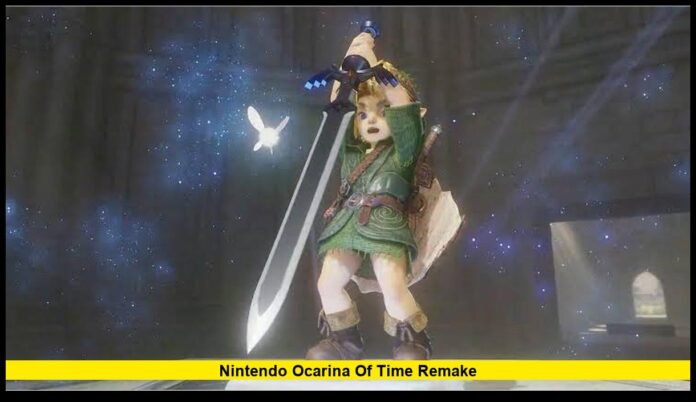

The Nintendo Ocarina of Time remake is scheduled to launch in the United States on November 5, 2026, exclusively for Nintendo Switch 2. The upcoming release brings the legendary 1998 adventure back with redesigned graphics, voiced cutscenes, orchestral music, updated movement, and modern camera controls. Nintendo has also introduced new ways to track progress, interact with the iconic ocarina, and explore Hyrule.
The remake marks a significant return for one of Nintendo’s most recognizable adventure games. Instead of simply bringing the original Nintendo 64 version to a modern console, Nintendo has rebuilt the experience with contemporary presentation and gameplay improvements. The familiar story of Link, Princess Zelda, Ganondorf, and the Triforce remains at the center of the adventure.
For U.S. players, the upcoming release brings several important details into focus. Nintendo has confirmed the November launch, Switch 2 exclusivity, physical and digital editions, and a range of new features. The company has also announced related accessories and collectible amiibo figures for the Zelda 40th-anniversary period.
Nintendo Ocarina of Time Remake Release Date and Availability
Nintendo has confirmed November 5, 2026, as the release date for The Legend of Zelda: Ocarina of Time on Nintendo Switch 2. The game is part of the franchise’s 40th-anniversary celebrations and brings Link’s classic adventure to the current generation of Nintendo hardware.
The launch gives longtime fans a chance to revisit Hyrule with updated graphics and controls. New players can also experience the original adventure through a version designed for modern gaming expectations.
The confirmed release details include:
- Release date: November 5, 2026.
- Platform: Nintendo Switch 2.
- Publisher: Nintendo.
- Game format: Single-player adventure.
- Play modes: TV, tabletop, and handheld.
- Physical edition: Confirmed.
- Digital edition: Confirmed.
- ESRB rating: Animated Blood, Fantasy Violence.
- Additional support: Compatible Zelda amiibo and the Nintendo Switch smartphone app.
Nintendo has identified the game as a Switch 2 exclusive. It has not announced a corresponding version for the original Nintendo Switch.
The game supports handheld, tabletop, and TV play, allowing players to choose how they experience the adventure. This flexibility makes the release suitable for both traditional television gaming and portable sessions.
Players should check their preferred retailer for current availability, purchasing options, and final checkout prices.
Why Ocarina of Time Remains Important to Nintendo
The original The Legend of Zelda: Ocarina of Time arrived on the Nintendo 64 in 1998. It brought the series into a three-dimensional world and combined exploration, combat, puzzle-solving, and a memorable musical system.
The adventure follows Link as he attempts to stop Ganondorf from gaining control of the Triforce. His journey takes him through forests, villages, dungeons, and other locations across Hyrule.
Princess Zelda plays a central role in the story, while Link’s relationships with other characters help move the adventure forward. The game also introduces the concept of traveling between different stages of Link’s life, creating important changes in how players experience the world.
Its influence comes from the way these elements work together. Players do more than defeat enemies. They investigate locations, discover hidden paths, learn melodies, solve environmental puzzles, and gradually uncover the larger story.
The new version retains this recognizable foundation. Nintendo’s confirmed changes focus on presentation, controls, sound, and additional player-support features.
That approach gives the remake a clear identity. It revisits an established adventure while updating the way players interact with it.
Redesigned Graphics Bring Hyrule Into a New Era
Visual improvements are among the most noticeable features of the remake. Nintendo has confirmed completely overhauled graphics and describes the new version as being built from the ground up for Nintendo Switch 2.
The original game reflected the technical capabilities of the Nintendo 64. Its environments and character models helped define three-dimensional adventure games, but the technology available at the time imposed limits on visual detail.
The remake introduces a more contemporary presentation. Characters, locations, and environmental elements receive a new visual treatment, while the camera offers greater freedom to view the surroundings.
Familiar areas such as Kokiri Forest, Goron City, Zora’s Domain, and Castle Town return as parts of Link’s journey. Their updated presentation gives returning players an opportunity to recognize locations while seeing them through a different visual lens.
The graphical changes also support the adventure’s atmosphere. Forests, temples, and other environments help establish the mood of each location, while improved presentation allows players to examine more of the world around them.
Nintendo has confirmed the visual overhaul, but players should avoid assuming that every technical feature associated with modern gaming is included. A specific native 4K resolution or fixed frame rate should not be treated as confirmed without an official specification.
The central improvement is clear: Nintendo has redesigned the game’s visual presentation for its current console.
Voiced Cutscenes Change How Players Experience the Story
The remake introduces voiced cutscenes and additional character dialogue, marking a major difference from the original Nintendo 64 release.
The original game relied heavily on written conversations. Players advanced through dialogue boxes as Link met characters, received information, and discovered new objectives.
The new version adds spoken performances to its cutscenes. Nintendo has confirmed this change as part of its effort to present the classic adventure to a modern audience.
Voice acting can give important scenes a different emotional character. Conversations can feel more immediate, while dramatic moments can benefit from spoken delivery and accompanying music.
This change may also help players who prefer listening to dialogue rather than reading every conversation. It provides a different way to engage with the story while retaining the familiar characters and central conflict.
Nintendo has confirmed voiced scenes, but players should not assume that every individual interaction uses the same presentation. The announced feature specifically highlights voiced cutscenes and additional character dialogue.
The result is a new presentation of Link’s journey without a separately announced replacement storyline.
New Movement Options Make Exploration More Flexible
Movement and camera controls are another major part of the remake’s design.
Nintendo has confirmed the addition of jumping and dashing, along with reworked camera controls. These changes bring the game’s basic interactions closer to the expectations many players have developed through modern action-adventure titles.
In the original version, movement and camera handling reflected the Nintendo 64’s controller design. The system helped establish how players navigated three-dimensional Zelda environments, but it differs from the control schemes common in contemporary games.
The remake introduces additional ways to move through Hyrule. Jumping gives players another movement option, while dashing allows faster traversal. Right-stick camera control also provides a more direct way to adjust the view.
Nintendo has additionally highlighted more responsive actions and faster loading.
These changes can make navigation feel more immediate. They also give newcomers a control system that may feel more familiar from the beginning.
However, modernized movement does not mean the adventure has become an entirely different game. Nintendo continues to present the remake around the original story and recognizable world.
The improvements are intended to update the experience rather than remove its defining elements.
Orchestral Music Gives Familiar Melodies a New Sound
Music has always been closely connected to Ocarina of Time. Link’s ocarina serves as both a musical instrument and an important tool for progressing through the adventure.
Nintendo has confirmed symphonic orchestral music and refreshed audio for the remake. This gives the game’s familiar musical identity a new presentation.
The soundtrack plays an important role in establishing the mood of different locations. Quiet melodies can complement exploration, while larger musical arrangements can support dramatic encounters and major story moments.
An orchestral presentation also works alongside the redesigned visuals and voiced cutscenes. These elements create a more contemporary audiovisual experience while retaining the musical identity that players associate with the original.
The ocarina itself remains central to the adventure. Learning melodies and using them at the right moments are important parts of Link’s journey.
Nintendo has not provided a complete track-by-track breakdown in the product information covered here. The confirmed detail is the inclusion of symphonic orchestral music, not a specific list of every altered composition.
For returning fans, the refreshed audio is one of the most meaningful changes to the remake’s presentation.
Threads of Time Helps Players Follow Their Progress
The remake introduces a progress-tracking feature called Threads of Time. It gives players a visual record of their journey and helps them identify their next objective.
A tapestry gradually fills in as players advance through the adventure. The system provides a reference point for understanding the progress made across the story.
This feature may be especially useful for people who play in short sessions. A player returning after several days can use the progress display to reconnect with the adventure instead of relying entirely on memory.
The feature also offers a different way to look at the structure of the journey. Players can see their progress as a continuing story rather than treating each session as an isolated series of tasks.
Threads of Time does not replace the adventure’s exploration and puzzles. Instead, it provides an additional reference for following the story.
The feature supports the remake’s broader goal of making the classic game accessible to a modern audience while preserving its single-player structure.
ZELDA NOTES Adds More Activities Through the Smartphone App
Nintendo has introduced ZELDA NOTES as a game-specific service within the Nintendo Switch smartphone app. The service provides additional activities and information for players during their adventure.
It requires a compatible smart device and Nintendo Account. Persistent internet access is also required for the relevant app services.
Several features have been announced for the remake.
Today’s Record: This feature allows players to review daily accomplishments and statistics, including the number of enemies defeated.
Gossip Quest: Players receive image-based challenges that direct them toward specific places in the game. Completing these challenges earns points toward music scores for the virtual ocarina.
Play Ocarina: The smartphone app allows players to use a touchscreen to play a virtual ocarina. Players can follow a guide, listen to automatic playback, and create music scores that they can share through QR codes.
Ocarina of Time Quiz: The companion service includes a quiz containing more than 2,000 questions. Players can take part in the daily quiz or spend earned rupees for additional attempts.
These features add activities beyond the main console adventure. They also build on the game’s musical and exploration systems.
Players do not need to assume that every feature operates directly through the console controller. ZELDA NOTES is designed to provide additional functions through a compatible smartphone.
Voice Recognition and Ocarina Accessories
The remake introduces another way to interact with Link’s instrument. Nintendo has announced a sound-recognition feature that allows players to perform melodies and trigger corresponding actions in the game.
The Nintendo Switch 2’s built-in microphone supports this interaction. Nintendo has also announced an Electric OCARINA OF TIME accessory designed to work with the game’s sound-recognition feature.
The electronic accessory offers two modes. Free Play Mode allows players to play individual notes and melodies, while Auto-Play Mode can play 12 in-game songs at the press of a button.
The device also includes a volume control and a headphone jack. Nintendo describes it as an electronic toy rather than a traditional ocarina, and players operate it using its buttons rather than blowing into it.
The accessory is sold separately. It does not function as a general game controller, and the game software and batteries are not included with the device.
This accessory gives fans another way to engage with the music associated with Hyrule. Buyers should review its product details before purchasing it specifically for use with the remake.
Young Link and Young Zelda amiibo Coming in 2027
Nintendo has announced Young Link and Young Zelda amiibo figures for 2027. The figures connect the remake with the franchise’s collectible merchandise.
Nintendo says these new figures can unlock in-game masks that evoke a retro graphical style. The company has also confirmed that existing The Legend of Zelda series amiibo can provide in-game extras.
The new figures will arrive after the game’s November 2026 launch. They are separate accessories rather than items included with the standard game purchase.
Players who already own compatible Zelda amiibo may have access to additional in-game benefits. The precise effects depend on the compatible figure and the supported functionality.
For collectors, the new figures provide another item to watch as Nintendo continues its anniversary plans.
Physical and Digital Editions for U.S. Buyers
Nintendo has confirmed physical and digital editions of the remake. Both provide access to the single-player adventure, but each option suits a different purchasing preference.
A physical edition gives collectors a boxed copy to keep alongside other Nintendo games. The first print run also features special textured foil cover art while supplies last.
A digital edition provides downloadable access through Nintendo’s digital storefront. Buyers should check the console’s available storage and the current listing details before downloading.
Nintendo has listed the game for U.S. customers, but availability and checkout pricing can vary by retailer. Buyers should verify the current price before completing an order.
| Purchase option | What buyers should know |
|---|---|
| Physical edition | Provides a physical game package |
| First print run | Includes special textured foil cover art while supplies last |
| Digital edition | Provides downloadable access |
| Platform | Nintendo Switch 2 |
| Release date | November 5, 2026 |
Players should also distinguish the standard game from separately sold accessories. The Electric OCARINA OF TIME and amiibo figures are additional products, not automatic inclusions with every game purchase.
Frequently Asked Questions
When will the Nintendo Ocarina of Time remake release?
Nintendo has confirmed November 5, 2026, as the release date for the Nintendo Switch 2 version.
Which console will support the remake?
The game is announced exclusively for Nintendo Switch 2. Nintendo has not confirmed a version for the original Nintendo Switch.
What major changes does the remake introduce?
The remake features overhauled graphics, voiced cutscenes, additional character dialogue, orchestral music, jumping, dashing, improved camera controls, and progress-tracking tools.
Does the remake retain the original story?
Nintendo presents the game as a remake of the 1998 adventure, retaining Link’s journey through Hyrule and the central conflict involving Ganondorf and the Triforce.
What is ZELDA NOTES?
ZELDA NOTES is a companion service in the Nintendo Switch smartphone app. It includes progress records, image-based location challenges, a virtual ocarina, and a quiz.
Can players use an ocarina accessory with the game?
Nintendo has announced an Electric OCARINA OF TIME accessory designed to work with the game’s sound-recognition feature. It is sold separately.
Are new amiibo figures coming with the remake?
Young Link and Young Zelda amiibo figures are planned for 2027. Nintendo says they can unlock special in-game masks.
Will the remake be available physically?
Yes. Nintendo has confirmed physical and digital editions. Special textured foil packaging is planned for the first physical print run while supplies last.
What Comes Next for the Nintendo Ocarina of Time Remake?
The November 5, 2026, launch marks the return of a major Zelda adventure with updated visuals, new controls, orchestral music, and additional companion features. Nintendo has also confirmed the game’s Switch 2 exclusivity and related accessories, giving players a clear picture of the planned release.
For longtime fans, the remake offers a new way to revisit Hyrule. For newcomers, the updated presentation and controls provide a modern entry point into Link’s classic journey. Players can check the latest official product details for current purchasing options and any further confirmed announcements.
Are you excited to experience Ocarina of Time on Nintendo Switch 2? Share your thoughts in the comments and keep following the latest confirmed Zelda updates.