
Social security cola reduction proposals are drawing attention as lawmakers and policymakers debate how to address Social Security’s long-term financing gap. As of August 23, 2026, no federal law has reduced the Social Security cost-of-living adjustment, and the 2027 COLA has not yet been officially determined. The latest federal data show July 2026 CPI-W inflation at 3.4% over the previous year, while the Social Security Administration’s 2026 Trustees Report continues to show significant long-term financing pressure.
Current Status of Social Security COLA Changes
The most important point for beneficiaries is that no COLA reduction has been enacted under current law.
Social Security benefits continue to receive annual COLAs under the existing statutory formula. The formula uses the Consumer Price Index for Urban Wage Earners and Clerical Workers, commonly called CPI-W. The calculation compares the average CPI-W for July, August and September with the corresponding average from the previous year.
The Social Security Administration has not announced the 2027 COLA because September’s inflation data are still unavailable. The official figure will depend on the complete third-quarter CPI-W data.
That means current estimates should not be treated as the final benefit increase.
The latest July CPI-W reading provides only part of the information needed for the calculation. The Bureau of Labor Statistics reported that CPI-W increased 3.4% over the 12 months ending in July 2026.
This matters because a proposed change to the COLA formula would affect how future annual increases are calculated. A lower adjustment could gradually reduce the growth of monthly benefits, while a higher or more senior-focused index could produce larger increases.
Why COLA Reduction Proposals Are Being Discussed
The debate over reducing COLAs is closely connected to Social Security’s financing problems.
The 2026 Trustees Report found that Social Security’s combined trust funds are projected to remain capable of paying scheduled benefits in full until 2034 under current law. After that point, continuing income would be sufficient to pay about 83% of scheduled benefits if lawmakers take no action.
The separate Old-Age and Survivors Insurance, or OASI, Trust Fund faces an earlier reserve depletion date. The Trustees project that OASI reserves will be depleted in the fourth quarter of 2032. At that point, continuing program income would cover about 78% of scheduled OASI benefits.
These projections do not mean that Social Security benefits will automatically be cut in 2032 or 2034. They describe what current law would permit if Congress does not make changes to the program’s financing.
Reducing the annual COLA is one policy option that Social Security actuaries have evaluated as a way to reduce long-term program costs.
The Office of the Chief Actuary maintains a list of potential changes to Social Security’s COLA formula. These are policy options for lawmakers to consider, not enacted changes in benefits.
What the Social Security Administration’s Latest Proposal Analysis Shows
The Social Security Administration’s current actuarial materials include several scenarios involving smaller annual COLAs.
Under the 2026 Trustees Report assumptions, one option would begin in December 2027 and reduce the annual COLA by 1 percentage point. Another would reduce the annual adjustment by 0.5 percentage point.
These figures are important because they show the scale of reductions that actuaries have examined.
They do not mean that Congress has selected either option.
The actuarial estimates show that a 1-percentage-point reduction would have a larger effect on Social Security’s long-term financial balance than a 0.5-percentage-point reduction. The SSA estimates that the 1-point option would eliminate about 46% of the long-range actuarial shortfall, while the 0.5-point option would eliminate about 24%.
The figures demonstrate why COLA changes appear in solvency discussions. A reduction in annual benefit growth can produce substantial savings over many years.
However, the effect would also accumulate for beneficiaries because each year’s lower increase would become part of the base used for future adjustments.
How a 1-Percentage-Point Reduction Could Work
A proposal to reduce a COLA by 1 percentage point would not necessarily mean that every Social Security recipient loses 1% of their existing monthly benefit.
Instead, the annual increase would be smaller than it would have been under the regular formula.
For example, if an inflation-based COLA were eventually calculated at 3%, a 1-percentage-point reduction would produce a 2% adjustment under that type of proposal.
The beneficiary would still receive an increase. The difference would be the size of that increase.
The impact could become more noticeable over several years because future COLAs would build on the lower benefit amount created by the earlier adjustment.
The SSA has also evaluated a version of the proposal that would reduce the annual COLA by 1 percentage point but would not reduce an increase below zero. Under that option, an adjustment smaller than 1% would not create a negative COLA or carry an unused reduction into a later year.
These are actuarial scenarios rather than current Social Security rules.
Another Option: Changing the CPI Formula
Not every proposal involving a smaller COLA uses a direct percentage-point reduction.
Another approach would change the inflation index itself.
The SSA has evaluated using a chained version of the CPI-W. The agency estimates that this approach would reduce the annual COLA by about 0.3 percentage point on average.
A chained CPI attempts to account for changes in consumer purchasing patterns when prices change. Supporters of such an approach have argued that it could provide a more economically precise measure of inflation.
For Social Security recipients, however, the important issue is the resulting benefit adjustment.
If the replacement index produces smaller annual increases, beneficiaries would receive slower benefit growth than under the existing formula.
The SSA’s current 2026 actuarial materials list several versions of chained-index approaches, including proposals affecting OASI beneficiaries and proposals that would apply the change at different starting dates.
Again, none of these options has replaced the current CPI-W formula.
Proposals That Would Increase Rather Than Reduce COLAs
The current debate is not limited to proposals that would lower annual increases.
Some legislation introduced in Congress would move in the opposite direction by using an inflation measure designed to better reflect spending patterns among older Americans.
The Social Security Expansion Act, introduced as H.R. 1700 in the House and S. 770 in the Senate in 2025, would use the Consumer Price Index for the Elderly, or CPI-E, for Social Security COLA calculations. The legislation remains in the introduced stage rather than being enacted law.
The CPI-E approach is important in the broader COLA debate because older households can have different spending patterns from the broader working-age population.
The SSA’s actuarial analysis of a CPI-E proposal estimates that switching to that index could increase annual COLAs by about 0.2 percentage point on average.
That would move benefits in the opposite direction from a COLA reduction.
The result is a major policy divide. One side of the debate focuses on lowering benefit growth to improve Social Security’s finances. Another focuses on increasing benefit growth to better reflect the expenses faced by older Americans.
New Social Security 2100 Legislation in 2026
The debate remains active in the 119th Congress.
Representative John Larson introduced H.R. 9519, the Social Security 2100 Act, on June 29, 2026. The bill was referred to the House Ways and Means Committee and other committees for consideration of provisions under their jurisdiction.
A Senate version, S. 5042, was introduced by Senator Richard Blumenthal on July 21, 2026. The Senate bill was read twice and referred to the Senate Finance Committee.
The introduction of these bills is significant for the COLA debate because they represent legislative efforts aimed at strengthening Social Security rather than simply reducing benefit growth.
However, introduction does not mean passage.
Neither bill has become law, and the current Social Security COLA formula remains in effect.
The 2027 COLA Is Still Being Determined
The 2027 COLA should not be confused with a proposed reduction.
The official adjustment has not yet been announced.
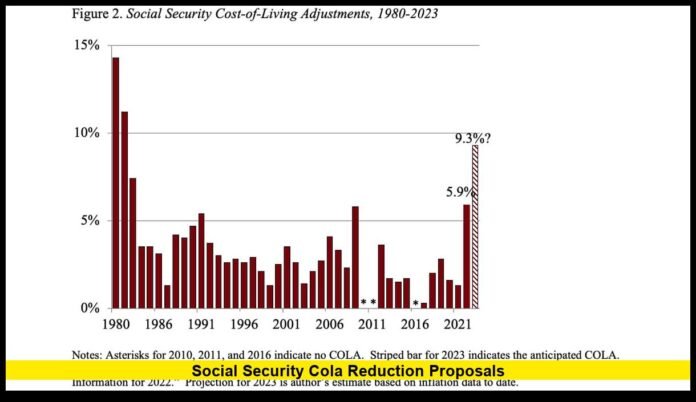
The 2026 Social Security COLA was 2.8%. The SSA confirms that the 2.8% adjustment began with Social Security benefits payable in January 2026.
For 2027, the calculation is still underway.
July 2026 CPI-W data are now available, but August and September readings remain necessary to complete the statutory calculation.
Current outside estimates have varied as inflation data have changed. Recent estimates have placed the eventual 2027 adjustment in the low-to-mid 3% range, but these remain forecasts rather than the official COLA.
That distinction is especially important when discussing potential reductions.
A forecast of a 3% or 4% COLA does not mean Congress has approved a reduction. Likewise, a projection that the final COLA could be higher than 2026’s 2.8% does not mean the increase has been finalized.
The official number depends on the remaining inflation data.
What the 2026 Trustees Report Means for Future COLAs
The latest Trustees Report gives lawmakers a clearer picture of why benefit changes remain part of the policy debate.
Under the report’s intermediate assumptions, the combined OASDI trust funds face a 75-year actuarial deficit equal to 4.42% of taxable payroll. The OASI portion accounts for a larger share of the problem, with a projected 75-year actuarial deficit of 4.55% of taxable payroll.
The Trustees also project that program costs will exceed total income in 2026 and remain above income throughout the 75-year projection period.
That creates pressure for legislative action.
Possible solutions include changes to payroll taxes, benefit formulas, retirement provisions, eligibility rules and COLAs. The Trustees Report itself does not select one solution.
COLA reductions therefore represent one part of a much broader Social Security solvency debate.
Why a COLA Reduction Could Matter Over Time
The most important effect of a smaller COLA is cumulative.
A reduction in one year’s increase would affect the starting point for later adjustments. If benefits receive smaller increases repeatedly, the gap between benefits under current law and benefits under a reduced-COLA policy could become larger over time.
This is why the SSA’s actuarial analysis measures the financial effects across decades rather than focusing only on the first year.
The impact would also differ from one household to another.
A beneficiary receiving a larger monthly payment would see a larger dollar difference from a given percentage-point reduction. A beneficiary with a smaller payment would see a smaller dollar difference, although the long-term effect could still matter.
The same percentage reduction would apply through the formula rather than being a flat dollar amount.
What Has Actually Changed So Far
For beneficiaries trying to separate confirmed developments from proposals, the current picture is straightforward:
- The existing Social Security COLA formula remains in effect.
- The 2026 COLA is 2.8%.
- The 2027 COLA has not yet been officially announced.
- July 2026 CPI-W increased 3.4% over the year.
- August and September CPI-W readings are still needed for the final 2027 calculation.
- The SSA has analyzed proposals that would reduce annual COLAs by 0.5 or 1 percentage point.
- The SSA has also analyzed chained CPI approaches that would lower COLAs by about 0.3 percentage point on average.
- Legislation introduced in the 119th Congress includes proposals that would instead use CPI-E and potentially produce higher COLAs.
- No COLA reduction proposal discussed in the SSA’s actuarial materials has automatically changed current Social Security benefits.
This distinction is essential because proposals and enacted law have very different consequences.
What Beneficiaries Should Watch Next
The next major development for Social Security COLAs will be the remaining 2026 inflation data.
Once September’s CPI-W figure becomes available, the Social Security Administration will have the complete third-quarter information needed to determine the 2027 adjustment under current law.
Congressional activity will also remain important.
New bills, committee action or negotiations could alter the debate over how Social Security benefits should be adjusted in future years. At present, however, there is no enacted law imposing a general reduction in the annual COLA.
The 2026 Trustees Report makes clear that lawmakers face a substantial financing challenge. But the report does not prescribe a single benefit-cutting solution. Its actuarial tables instead allow policymakers to evaluate different options and their financial effects.
For Social Security recipients, the practical takeaway is that current benefits continue to follow existing law. Any permanent change to the COLA formula would require congressional action and a change in federal law.
The debate over social security cola reduction proposals is therefore about potential future policy, not an automatic reduction already scheduled for beneficiaries.
As the 2027 COLA calculation moves closer to completion and Congress considers competing approaches to Social Security’s finances, the difference between an introduced proposal and an enacted benefit change will remain critical.
What do you think about the future of Social Security COLAs? Share your view and stay tuned for the latest confirmed developments.