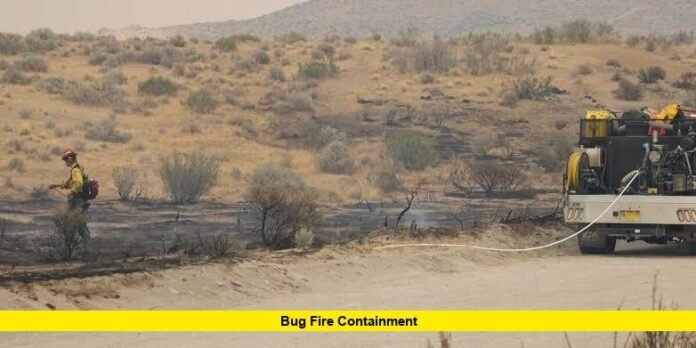

Bug Fire containment has climbed to 94 percent as of August 23, 2026, marking a major turning point for firefighting crews battling one of Northern California’s largest wildfires of the season. The blaze in Lassen County has held steady at 93,733 acres with 94 percent containment, marking 15 days since its discovery on August 8.
The fire has burned through short grass fuel that dominates the region’s terrain, and officials say the footprint has stopped growing in recent days. No acreage has been added in the latest reporting period, and containment has remained static, a sign that active suppression work has stabilized the fire’s footprint.
Current Bug Fire Status
The numbers tell a story of steady progress. The Bug Fire in Lassen County has held steady at 93,733 acres with 94 percent containment as of August 22, fourteen days after its discovery on August 8. Crews have not reported any new growth since then.
Officials describe the incident as being in its closing phase. At 94 percent containment, crews have moved beyond the early aggressive suppression phase and are now focused on securing the remaining uncontained line and mop-up work. That shift signals the fire is no longer spreading aggressively across the landscape.
Estimated costs for the response have reached $22.2 million. The fire was discovered on August 8, 2026, and is managed by a Type 3 Team. Investigators attribute the ignition to human activity rather than lightning or equipment failure.
How the Fire Grew So Large
Understanding the path to today’s containment numbers helps explain why full control has taken so long. The Bug Fire rapidly expanded from 800 acres on August 9 to a peak of 93,733 acres by August 18, with containment rising from 3 percent to 87 percent over that period.
Firefighting resources scaled up dramatically during that stretch. Personnel increased from 220 on August 10 to a peak of 849 on August 16, while estimated costs climbed from $5,000,000 to over $22.7 million. That surge in staffing helped crews get ahead of the flames before hot, dry conditions could push the fire further.
Fire behavior shifted several times as containment grew. Fire behavior evolved from active flanking and short-range spotting to extreme wind-driven runs, then to moderate uphill runs, and finally to minimal creeping and smoldering as containment improved. That progression is typical for large grass and brush fires once crews establish solid containment lines around the perimeter.
Personnel numbers have since scaled back as the threat eased. Recent updates put staffing at roughly 200 firefighters, a fraction of the peak deployment, reflecting the reduced need for aggressive suppression work.
Bug Fire and Stallion Fire Together
The Bug Fire has not burned alone. A second blaze, the Stallion Fire, ignited nearby just two days later and has been tracked alongside it throughout the response.
Together, the two fires have scorched a massive stretch of land straddling the California-Nevada border. The Bug Fire has burned 93,733 acres since it started August 8 and is 94 percent contained, while the Stallion Fire, which started August 10, has burned 40,691 acres and is 98 percent contained. Investigators have determined both fires were caused by humans.
Crews assigned to both incidents remain active despite the high containment figures. A total of 249 personnel are assigned across the two fires, with resources including two crews, 15 engines and water tenders, two helicopters and nine pieces of miscellaneous heavy equipment. That combined force continues patrolling containment lines for hot spots.
Flare-ups remain a real possibility even at this stage. Crews recently responded to another fuel ignition within the fire perimeter, since such ignitions are common because larger fuels can retain heat and continue to smolder even after an area has reached containment.
Weather Concerns Still Complicate Suppression
Despite the high containment percentage, weather remains a wildcard for crews on the ground. A Red Flag Warning has been in effect, with southwest winds expected to gust to 30-35 mph, peaking around 4 p.m. on the Bug Fire and between 4 and 8 p.m. on the Stallion Fire.
Thunderstorms add another layer of unpredictability. There is also a 7-15 percent chance of thunderstorms across the fire area, and smoke may remain present, affecting local air quality. Fire managers are watching these conditions closely, since gusty winds can reignite smoldering fuel even within a well-contained perimeter.
Residents in nearby communities have been advised to stay alert for shifting smoke conditions. Air quality can fluctuate quickly when wind patterns change direction, even after a fire is largely under control.
Repair Work Now Underway
With the fire mostly contained, attention has turned toward repairing the land firefighting crews disturbed while building containment lines. Heavy equipment and hand crews are working together on suppression repair following the Bug and Stallion fires.
Dozers and excavators are playing a central role in that recovery effort. Dozers and excavators are rehabilitating containment lines, roads, trails and other areas impacted by firefighting operations by reshaping ground and improving drainage to reduce erosion and flooding.
Smaller-scale repairs are happening by hand in more delicate terrain. Hand crews are repairing smaller or sensitive areas using hand tools to restore natural contours, cover disturbed soil and remove debris. This work protects roads and natural resources as the burned landscape begins its recovery.
Impact on Homes and Communities
The human toll of the fire has been significant, even though large-scale evacuations have eased considerably. At least nine structures were reported destroyed, and the number of evacuated residents dropped from about 2,600 to 282, with most repopulation occurring in Antelope Valley and Palomino Valley.
Power has been restored to most affected homes. NV Energy restored power to homes in the area, while the number of homes threatened by the Bug Fire fell from about 6,000 to approximately 1,500. Those numbers have continued to drop as containment has grown.
One serious injury during the incident turned fatal. An individual who sustained burn injuries on August 12, 2026, on the Nevada side of the incident later succumbed to their injuries, according to fire officials managing the response. Authorities have directed additional inquiries to the Washoe County Sheriff’s Office.
Traffic disruptions caused by the fire have largely resolved. Major routes through the area, including US-395 and Highway 70, have reopened to travelers, though officials continue urging caution near active fire personnel and equipment.
What Comes Next
Full containment appears within reach in the coming days if weather cooperates. The fire’s lack of growth suggests personnel are holding their position effectively across the fire’s perimeter, and its trajectory points toward imminent full containment as crews complete final suppression efforts.
Officials continue to caution residents against assuming the danger has fully passed. Smoldering fuel, shifting winds, and dry vegetation mean flare-ups can still occur even after containment reaches the high 90s.
Local authorities are urging residents in Lassen County and the surrounding Nevada border region to keep monitoring official channels for evacuation zone updates. Two evacuation zones remain affected, and residents are advised to look up their zone status through their county or Genasys notification systems.
Fire crews say the coming days will focus heavily on mop-up operations rather than active firefighting. That shift typically marks the final stretch before an incident is declared fully contained and management transitions back to local agencies.
Stay tuned, and share your thoughts below on how this wildfire season has affected your community.