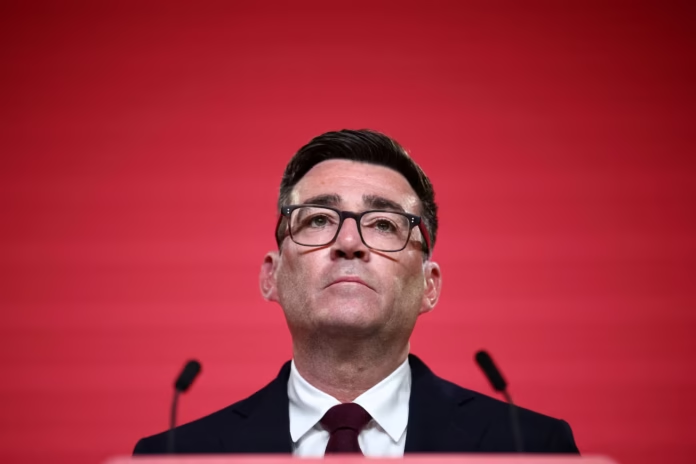

Since Andy Burnham’s rise to become Leader of the Labour Party and Prime Minister of the United Kingdom in July 2026, one question has dominated political discussion across Britain: is Andy Burnham a socialist? The answer is not straightforward. Burnham’s career has spanned New Labour centrism, soft-left populism, and now leadership of a party that includes everyone from Blairite moderates to committed socialists. Understanding where he truly stands requires looking at his full political journey, from his early days as a loyal Blairite MP to his current position at the top of British government.
Who Is Andy Burnham?
Andrew Murray Burnham was born in Liverpool and raised in Culcheth, a commuter village in Cheshire near Warrington. The son of a BT engineer and a GP receptionist, he attended a local Roman Catholic comprehensive school before studying English at Cambridge University. Burnham has said he was drawn to the Labour Party as a teenager after watching “Boys from the Blackstuff,” a BBC drama depicting unemployment and hardship in 1980s Liverpool. He joined the party in 1984 at the age of 14, and by the mid-1990s he was working inside the Labour machine as a researcher and special adviser.
Burnham was elected as Labour MP for Leigh in 2001, entering Parliament under Tony Blair. He rose steadily through government, eventually serving as Chief Secretary to the Treasury, Culture Secretary, and Health Secretary under Gordon Brown. During his time as Health Secretary, he oversaw NHS reforms that included private finance initiative (PFI) contracts, a policy area that later drew criticism from those on the party’s left. This early record is central to why some commentators still hesitate to describe him as a true socialist, despite his more recent left-leaning image.
The Political Shift: From Blairite to “Soft Left”
For much of his early career, Burnham was firmly associated with New Labour, the centrist, business-friendly wing of the party shaped by Tony Blair. Political observers have long noted his ability to adapt to whichever political current was ascendant within Labour, giving rise to a well-known Westminster joke about a “Blairite, a Brownite and a Corbynite” walking into a bar, with the barman simply asking, “What are you drinking, Andy?”
After Labour’s defeat in the 2010 general election, Burnham ran for party leader and finished fourth, positioning himself as a candidate favored by trade unions. He ran again in 2015, this time branding himself as the “soft left” alternative, but was decisively beaten by Jeremy Corbyn, a veteran democratic socialist whose campaign pulled the party sharply leftward. Burnham later served in Corbyn’s shadow cabinet as shadow home secretary, though he largely avoided the internal factional warfare that consumed Labour during that period.
It was during and after this period that Burnham began describing his outlook using terms like “aspirational socialism,” a label broad enough that he once also referred to a proposed mansion tax as reflecting “the politics of envy,” a comment that drew criticism from those further to his left. This kind of positioning is a key reason why the question “is Andy Burnham a socialist” continues to generate debate rather than a simple yes-or-no answer.
Mayor of Greater Manchester and “Manchesterism”
In 2017, Burnham left Westminster to become Mayor of Greater Manchester, winning with 63% of the vote. As mayor, he built a reputation around two defining moments: his public clashes with the Conservative government over Covid-19 financial support for the north of England in October 2020, and his long-running campaign for justice for the Hillsborough disaster victims, which he championed after being heckled at a memorial event in 2009.
During his mayoralty, Burnham developed an economic philosophy he sometimes called “Manchesterism,” which he has described as a form of “business-friendly socialism.” This framing captures much of the tension in his political identity: he supports greater public ownership and investment in areas like transport and housing, while also emphasizing partnership with business and fiscal caution on national spending. He has, for example, called for a large-scale social housing programme, and he backed Liverpool’s plan to return its commuter rail network to public ownership.
He also pledged to donate a portion of his mayoral salary to a homelessness fund and set a goal of ending rough sleeping in Greater Manchester, policies that reinforced his image as a socially conscious, left-leaning politician even as critics questioned how far his substance matched his rhetoric.
The 2026 Labour Leadership and Premiership
The question of Burnham’s ideology became a matter of national significance in 2026. After Keir Starmer announced his resignation as Labour leader and Prime Minister on June 22, 2026, following mounting pressure from Labour MPs and a poor showing in local elections, Burnham emerged as the overwhelming favorite to replace him. Because Labour Party rules require leadership candidates to be sitting MPs, Burnham first needed to return to Parliament. He won the Makerfield by-election on June 18, 2026, after the sitting MP stood down to make way for him, and nominations for the leadership followed shortly after.
Burnham secured an extraordinary level of support, receiving <cite index=”1-1″>nominations from 379 Labour MPs, over 94% of the parliamentary party</cite>, making him the only candidate on the ballot. On July 17, 2026, he was formally <cite index=”5-1″>elected Leader of the Labour Party at a Special Conference of the Trades Union Congress in London, with the backing of 379 MPs and 23 affiliate organisations, including Labour’s socialist societies and trade unions</cite>. He became Prime Minister shortly afterward.
In his first speech as leader, Burnham argued that Britain had <cite index=”3-1″>”surrendered control of the essentials: housing, water, energy, transport,” and said this happened because political power had been centralized while economic power was privatized</cite>. He has also championed the <cite index=”3-1″>return of rail networks to public ownership, describing it as putting railways under public control rather than shareholder interests</cite>. These positions place him well to the left of Starmer on economic policy, and they are a major reason many voters and commentators now associate him with socialism.
At the same time, Burnham has been careful to reassure financial markets. He has publicly backed Chancellor Rachel Reeves’s fiscal rules, even after suggesting the government should not be “in hock to the bond markets.” One notable exception to his fiscal caution is defense spending, where he has said there may be a case for exceeding normal budget rules given pressure to increase military investment. This mixture of left-leaning rhetoric and fiscal pragmatism is precisely why analysts describe him as part of Labour’s “soft left” rather than its socialist left.
What Critics and Supporters Say
Opinions on whether Andy Burnham qualifies as a socialist vary sharply depending on the source. Some left-wing commentators and socialist publications argue he is not a genuine socialist at all, pointing to his Blairite record, his Cambridge education, and his continued support for NATO membership and the UK’s nuclear deterrent, both positions he defended even during his most left-leaning leadership campaign in 2015. Critics from this perspective argue that his economic program still fundamentally accepts market-based structures and fiscal orthodoxy, and that his populist tone masks continuity with previous Labour governments’ policies.
On the other hand, some media coverage, particularly from outlets covering his rise to the premiership, has described him using terms like “left-wing” and has noted his platform includes policies traditionally associated with democratic socialism, such as public ownership of utilities and transport, large-scale social housing investment, and skepticism toward market-led approaches to essential services. Political scientists more commonly place him within the “soft left” tradition of the Labour Party, a position distinct from both New Labour centrism and the democratic socialism associated with Jeremy Corbyn.
It’s worth noting that Burnham himself has often rejected simple labels. He has said he finds the “flip-flop” characterization frustrating, describing his political views as “nuanced” rather than fitting neatly into any single ideological category. When reflecting on New Labour, he has said “the early albums were very good,” suggesting he sees value in aspects of the Blair-era project while believing it ultimately became too focused on courting establishment power and influence.
Public Interest and Why the Question Matters Now
Interest in Burnham’s ideology has surged since he became Prime Minister, as voters and political observers try to understand what kind of government Britain now has. His rise was fueled partly by the perception that he represents a genuine departure from Starmer’s more centrist approach, and partly by concern within Labour about the growing popularity of Nigel Farage’s Reform UK party and the left-wing Green Party, both of which have gained ground amid dissatisfaction with the political establishment.
Some polling analysts have suggested Burnham may represent Labour’s best chance of preventing further gains by Reform UK, framing him as a unifying figure who can appeal to both traditional Labour voters and those drawn to more populist, anti-establishment politics. Others remain skeptical that his popularity as a regional mayor will translate into sustained support as a national leader facing the full scrutiny of Westminster politics and financial markets.
Final Thoughts
So, is Andy Burnham a socialist? Based on his record, the most accurate description is that he occupies the “soft left” of the Labour Party, a position that blends genuine support for public ownership, social housing, and reduced NHS privatization with continued acceptance of fiscal discipline, NATO membership, and pro-business partnerships. He is not a doctrinaire socialist in the mold of Jeremy Corbyn, nor is he a pure centrist in the tradition of Tony Blair. Instead, Burnham has built a political identity around flexibility, describing his own philosophy as “aspirational socialism” and, more recently, as a form of “business-friendly socialism” branded Manchesterism.
As Prime Minister, his actual policy decisions in the months ahead will likely provide the clearest answer yet to this ongoing debate. Whether his government pursues genuinely transformative public ownership policies or largely maintains the fiscal caution of his predecessor will determine how history, and the British public, ultimately label his politics.
Stay tuned for more updates on Andy Burnham’s premiership, and share your thoughts on his political direction in the comments below.