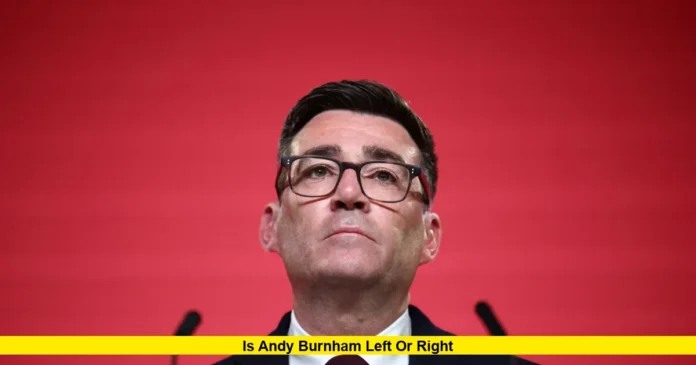

Since Andy Burnham stepped into the role of Labour Party leader and prime minister in July 2026, one question has been trending across search engines and social media: is Andy Burnham left or right on the political spectrum? The short answer is that Burnham sits on the left side of British politics, specifically within Labour’s “soft left” tradition, though his career shows a pragmatic streak that has occasionally drawn criticism from both wings of his party. Understanding where he stands requires looking at his background, his voting record, his time as Mayor of Greater Manchester, and the choices he has made since returning to Westminster.
Who Is Andy Burnham
Andrew Murray Burnham was born on 7 January 1970 and grew up in a working-class household, with a father who worked as a telephone engineer and a mother who worked as a receptionist. He has often spoken about how the miners’ strike of the 1980s shaped his political outlook, and he joined the Labour Party at the age of 14. He went on to study English at Fitzwilliam College, Cambridge, before working as a researcher for Labour politicians and later as an adviser to a culture secretary. This early grounding in trade union communities and working-class politics is often cited as the foundation of his left-leaning identity, and it remains a reference point whenever commentators discuss whether Andy Burnham is left or right.
Early Political Career and Ministerial Roles
Burnham was first elected to Parliament in 2001 as the MP for Leigh, a former mining constituency in Greater Manchester. Under the governments of Tony Blair and Gordon Brown, he rose steadily through ministerial ranks. He served as Chief Secretary to the Treasury, then as Secretary of State for Culture, Media and Sport, and finally as Secretary of State for Health from 2009 to 2010. As health secretary, he prioritized public sector care for older and disabled adults, a policy stance generally associated with the left of the political spectrum. However, his handling of the Stafford Hospital crisis, where he was criticized for resisting calls for a full statutory public inquiry, became a lasting controversy and is sometimes raised by critics questioning his judgment on public accountability.
After Labour lost power in 2010, Burnham ran for the party leadership twice, first in 2010 and again in 2015. In both contests he positioned himself as a unifying figure rather than a strict ideologue. He finished fourth in 2010 and second in 2015, losing to the more clearly left-wing candidate Jeremy Corbyn. Despite that defeat, Burnham went on to serve as Shadow Home Secretary in Corbyn’s shadow cabinet, a role that placed him within a leadership team widely regarded as one of the most left-leaning in modern Labour history. This period is often used as evidence that Burnham is comfortable operating within the left of the party, even if he does not always share every position of its most radical members.
The Manchester Mayoralty and His “Soft Left” Identity
In 2017, Burnham resigned his Westminster seat to become the first directly elected Mayor of Greater Manchester, a position he held until his return to Parliament in 2026. During his mayoralty, he became known as the “King of the North,” a nickname earned through his public clashes with the national government over funding for regional COVID-19 restrictions, homelessness initiatives, and transport investment. His signature achievement was overseeing the Bee Network, an integrated, publicly controlled bus and tram system for Greater Manchester, along with a major home-building program aimed at tackling the region’s housing crisis.
Political scientists and commentators frequently describe Burnham as part of Labour’s “soft left,” a faction that supports strong public services, greater regional devolution, and workers’ rights, while generally avoiding the more confrontational rhetoric associated with the party’s hard-left wing. Lotte Hargrave, a political science researcher at Manchester University, has noted that despite his adaptability over the years, Burnham is most closely associated with this soft-left tradition. This label helps explain why, when people search for whether Andy Burnham is left or right, the most accurate answer places him left of center but not at the furthest edge of Labour’s ideological spectrum.
Return to Westminster and the Path to Downing Street
Burnham’s political comeback accelerated in 2026 after Labour suffered a difficult set of local election results in May. He won the Makerfield by-election in June 2026, returning to Parliament for the first time since 2017. His victory in Makerfield was notable because it came against a strong challenge from the right-wing populist party Reform UK, positioning Burnham as one of the few senior Labour figures capable of holding off Reform’s growing appeal in traditional Labour strongholds.
Following mounting pressure within the Labour Party and Keir Starmer’s resignation as prime minister, Burnham was confirmed as the new Labour Party leader on 17 July 2026, having stood unopposed in the leadership contest. He was set to be appointed prime minister shortly afterward. In his first speech as leader, Burnham pledged to end Labour’s internal factionalism, stating that the party would not defeat what he called “Britain’s new right” if it remained consumed by infighting. He promised to deliver “hope in every heart” and pledged renewed focus on economic growth across the country’s regions.
Where Critics and Supporters Disagree
Despite his soft-left reputation, some commentators have pointed to specific policy signals from Burnham’s camp that appear to lean rightward, particularly around immigration enforcement. Reports ahead of his return to Parliament suggested Burnham was prepared to support tougher immigration reforms championed by Home Secretary Shabana Mahmood, a move that unsettled some voices on Labour’s left flank. Critics have also noted that some of his closest advisers have previously worked with organizations regarded as being on the party’s more centrist or rightward-leaning wing. These developments have fueled ongoing debate about whether Andy Burnham is left or right in practice, as opposed to in political branding.
At the same time, supporters argue that Burnham’s willingness to work across factions is a strength rather than evidence of ideological drift. They point to his record on public housing, transport nationalization at the regional level, and his consistent support for strengthening the National Health Service as proof that his core instincts remain rooted in traditional Labour, left-of-center values. His public image as a pragmatic, plain-speaking politician who prioritizes results over rigid ideology has helped him become one of the most popular politicians in Britain, according to recent polling.
Public Interest and Polling Trends
Public and media interest in Burnham’s political identity has surged since his return to national politics. Polling commissioned around the Makerfield by-election showed Labour, under Burnham’s influence, holding a competitive lead over Reform UK, though the margins varied between polling organizations. Separate polling has also indicated that Burnham has overtaken Reform UK leader Nigel Farage as the politician voters consider most likely to become the country’s next prime minister following a general election. This level of public attention has made “is Andy Burnham left or right” one of the most searched political identity questions in the UK, as voters try to understand what kind of leadership his premiership may bring compared to his predecessor.
Latest Updates
As of late July 2026, Burnham has formally taken over as Labour Party leader and is expected to be confirmed as prime minister, succeeding Keir Starmer. There is no official confirmation yet of his full cabinet lineup or his complete policy platform, though reports suggest his team has approached Shabana Mahmood about a senior economic role. Given how recently these developments have unfolded, some details about his governing priorities may still change, and readers should treat any unconfirmed cabinet appointments or policy plans as provisional rather than final.
Final Thoughts
So, is Andy Burnham left or right? Based on his career history, his political associations, and his public positioning, Burnham is best described as a left-of-center politician rooted in Labour’s soft-left tradition. His working-class background, his ministerial record on public health and social care, and his transport and housing achievements as Manchester mayor all point toward a left-leaning political identity. At the same time, his pragmatic approach to governing, his openness to working with figures across Labour’s internal spectrum, and some of his recent policy signals on immigration show a politician who resists being boxed into a single ideological category. As he settles into his new role at the top of British politics, his policy choices in the coming months will likely offer the clearest answers yet about exactly where he stands.
Stay tuned for more updates on Andy Burnham’s premiership, and share your thoughts on his political direction in the comments below.