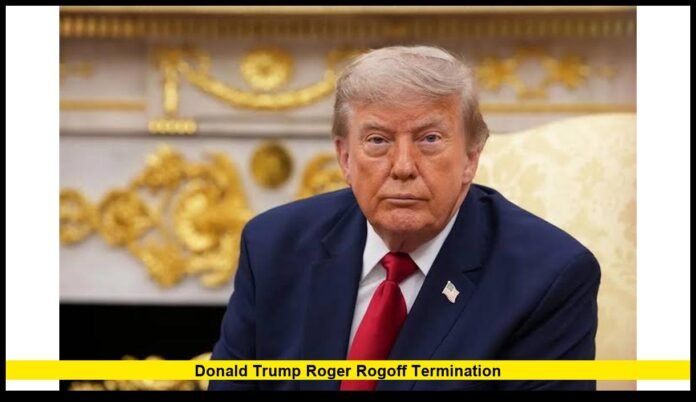

Donald Trump Roger Rogoff termination became one of the most significant legal and political developments on July 16, 2026, after President Donald Trump removed Roger Rogoff from the role of U.S. Attorney for the Western District of Washington less than an hour after he was sworn into office. The unusual sequence of events immediately sparked debate over presidential authority, judicial appointments, and the legal framework governing temporary U.S. attorneys. As of today, Rogoff has been removed from office, Acting Attorney General Todd Blanche has defended the administration’s decision, and Rogoff has indicated he is considering legal action.
A Rare Chain of Events Unfolds in Seattle
The controversy began after the federal judges serving in the Western District of Washington unanimously selected Roger Rogoff to become the district’s U.S. Attorney.
The appointment came after the expiration of a previous interim appointment without a Senate-confirmed replacement. Under federal law, district judges may appoint a U.S. attorney when an interim appointment expires and the position remains vacant.
Rogoff took the oath of office at the federal courthouse in Seattle during the morning. Shortly afterward, while reporting to the U.S. Attorney’s Office, he received an email notifying him that President Donald Trump had removed him from the position.
The dismissal occurred less than one hour after his swearing-in, making it one of the shortest tenures ever recorded for a U.S. attorney.
Who Is Roger Rogoff?
Roger Rogoff is widely known within Washington state’s legal community for his decades of public service.
During his career, he has served as:
- A federal prosecutor
- A state prosecutor
- A King County Superior Court judge
- Director of Washington state’s Office of Independent Investigations
His experience spans criminal prosecutions, courtroom litigation, judicial service, and oversight of independent investigations involving law enforcement.
The federal judges who appointed Rogoff cited his extensive legal background and public service experience when selecting him to lead the U.S. Attorney’s Office.
Following his dismissal, Rogoff said he was honored by the confidence shown by the judges and proud of his career in public service. He also confirmed that he is consulting attorneys about potential legal options.
Why Was the Position Vacant?
The vacancy resulted from the expiration of an interim appointment.
Normally, U.S. attorneys are nominated by the President and confirmed by the U.S. Senate.
When a vacancy occurs before Senate confirmation, the Attorney General may appoint an interim U.S. attorney.
Federal law limits that interim appointment to 120 days.
If the Senate has not confirmed a permanent nominee by the time the interim period ends, the federal district court may appoint someone to continue serving until a presidential nominee receives Senate confirmation.
That is exactly what happened in Seattle.
After the interim appointment expired without Senate confirmation of a permanent replacement, the district’s federal judges exercised their statutory authority and unanimously selected Rogoff.
Why Did President Trump Remove Rogoff?
The Trump administration argues that the President has constitutional authority to remove U.S. attorneys, even when they have been temporarily appointed by federal judges.
Acting Attorney General Todd Blanche publicly defended the decision shortly after Rogoff’s dismissal.
Blanche also criticized the district court judges, saying they did not consult with the administration before making their appointment.
The administration’s position is that judicial appointment authority under federal law does not eliminate presidential removal authority.
That interpretation became the basis for removing Rogoff shortly after he entered office.
How Federal Law Handles Temporary U.S. Attorney Appointments
The appointment process follows several distinct steps.
- The President nominates a U.S. attorney.
- The Senate considers and confirms the nominee.
- If the office becomes vacant, the Attorney General may appoint an interim U.S. attorney.
- The interim appointment generally lasts for 120 days.
- If no Senate-confirmed nominee has taken office when the interim period expires, federal district judges may appoint a temporary replacement.
Congress created this process to ensure federal prosecutor offices continue operating even when confirmation delays occur.
The Seattle case has focused national attention on what happens after judges make that appointment and whether the President may immediately remove the person selected.
Why This Case Matters Beyond Seattle
Although the dispute centers on one federal district, the legal questions extend much further.
The controversy touches on several important constitutional and statutory issues, including:
- Presidential authority over executive branch officials
- Judicial appointment powers established by Congress
- Separation of powers between branches of government
- Future handling of vacant U.S. attorney positions
Legal observers say the dispute could become an important test case if it reaches federal court.
Any judicial ruling could influence how similar appointments are handled in future administrations.
The Legal Questions That Remain Unanswered
Several major legal questions remain unresolved.
Among them are:
- Can a President immediately dismiss a court-appointed U.S. attorney?
- Does the federal appointment statute provide any protection for judicial appointees?
- How should courts balance statutory appointment authority against constitutional executive powers?
As of today, no federal court has ruled on these specific questions in Rogoff’s case.
Until litigation occurs, these issues remain unsettled.
Could There Be a Lawsuit?
Roger Rogoff has publicly acknowledged that he is evaluating possible legal action.
He has not yet announced that a lawsuit has officially been filed.
If litigation proceeds, attorneys will likely examine:
- The legality of the President’s removal authority.
- Congressional intent behind the temporary appointment statute.
- Constitutional separation of powers.
- Previous court decisions involving executive appointments.
A lawsuit could eventually provide greater legal clarity regarding temporary U.S. attorney appointments across the country.
Political Reactions Continue
The dismissal quickly generated reactions from both supporters and critics.
Supporters of the administration argue that U.S. attorneys are executive branch officials who ultimately answer to the President.
Critics contend that Congress specifically authorized federal judges to fill vacancies after interim appointments expire and argue that the immediate removal undermines that statutory process.
The disagreement has intensified an ongoing national discussion over executive authority and the independence of federal prosecutors.
Who Is Leading the Office Now?
Following Rogoff’s removal, Charles Neil Floyd returned to lead the U.S. Attorney’s Office for the Western District of Washington in his role as First Assistant U.S. Attorney.
The office continues handling federal criminal prosecutions, civil litigation involving the federal government, organized crime investigations, public corruption cases, financial crimes, immigration matters, and national security issues.
The transition means ongoing federal cases continue moving through the justice system despite the leadership dispute.
Why the Story Has Received National Coverage
Several factors have made this one of the most closely followed legal stories of the week.
The removal happened almost immediately after the appointment.
The dispute involves multiple branches of government.
It raises constitutional questions that have not been fully resolved.
It could establish legal precedent for future administrations.
Because U.S. attorneys serve as the chief federal prosecutors within their districts, leadership changes can affect the administration of justice across an entire region.
Those factors have placed the Seattle dispute under national scrutiny.
What Happens Next?
Several developments could shape the next phase of the controversy.
Observers will be watching for:
- A possible lawsuit by Roger Rogoff.
- Additional statements from the Department of Justice.
- Any action by the federal judges who appointed him.
- Future court rulings interpreting the appointment statute.
- A Senate-confirmed nominee for the Western District of Washington.
Until one or more of those events occurs, the legal debate surrounding the dismissal remains unresolved.
For now, President Donald Trump has removed Roger Rogoff from office, the administration continues to defend its decision, and legal experts expect the dispute to remain closely watched in the weeks ahead.
As this legal dispute continues to develop, stay informed about the latest updates and join the conversation by sharing your thoughts in the comments below.