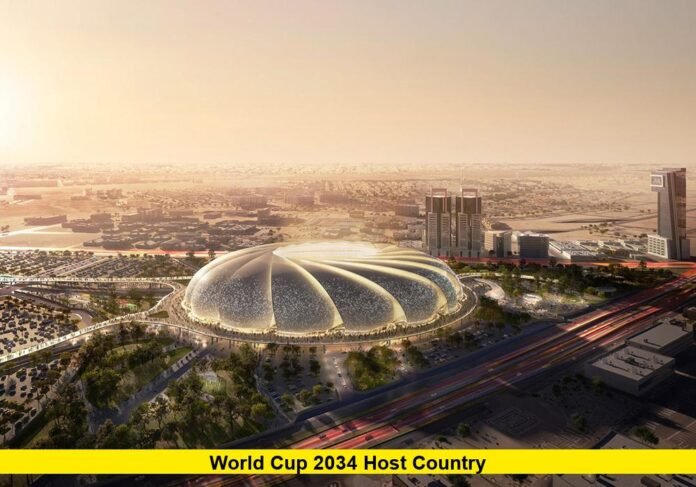

The world cup 2034 host country is officially Saudi Arabia, marking one of the most significant and talked-about decisions in the history of international football. FIFA confirmed the Kingdom as the sole host of the 2034 FIFA World Cup on December 11, 2024, setting the stage for a tournament that will be unlike any before it. For football fans, investors, and travelers alike, understanding what this means for the sport, the region, and the global sporting calendar has become a topic of growing interest as preparations move forward.
How Saudi Arabia Became the World Cup 2034 Host Country
Saudi Arabia’s path to hosting rights was shaped largely by FIFA’s confederation rotation policy, a rule designed to prevent the same continent from hosting the tournament in consecutive cycles. When FIFA decided to award the 2030 World Cup to a combined bid from Spain, Portugal, and Morocco, along with centennial matches in Argentina, Paraguay, and Uruguay, it effectively eliminated Europe, Africa, and South America from contention for 2034. That left only the Asian Football Confederation and the Oceania Football Confederation eligible to bid.
Since no Oceania nation currently has the stadium infrastructure required to host a men’s World Cup, attention quickly turned to Asia. Saudi Arabia announced its intention to bid within hours of FIFA opening the bidding window in October 2023, and it quickly gained widespread backing from Asian football federations. Australia, once seen as a potential rival bidder, announced it would not pursue a bid, leaving Saudi Arabia as the only candidate. As a result, the Kingdom’s selection as host became a formality by the time FIFA’s Extraordinary Congress convened in December 2024.
This will mark the second time a Middle Eastern nation has hosted the World Cup, following Qatar’s tournament in 2022. It also represents a major milestone for Vision 2030, the wide-reaching Saudi government initiative aimed at diversifying the economy and expanding the country’s global cultural and sporting influence.
What Makes the 2034 World Cup Different
One of the most notable aspects of the 2034 tournament is its format. It will be the first time the 48-team World Cup structure, introduced at the 2026 tournament in the United States, Canada, and Mexico, will be hosted entirely within a single country. That is a considerable logistical undertaking, given that the expanded format now includes 104 total matches compared to 64 in the previous 32-team era.
According to the bid documentation submitted to FIFA, Saudi Arabia plans to build and renovate 15 stadiums spread across five host cities: Riyadh, Jeddah, Al-Khobar, Abha, and NEOM. Riyadh alone is expected to house eight of these stadiums, reflecting its role as the primary hub of the tournament. Jeddah is set to include four venues, with Al-Khobar, Abha, and NEOM each hosting one. Of the proposed stadiums, several are entirely new builds, a handful are already under construction, and a smaller number involve refurbishing or temporarily expanding existing venues. In addition to the stadiums themselves, Saudi organizers have outlined plans for well over one hundred training sites spread across additional cities to accommodate the expanded number of participating national teams.
Because much of this infrastructure is being built from the ground up rather than adapted from an existing base of major stadiums, the scale of construction differs significantly from the shared North American model used for the 2026 tournament. This build-out is happening alongside other major Saudi development projects, including Expo Riyadh 2030, which adds further pressure and opportunity to the country’s ongoing infrastructure programs.
Climate, Scheduling, and Logistical Considerations
One of the more practical questions surrounding the World Cup 2034 host country involves timing. Saudi Arabia’s climate presents genuine challenges for hosting a summer tournament, since daily temperatures during the traditional June and July World Cup window can regularly climb into the mid-to-high 30s Celsius, or the high 90s Fahrenheit, with minimal overnight relief. For this reason, most major sporting events in the country, including the Saudi Pro League season, are scheduled during the cooler months between autumn and spring.
Although Saudi football officials have publicly indicated an interest in maintaining a traditional summer schedule, many analysts have pointed to the precedent set by Qatar’s 2022 World Cup, which was shifted to November and December specifically to avoid extreme heat. Because the Islamic holy month of Ramadan is expected to fall in the latter part of 2033 and early 2034, some observers believe a January or February window could ultimately prove more workable, though no official decision on scheduling has been made public at this time. Until FIFA and Saudi organizers confirm specific dates, any timeline beyond the officially announced host year should be treated as unconfirmed.
Public and Industry Reaction
The announcement of Saudi Arabia as host generated a wide range of reactions across the football world. Within the Kingdom, the news was met with widespread celebration, with fans gathering in cities like Riyadh and Jeddah to mark what many view as the culmination of years of investment in sports infrastructure, entertainment, and international sporting events. Saudi Arabia has already built a substantial sporting profile in recent years, hosting Formula 1 races, professional boxing matches, golf tournaments through LIV Golf, and top-tier tennis events, while its Public Investment Fund has also taken ownership stakes in global sports properties, including Premier League club Newcastle United.
Outside the country, the decision drew considerable criticism from human rights organizations and some football federations. Concerns have centered on labor conditions for migrant workers involved in stadium and infrastructure construction, restrictions on free expression, and the treatment of LGBTQ+ individuals under Saudi law. Some organizations have also raised questions about the broader environmental footprint of building so many new venues in a short timeframe. FIFA has stated that its bidding process included human rights assessments and has pointed to social reforms undertaken in Saudi Arabia in recent years, while acknowledging that additional risks will need to be monitored in the years leading up to the tournament. Saudi officials have said that existing labor laws and a human rights-based approach to contracts will help protect workers throughout the construction period.
Reaction from current and former players has been more mixed, with some prominent figures expressing enthusiasm about the tournament’s potential scale and atmosphere, while other football associations have said they will continue to monitor conditions in the country as preparations progress.
What This Means for Global Football
Beyond the logistics and controversy, hosting the World Cup 2034 host country designation carries enormous significance for the future of the sport in the Middle East and Asia more broadly. Saudi Arabia’s own national team, known as the Green Falcons, will enter the tournament with home-field advantage and considerable pressure to perform well, especially after the disappointing group-stage exits experienced by two of the more recent host nations. Saudi Arabia has qualified for six of the last eight World Cups, giving it a reasonably strong recent record heading into a decade of preparation.
The tournament is also expected to accelerate youth development programs across the country, with initiatives already underway to identify and train the next generation of Saudi footballers ahead of 2034. For neighboring countries and the wider Asian Football Confederation, a Saudi-hosted World Cup represents a rare opportunity to showcase regional football on the sport’s biggest stage, following in the footsteps of Qatar’s tournament in 2022.
From a commercial standpoint, FIFA’s continued expansion of the tournament format is expected to generate substantial new revenue streams, including increased broadcast rights, sponsorship deals, and ticketing systems that have grown more sophisticated with each cycle. Saudi organizers are expected to draw heavily on lessons learned from the 2026 World Cup, particularly around ticket pricing models and stadium operations, as they finalize plans for what will be the first single-nation hosting of the 48-team format.
Final Thoughts
The confirmation of Saudi Arabia as the World Cup 2034 host country represents a defining moment for both the Kingdom and international football as a whole. With an ambitious stadium-building program, a clear connection to the broader Vision 2030 economic strategy, and a decade still ahead for preparation, the tournament is poised to be one of the most closely watched in World Cup history. At the same time, unresolved questions around scheduling, labor conditions, and broader human rights considerations mean that global attention on the Kingdom’s preparations is unlikely to fade in the years leading up to kickoff. As more details are finalized, fans and industry observers alike will be watching closely to see how these plans take shape.
Stay tuned for more updates on World Cup 2034 preparations, and feel free to share your thoughts in the comments below.