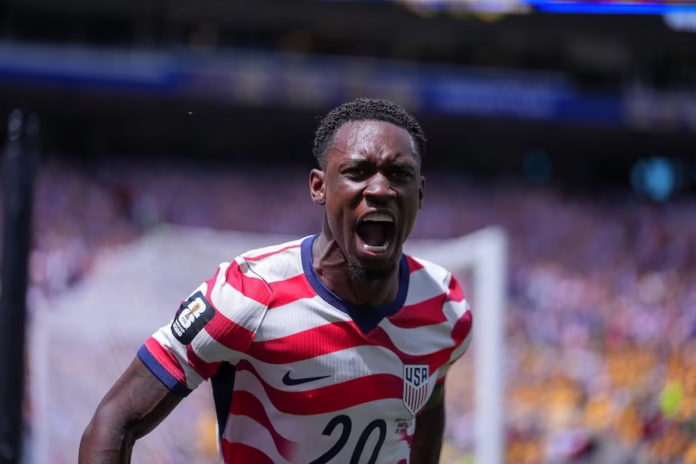

President Donald Trump called FIFA president Gianni Infantino this week, asking soccer’s global governing body to review a controversial red card issued to Team USA forward Folarin Balogun during the 2026 World Cup. The call, confirmed by multiple sources familiar with the conversation, came just days before Balogun and the U.S. Men’s National Team were set to face Belgium in a pivotal Round of 16 match, and it has quickly become one of the most talked-about storylines of this summer’s tournament.
Background: The Red Card That Sparked the Controversy
The chain of events began during Team USA’s 2-0 victory over Bosnia and Herzegovina in the Round of 32. Balogun, who had already scored a go-ahead goal earlier in the match, was shown a red card in the 64th minute after stepping awkwardly on the ankle of Bosnian defender Tarik Muharemović. Under standard World Cup rules, a red card automatically triggers a one-match suspension, which would have ruled Balogun out of the team’s next fixture against Belgium.
Many observers, including U.S. captain Christian Pulisic, argued that the challenge lacked any real intent to injure and that the punishment did not fit the play. Still, red card suspensions are rarely reversed, and the decision appeared to leave head coach Mauricio Pochettino searching for a way to replace his team’s most productive scorer in a win-or-go-home match.
The Phone Call and FIFA’s Reversal
According to multiple reports, Trump reached out to Infantino directly earlier in the week to request a review of the suspension. The exact details of what was discussed between the two leaders have not been made public, and there is no official confirmation from the White House or FIFA detailing the full content of the conversation. What is confirmed is that FIFA’s Disciplinary Committee announced on Sunday that Balogun’s suspension would be lifted, clearing him to play against Belgium.
In its official statement, FIFA cited Article 27 of its disciplinary code, which allows the organization’s judicial bodies to fully or partially suspend the enforcement of a disciplinary measure. FIFA specified that Balogun’s suspension would instead be held for a one-year probationary period, meaning a similar offense during that window could result in the original penalty being enforced.
This is not the first time FIFA has used this type of provision during the 2026 tournament. Earlier in the competition, the organization deferred suspensions for players including Cristiano Ronaldo, Nicolás Otamendi, and Moisés Caicedo, allowing each to continue playing despite red card infractions. However, the timing and public nature of a sitting U.S. president personally intervening in a FIFA disciplinary matter is widely seen as unprecedented, adding an extra layer of scrutiny to an already headline-grabbing decision.
Reaction From Belgium and the Soccer World
The ruling did not sit well with everyone. The Royal Belgian Football Association released a statement saying it was astonished by FIFA’s decision to allow Balogun back onto the field. Belgium head coach Rudi Garcia was even more pointed in his criticism, joking that FIFA seemed to think July 5 was April Fools’ Day rather than a serious competition date. Garcia declined to say directly whether he believed Trump’s phone call had influenced FIFA’s ruling, though the Belgian federation confirmed it was exploring all possible options, including a potential appeal to the Court of Arbitration for Sport.
For his part, Trump did not publicly claim credit for the reversal. Instead, he posted a message on social media thanking FIFA for what he called doing the right thing and correcting what he described as a serious injustice. He stopped short of stating that his call played any specific role in the outcome, leaving the extent of his influence on FIFA’s internal decision-making a matter of public speculation rather than confirmed fact.
Trump and Infantino’s Relationship
The episode has renewed attention on the close relationship between Trump and Infantino, which has developed publicly over the past year. In December, during the official World Cup draw at the Kennedy Center in Washington, D.C., Infantino presented Trump with the inaugural FIFA Peace Prize, a newly created honor. During the ceremony, Infantino praised Trump’s leadership and pledged FIFA’s support in helping foster global stability, remarks that drew both praise and criticism given FIFA’s traditional position as a neutral international sporting body.
The two have appeared together at several high-profile events since then, including last year’s FIFA Club World Cup Final, where Trump took part in the trophy presentation. That same arrangement is expected to repeat itself on July 19, when Trump and Infantino are scheduled to appear together at New Jersey’s MetLife Stadium for the World Cup Final, with Trump again set to hand the championship trophy to the winning team’s captain.
Supporters of the relationship point to it as evidence of the United States’ growing role in global soccer as co-host of the 2026 World Cup alongside Mexico and Canada. Critics, however, see the optics of a U.S. president calling a sports governing body to intervene in an in-game officiating matter as a blurring of lines between politics and athletic competition, especially given FIFA’s stated commitment to keeping disciplinary rulings independent of outside pressure.
Balogun’s Role and Performance at the World Cup
Beyond the political undertones, the controversy has also placed a spotlight on Balogun himself. The 25-year-old forward, who plays his club soccer for Monaco, has emerged as one of the most important attacking players for the United States during this tournament. His three goals through the group stage and Round of 32 rank among the best totals ever recorded by an American player in a single World Cup, trailing only a handful of historic performances from past U.S. tournaments.
Born in Brooklyn to Nigerian parents who were living in London at the time, Balogun represented England at the youth level before switching his international allegiance to the United States in 2023. Since making that decision, he has developed into a key attacking option for Pochettino’s squad, and his continued eligibility is viewed by many fans and analysts as important to the team’s chances of advancing deeper into the tournament than in recent World Cup cycles.
With Balogun cleared to play, Team USA entered its Round of 16 match against Belgium at full strength offensively, aiming to build on a run that has already generated significant excitement among American soccer fans. A win would move the team into just its second quarterfinal appearance in program history.
Public Interest and Ongoing Scrutiny
The story has generated substantial public interest, not only among soccer fans but also within political circles, given the unusual nature of a U.S. president directly engaging with an international sports federation over an in-match officiating decision. News outlets across both sports and political coverage picked up the story within hours of FIFA’s announcement, and the topic quickly became one of the most discussed sports stories of the week.
Whether the Belgian federation moves forward with a formal appeal remains uncertain, and there is no official confirmation at this time regarding any further review or investigation into the decision by FIFA’s own governing bodies. Similarly, there has been no detailed public accounting from either the White House or FIFA regarding the specific substance of the conversation between Trump and Infantino, leaving much of the discussion around the call’s actual influence based on the surrounding circumstances rather than confirmed statements from either party.
Final Thoughts
The news that Trump called FIFA president Gianni Infantino to seek a review of Folarin Balogun’s red card has added an unexpected political dimension to the 2026 World Cup, a tournament already notable for being the first hosted jointly by the United States, Mexico, and Canada. While FIFA’s official justification for lifting the suspension rested on its own disciplinary code, the timing of Trump’s call and his public celebration of the outcome have ensured that the story will remain a talking point well beyond the final whistle of the USA-Belgium match. As the tournament progresses toward its July 19 final, where Trump and Infantino are again expected to share the stage, the intersection of American politics and international soccer looks likely to stay in the spotlight.
Stay tuned for more updates on this developing World Cup story, and feel free to share your thoughts in the comments below.