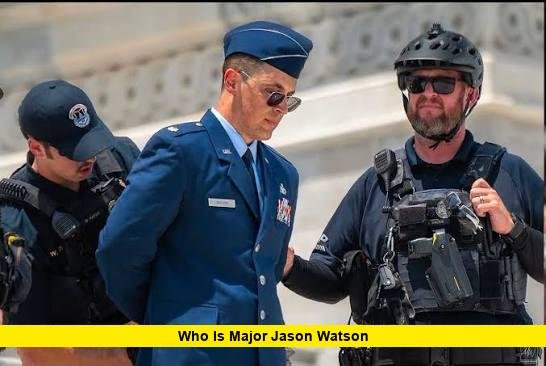

The question “who is Major Jason Watson” has been trending across social media and news platforms after a dramatic scene unfolded on the steps of the U.S. Capitol. An active-duty U.S. Air Force officer, Watson stood in full uniform holding a sign calling for the impeachment of President Donald Trump and Vice President JD Vance, an act of defiance that led to his arrest and thrust his name into the national spotlight. His decision to publicly challenge the sitting administration while still serving in the military has made him one of the most talked-about figures in recent political news, sparking debate over free speech, military conduct, and civilian oversight of the armed forces.
Background and Military Career
Jason Watson is a career officer who enlisted in the United States Air Force in 2005, building a long record of active-duty service. Over the years, he rose through the ranks to become a major, a role that reflects significant leadership experience and trust within the military structure. At the time of his arrest, Watson was serving as a logistics readiness officer stationed in Poland, a position responsible for coordinating supply chains, transportation, and operational support for military missions overseas. He was reportedly on leave from that post when he traveled to Washington, D.C., to take part in the demonstration.
Little personal biographical information about Watson has been made public, and there is no official confirmation of details such as his hometown, family life, or specific military honors beyond his standing as a long-serving, active-duty officer. What is confirmed is that his nearly two-decade career gave him firsthand knowledge of military operations, which he referenced directly in his public remarks about recent overseas military actions.
The Capitol Protest and Arrest
The incident that brought Major Jason Watson widespread attention took place outside the U.S. Capitol, where he joined a press conference organized by the Removal Coalition, a grassroots advocacy group pushing for the president’s removal from office. Watson was accompanied to the event by Representative Al Green of Texas, a Democrat who has been an outspoken advocate for impeachment proceedings against the president. Standing before reporters and demonstrators, Watson delivered a lengthy speech in which he accused the administration of committing what he described as numerous impeachable offenses.
He specifically criticized recent military strikes, arguing that they violated the War Powers Act because they were carried out without congressional approval or an imminent threat to national security. Watson claimed these operations resulted in the deaths of service members and injuries to many others. He also raised concerns about the handling of federal appointments, government spending authority, immigration enforcement actions, and the treatment of protesters, framing each issue as part of a broader pattern of constitutional violations.
After the press conference, Watson walked up the Capitol steps while Representative Green was still present. Demonstrating on the Capitol steps is generally prohibited unless the individual is accompanied by a sitting member of Congress. When Green left the area, U.S. Capitol Police instructed Watson to stop his demonstration or face arrest. Watson did not comply, and officers took him into custody. According to a Capitol Police spokesperson, he was arrested for crowding, obstructing, and incommoding, a charge tied to unlawfully occupying restricted areas of the Capitol grounds. Video footage of the arrest, which showed Watson holding a placard reading “Impeach Convict Remove” before calmly placing it down and allowing himself to be handcuffed, spread quickly across social media platforms.
Reaction From Lawmakers and Advocacy Groups
Representative Al Green publicly praised Watson’s actions shortly after witnessing the arrest, describing the moment as a powerful display of conviction from someone within the military. Green has been a prominent figure in impeachment efforts, having filed articles of impeachment against the president in December, a resolution that was ultimately voted down by the House.
Advocacy organizations were quick to respond as well. Free Speech For People, a nonprofit that has led a long-running impeachment campaign, issued a statement commending Watson for his willingness to risk his military career for what the group called a matter of constitutional accountability. The organization’s leadership argued that Watson’s actions highlighted a contrast between his willingness to act and the reluctance of many elected officials to pursue similar accountability measures. The Removal Coalition, which organized the original press conference, also expressed support, noting that Watson had reached out to the group earlier in the year because he wanted to become involved in the broader impeachment movement.
Not everyone viewed Watson’s actions favorably. Some commentators and political voices criticized the protest as inappropriate for an active-duty officer, arguing that a uniformed service member publicly criticizing the commander-in-chief blurs important lines between military service and political activism. Critics also pointed out that the president holds broad constitutional authority as commander-in-chief to direct military operations, and they disputed Watson’s characterization of the strikes as unconstitutional. This divide in public reaction reflects the broader national debate over presidential war powers, military neutrality, and the boundaries of free expression for service members.
Legal Developments and Case Status
Following his arrest, Watson was processed by Capitol Police and briefly held before his release. A District of Columbia Superior Court official later confirmed that Watson was released and that prosecutors were not expected to pursue formal charges against him. The office responsible for deciding whether to file charges did not immediately provide additional comment on the decision. As of now, there is no official confirmation of any pending criminal case moving forward, and it remains unclear whether the Air Force will pursue separate administrative or disciplinary action related to his conduct while on leave. The Air Force has not publicly confirmed additional details about Watson’s active-duty status following the incident.
Public Interest and Why This Story Matters
The story of Major Jason Watson has resonated widely because it touches on several sensitive and highly debated topics at once: military conduct, presidential accountability, free speech rights, and the ongoing push by some lawmakers and advocacy groups to impeach the president. Polling referenced by advocacy organizations suggests that a notable share of Americans believe there may be grounds for impeachment, while prediction markets have shown fluctuating odds on whether such proceedings will ultimately succeed. Watson’s willingness to place his military career on the line has added a uniquely personal dimension to this larger political conversation, making his case a focal point for discussions about where personal conscience intersects with professional duty in the armed forces.
His remarks during the press conference, in which he acknowledged shared responsibility across the political spectrum for the current state of national division, also struck a chord with many observers who saw his message as an appeal for unity rather than a purely partisan statement. Whether viewed as an act of principled courage or an inappropriate breach of military conduct standards, Watson’s protest has undeniably added a new and closely watched chapter to the broader impeachment debate.
Final Thoughts
Major Jason Watson’s arrest at the Capitol has turned a career military officer into an unexpected symbol in one of the most contentious political debates of the moment. His nearly two-decade career in the Air Force, his outspoken criticism of recent military and executive actions, and his decision to risk his professional standing for a public act of protest have combined to make his name one of the most searched topics in recent days. While the legal situation surrounding his arrest appears to be resolved for now, the broader questions his protest raised about military conduct, constitutional authority, and political accountability are likely to remain part of the national conversation for some time.
Stay tuned for more updates on this developing story, and share your thoughts on Major Jason Watson’s protest in the comments below.