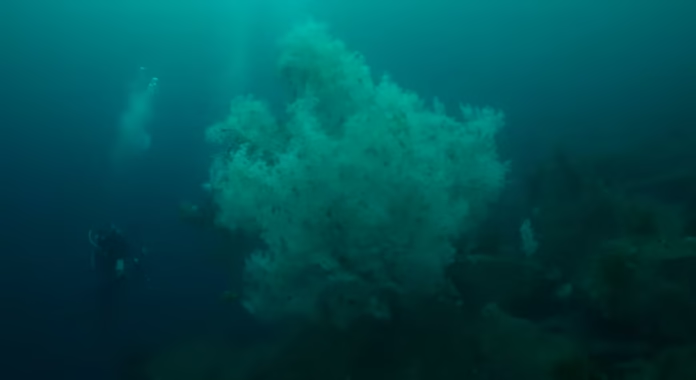

The new zealand black coral discovery has captured global attention after marine biologists exploring the remote waters of Fiordland found a colony so large that researchers say it may be one of the biggest ever recorded in the country’s history. Hidden in the deep, undisturbed channels of New Zealand’s southern fjords, the coral has stunned even veteran scientists with its sheer scale, prompting fresh conversations about deep-sea biodiversity, marine conservation, and how much of the ocean floor remains unexplored.
Where the Coral Was Found
The colony was discovered during a survey dive led by researchers from Te Herenga Waka—Victoria University of Wellington, working in the deep waters of Fiordland National Park on New Zealand’s South Island. Fiordland is known for its steep underwater cliffs, dark and nutrient-rich waters, and marine ecosystems that are rarely disturbed by human activity. These conditions make it one of the few places on Earth where slow-growing deep-sea species like black coral can thrive for centuries without interference.
The team was conducting routine underwater surveys when they came across the colony resting in one of the fjord’s deep channels. Its size was immediately apparent, even to experienced divers who have spent decades studying coral ecosystems in the region.
Just How Big Is This Coral?
The coral measures approximately four metres tall and 4.5 metres wide, dimensions that far exceed what researchers typically encounter. According to the survey team, most black corals found in New Zealand waters are considerably smaller, usually reaching no more than two to three metres in height.
Professor James Bell, a marine biologist who has studied coral ecosystems for 25 years, described the specimen as “absolutely huge,” noting that it is by far the largest black coral he has personally observed in his career. He explained that while divers occasionally come across sizable colonies, nothing compares to the scale of this particular find.
Based on its size and known growth rates for the species, scientists estimate the coral to be somewhere between 300 and 400 years old. That means the colony likely began forming long before New Zealand’s modern era of exploration and settlement, quietly growing in near-total darkness while the world above the surface transformed completely.
What Exactly Is Black Coral?
One of the more surprising details about this discovery is that black coral is not actually black in appearance. The species identified in this case, Antipathella fiordensis, has a pale, almost translucent look when alive. The “black” designation refers to the color of its skeleton, which is only visible once the living tissue has been removed or has died away.
Black coral colonies grow extremely slowly, often adding just a small amount of growth each year, which is part of why finding a specimen of this size is so remarkable. Their slow growth rate also makes them particularly vulnerable to environmental disturbance, since a damaged colony can take centuries to recover, if it recovers at all.
In New Zealand, black coral is a protected species under the Wildlife Act, meaning it cannot be legally collected, disturbed, or removed from its habitat without authorization. This legal protection reflects growing recognition of how ecologically important these slow-growing organisms are to the broader marine environment.
Why This Discovery Matters for Marine Conservation
Beyond its impressive size, researchers say the coral holds real scientific and ecological value. Large, mature colonies like this one serve as important breeding stock for the species, helping to sustain future generations of black coral in the region. Because these organisms grow so slowly, older and larger colonies are disproportionately valuable to the long-term health of the population.
Scientists involved in the discovery have pointed out that finding a coral of this age and scale suggests the deep waters of Fiordland may still be relatively undisturbed compared to other marine environments around the world. This is seen as encouraging news for conservationists, since it indicates that certain deep-sea habitats in New Zealand remain intact and capable of supporting long-lived, slow-growing species.
At the same time, the discovery has raised questions about how much of the surrounding underwater terrain remains unmapped or unexamined. Fiordland’s steep, dark channels are notoriously difficult to survey, and researchers have acknowledged that there could be other large or previously undocumented marine life still waiting to be found in similarly remote parts of the coastline.
The Research Team Behind the Find
The discovery was made by a team associated with Victoria University of Wellington, whose researchers have long studied coral ecosystems and marine biodiversity across New Zealand’s coastal waters. Professor Bell, who has been involved in coral research for over two decades, has been the primary voice sharing details of the find with the public, describing both the excitement and the scientific significance of encountering such a rare specimen.
Following the discovery, researchers have called on divers, boat operators, and members of the public who frequent Fiordland’s waters to report any sightings of unusually large black coral colonies. This kind of citizen input could help scientists build a clearer picture of where other significant coral populations may exist, particularly in areas that are difficult or costly to survey using traditional research methods.
Public Reaction to the Discovery
News of the coral’s discovery spread quickly, drawing interest from marine biology enthusiasts, conservation groups, and the general public alike. Many were struck by the idea that a living organism of this age and scale could exist quietly beneath New Zealand’s surface for centuries without being noticed. The story has also renewed public interest in Fiordland as one of the country’s most ecologically significant and least disturbed marine regions.
Coverage of the find has emphasized both its rarity and its symbolic value, with many pointing out that the coral likely began growing long before much of the surrounding coastline had been explored or documented. For a country closely associated with its natural landscapes, the discovery has reinforced Fiordland’s reputation as a place where remarkable, ancient life can still be found beneath the waves.
What Comes Next
Researchers say they intend to continue monitoring the coral and its surrounding habitat to better understand how it has managed to survive and grow undisturbed for so long. Ongoing surveys of Fiordland’s deep waters may also help scientists identify whether similar large colonies exist elsewhere in the region, which could further inform conservation priorities for the protected species.
There is currently no official confirmation of additional colonies of comparable size being found, though scientists have not ruled out the possibility given how little of the deep fjord environment has been thoroughly surveyed. Any future findings will likely be shared through university research updates as more data becomes available.
Final Thoughts
The discovery of this centuries-old black coral colony in Fiordland offers a rare glimpse into just how much life continues to exist, quietly and largely untouched, beneath New Zealand’s coastal waters. As one of the largest specimens ever recorded in the region, the coral stands as both a scientific milestone and a reminder of the importance of protecting deep-sea ecosystems that take hundreds of years to form and can be lost in a matter of moments if disturbed. For researchers and the public alike, the find has reignited curiosity about what else may still be hidden in the depths of New Zealand’s remote fjords.
Stay tuned for more updates on this remarkable discovery, and feel free to share your thoughts in the comments below.