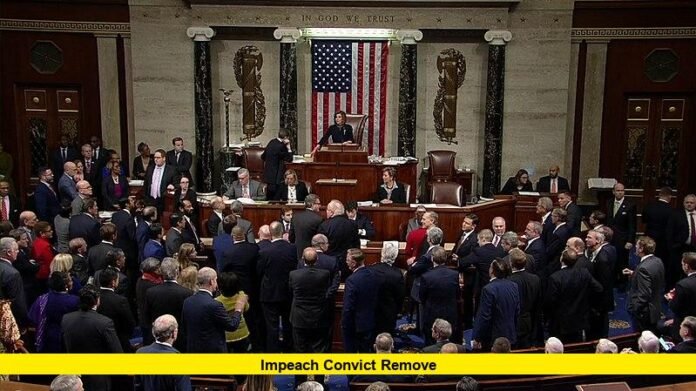

Few phrases capture the current political moment quite like impeach, convict, remove, a three-word sequence that has moved from legal textbooks into protest chants, congressional floor speeches, and social media hashtags. As renewed calls for accountability continue to surface in Washington, understanding what this process actually requires, and how far it is from being completed, has become essential for anyone following the news.
Breaking Down the Three-Step Process
At its core, impeachment is not a single event but a sequence of constitutional steps that must occur in order. Each stage carries its own requirements, and skipping or rushing any one of them is simply not possible under the Constitution.
- Impeach – The House of Representatives votes to formally charge an official with misconduct through articles of impeachment.
- Convict – The Senate conducts a trial and votes on whether the accused official is guilty. Conviction requires a two-thirds majority.
- Remove – A conviction results in automatic removal from office, and the Senate may separately vote to disqualify the individual from holding future federal office.
A common misconception is that being impeached means being removed from office. In reality, impeachment is closer to an indictment than a conviction. Without a Senate trial resulting in a two-thirds vote, an impeached official remains in their position. This distinction is central to why political movements so often use all three words together rather than relying on “impeachment” alone.
Constitutional Origins and Legal Framework
The authority for this process comes directly from Article I and Article II of the U.S. Constitution. The House holds the exclusive power to impeach, while the Senate holds the exclusive power to conduct the resulting trial. Article II specifies that the president, vice president, and other civil officers can be removed from office for treason, bribery, or other high crimes and misdemeanors.
Unlike a criminal trial, impeachment carries no risk of jail time or fines. Its consequences are limited strictly to removal from office and, if the Senate chooses, disqualification from holding future federal office. This narrower scope was intentional. The framers wanted a mechanism to check abuses of power without turning Congress into a criminal court capable of imprisoning political rivals. A separate criminal case can still be pursued through the ordinary justice system after an impeachment concludes, regardless of the outcome.
A Look at Historical Precedent
Impeachment has been used far less often than many people assume. Since the country’s founding, the House has initiated impeachment proceedings dozens of times, yet only a small number have ended in a Senate conviction, and most of those involved federal judges rather than presidents.
Three sitting presidents have been impeached by the House throughout American history, and in every case, the Senate ultimately declined to convict. This pattern illustrates just how rarely the full impeach, convict, remove sequence has actually been completed at the presidential level. Other officials, including cabinet secretaries and even a U.S. senator in the nation’s early years, have also faced impeachment proceedings, underscoring that the process extends well beyond the executive branch.
Why the Senate Threshold Matters So Much
The two-thirds requirement for conviction is arguably the most significant obstacle in the entire process. In a Senate that is closely divided along party lines, reaching that threshold demands substantial bipartisan agreement, something that has proven difficult to achieve even in politically turbulent periods. Supporters of the high bar argue it protects the country from impeachment becoming a routine political weapon, while critics argue it makes meaningful accountability nearly impossible regardless of the underlying conduct.
This tension helps explain why grassroots campaigns built around the phrase impeach, convict, remove tend to focus heavily on public pressure and awareness. Since the constitutional math cannot be changed by protest alone, advocacy groups often aim their efforts at shifting public opinion in hopes that it will eventually influence how individual lawmakers vote.
Public Interest and Recent Attention
Public interest in the impeachment process has surged in recent months, driven by a combination of congressional activity and high-profile demonstrations in Washington. One notable moment came when an active-duty Air Force major was arrested on the steps of the U.S. Capitol after publicly calling for President Trump and Vice President JD Vance to be impeached, convicted, and removed from office, an incident that drew national media coverage and renewed scrutiny of how service members navigate political expression while in uniform. Beyond that single event, advocacy organizations have reported gathering more than a million petition signatures, while national polling shows public opinion on the underlying question remains closely divided, with survey results varying depending on which organization commissions the poll.
Congressional Action and Its Limits
Members of Congress have introduced multiple articles of impeachment in recent months, though none have advanced to a Senate trial. In at least one instance, a House vote to force consideration of impeachment articles failed by a wide margin, with the vast majority of the chamber declining to move the process forward. This outcome reflects the broader pattern seen throughout American history, in which impeachment efforts frequently stall well before reaching the Senate, regardless of how much public attention they generate.
It is worth noting that any claims about pending impeachment votes, Senate trial dates, or formal charges should be treated cautiously unless confirmed through official congressional records. Advocacy statements and public rallies, while newsworthy, do not carry the same weight as an actual House vote or Senate proceeding, and there is no official confirmation of any imminent removal action at this time.
What This Means Going Forward
For everyday readers trying to make sense of the headlines, the key takeaway is that impeachment, conviction, and removal are three separate and sequential events, not interchangeable terms. An official being impeached is newsworthy, but it does not mean they have lost their position. Only a successful Senate conviction accomplishes that, and history shows just how rarely that threshold has been met.
As long as political tensions remain high, it is likely that calls to impeach, convict, and remove various officials will continue to surface in the news cycle. Staying informed about the actual mechanics of the process, rather than relying on slogans alone, is the best way to evaluate how seriously any particular effort is likely to progress.
Final Thoughts
The renewed national conversation around impeach, convict, remove reflects deep public interest in government accountability, but it also highlights how demanding the constitutional process truly is. From the House’s initial vote to impeach, to the Senate’s high bar for conviction, to the final step of removal, each stage requires substantial political consensus that has historically been difficult to achieve. Understanding this framework helps separate genuine legislative developments from advocacy and political messaging, giving readers a clearer picture of what would actually need to happen for any removal effort to succeed.
Stay informed as this story develops, and share your thoughts in the comments below.