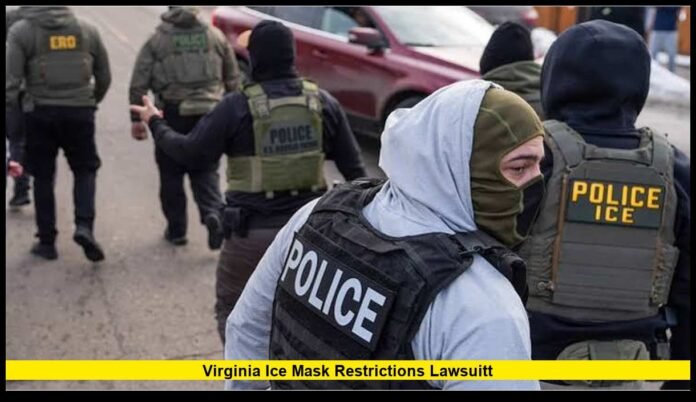

The Virginia ICE mask restrictions lawsuit has quickly become one of the most significant legal disputes involving immigration enforcement, state authority, and constitutional law in the United States. The case has attracted nationwide attention because it raises important questions about whether a state can regulate how federal immigration officers perform their official duties. As the legal battle moves through the federal court system, the outcome could influence immigration enforcement policies, public accountability standards, and the balance of power between state and federal governments for years to come.
The lawsuit comes after Virginia enacted legislation placing restrictions on the use of face coverings by law enforcement officers during official operations. While supporters describe the measure as an effort to increase transparency and public trust, federal officials argue that the law interferes with federal immigration enforcement and violates long-established constitutional principles. The disagreement has created a legal showdown with implications that extend far beyond Virginia.
Why the Case Has Drawn National Attention
Disputes between states and the federal government are not uncommon, but this case stands out because it directly affects the daily operations of federal immigration officers. Immigration enforcement has remained one of the most debated public policy issues in the United States, and this lawsuit adds another chapter to the ongoing conversation.
The controversy also arrives during a period when immigration enforcement practices are receiving increased public scrutiny. Questions about officer identification, transparency during enforcement operations, and public accountability have become central topics in political and legal discussions across the country.
Legal experts believe the decision in this case could become an important precedent that shapes future interactions between state governments and federal agencies.
What Prompted the Lawsuit?
Virginia lawmakers approved legislation that limits when law enforcement officers may wear face coverings while conducting official duties. The law also requires officers to display identifying information during many enforcement actions.
Supporters of the legislation argued that residents should be able to identify officers carrying out law enforcement activities in their communities. According to lawmakers backing the measure, clear identification helps build trust, reduces confusion, and discourages individuals from impersonating law enforcement officers.
Federal officials, however, strongly opposed applying these requirements to federal immigration officers. Shortly before the law took effect, the U.S. Department of Justice filed a lawsuit asking a federal court to block enforcement of the statute against federal personnel.
The federal government argues that Virginia cannot impose criminal penalties or operational requirements on federal officers acting within the scope of their official responsibilities.
Understanding the Main Legal Issues
Although the lawsuit involves immigration enforcement, the central legal questions focus on constitutional authority rather than immigration policy itself.
The dispute asks whether a state government can regulate how federal officers perform duties that have been authorized by federal law.
Federal attorneys maintain that allowing states to impose different operational rules on federal officers would create inconsistent enforcement standards across the country. They argue that federal agencies must be able to establish their own procedures without interference from individual states.
Virginia officials respond that the law is designed to improve transparency and accountability rather than obstruct federal operations.
These competing viewpoints form the heart of the legal battle.
Why Some ICE Officers Wear Face Coverings
One of the most widely discussed aspects of the case involves the use of masks by immigration officers during enforcement operations.
Federal officials explain that face coverings are used for several practical reasons. Officers sometimes participate in operations targeting dangerous criminal organizations, transnational gangs, or individuals with violent criminal histories. In these situations, protecting an officer’s identity may reduce the risk of retaliation against both officers and their families.
Federal agencies also argue that social media has made it easier for individuals to identify officers, publish personal information online, and encourage harassment or threats.
Supporters of allowing masks believe these concerns justify protecting officers’ identities during sensitive operations.
Critics, however, argue that individuals exercising law enforcement authority should generally be identifiable to the public. They believe visible identification increases confidence in law enforcement and helps prevent abuse or misconduct.
These competing priorities—officer safety and public accountability—have become central themes in the lawsuit.
Virginia’s Position
Virginia officials have consistently defended the legislation as a transparency measure.
According to supporters, residents should know who is exercising governmental authority in their communities. When officers display names or identifying information, citizens can more easily report misconduct, verify legitimate law enforcement actions, and distinguish real officers from individuals attempting to impersonate police or federal agents.
State leaders also argue that many local and state police departments already operate under identification requirements without significant operational problems.
From their perspective, requiring visible identification promotes accountability while maintaining public confidence in law enforcement institutions.
Supporters further contend that the law applies broadly rather than targeting a single agency, reflecting a broader policy decision about policing standards within Virginia.
The Federal Government’s Arguments
Federal officials view the issue quite differently.
The Justice Department argues that federal immigration officers operate under federal authority and are governed by federal policies rather than state legislation.
According to federal attorneys, allowing every state to establish separate operational requirements for federal officers would create a patchwork of regulations that could interfere with nationwide law enforcement responsibilities.
The federal government also argues that operational decisions—including protective equipment, officer identification, and tactical procedures—should remain within the authority of federal agencies that possess expertise in immigration enforcement.
Another major concern involves officer safety. Federal officials maintain that forcing officers to reveal their identities during potentially dangerous operations may increase security risks for personnel and their families.
These constitutional and practical concerns form the foundation of the government’s legal challenge.
The Constitutional Questions
Several constitutional principles are expected to play a major role as the lawsuit proceeds.
The Supremacy Clause
The Supremacy Clause establishes that federal law generally takes precedence over conflicting state law.
Federal attorneys argue that because immigration enforcement is a federal responsibility, states cannot impose additional restrictions that interfere with federally authorized activities.
Virginia, however, maintains that its legislation serves legitimate public safety and accountability objectives.
Determining whether these interests conflict with federal authority will likely become one of the court’s central tasks.
Federal Immunity
Another important legal concept involves the doctrine of intergovernmental immunity.
Under this doctrine, states generally may not regulate or penalize federal agencies in ways that interfere with their official functions.
The federal government argues that Virginia’s law effectively attempts to regulate federal officers while they perform federally authorized duties.
Virginia disputes that characterization, arguing the law promotes transparency rather than interfering with enforcement.
The court’s interpretation of these constitutional principles may shape future disputes involving federal agencies operating within individual states.
Broader Implications for Immigration Enforcement
Although the lawsuit specifically concerns Virginia, its impact could extend nationwide.
If the federal government prevails, the ruling could reinforce federal authority over immigration enforcement procedures and limit states’ ability to regulate federal officers.
If Virginia successfully defends its law, other states may consider adopting similar transparency requirements for federal law enforcement personnel operating within their borders.
Either outcome could influence future legislative efforts involving immigration enforcement, law enforcement accountability, and state-federal relations.
Public Debate Surrounding the Case
The lawsuit has generated strong opinions from both supporters and critics.
Supporters of the Virginia law argue that:
- Law enforcement officers exercising governmental authority should be identifiable.
- Transparency helps strengthen public confidence.
- Clear identification discourages impersonation.
- Accountability benefits both officers and the public.
Opponents respond that:
- Officer safety should remain the highest priority.
- Immigration officers frequently face unique security risks.
- Operational decisions should remain under federal control.
- States should not regulate federal law enforcement activities.
Because these concerns involve both constitutional law and public policy, the debate is likely to continue regardless of the eventual court decision.
How the Litigation Could Progress
Legal cases involving constitutional questions often move through multiple stages.
Initially, the court may decide whether to temporarily block enforcement of the law while litigation continues.
Following additional hearings, the court will eventually issue a decision addressing the constitutional issues presented by both sides.
If either party disagrees with the ruling, an appeal could follow.
Given the significance of the legal questions, appellate courts may ultimately determine the outcome.
Some legal observers also believe the dispute could eventually receive review from the U.S. Supreme Court if lower courts issue conflicting interpretations or if the constitutional issues are considered sufficiently important.
Possible Outcomes
Several outcomes remain possible as the litigation continues.
One possibility is that the court concludes Virginia cannot regulate federal officers while they perform official duties. Such a ruling would reinforce federal authority over immigration enforcement operations.
Another possibility is that the court determines Virginia’s transparency requirements are permissible under constitutional principles. This could encourage similar legislation in other states.
A third possibility involves a narrower ruling that addresses only specific portions of the law while allowing others to remain in effect.
Courts sometimes resolve constitutional disputes by limiting rather than completely invalidating legislation.
Why This Case Matters Beyond Virginia
Although the dispute originated in one state, its significance reaches much further.
Federal agencies regularly operate within every state, and disagreements over state authority occasionally arise in areas including environmental regulation, transportation, labor standards, public health, and law enforcement.
A decision defining how much authority states possess over federal officers may influence future disputes involving agencies beyond immigration enforcement.
For that reason, constitutional scholars, policymakers, and legal professionals across the country are closely watching the case.
The Virginia ICE mask restrictions lawsuit represents more than a disagreement over face coverings. It is a test of constitutional boundaries, governmental authority, and the ongoing relationship between state governments and the federal government.
Frequently Asked Questions
What is the Virginia ICE mask restrictions lawsuit about?
The lawsuit challenges a Virginia law that restricts the use of face coverings by many law enforcement officers, including federal immigration officers, while conducting official duties.
Why did the federal government file the lawsuit?
Federal officials argue that states cannot regulate how federal officers perform responsibilities authorized under federal law.
Why does Virginia support the legislation?
Virginia officials say the law promotes transparency, public accountability, and trust by requiring officers to display identifying information during enforcement activities.
Does the case affect only Virginia?
No. Although the law applies within Virginia, the legal principles involved could influence similar disputes and future legislation in other states.
Has the case been resolved?
No. The litigation remains ongoing, and the courts have not yet issued a final decision on the constitutional questions presented.
Final Thoughts
The legal questions raised by this case go well beyond immigration enforcement. They touch on constitutional authority, public accountability, officer safety, and the relationship between state governments and federal agencies. Whatever the final outcome, the decision is expected to become an important legal milestone that may influence future debates over federal law enforcement authority throughout the United States.
As the courts continue examining the issues, policymakers, legal experts, and the public will be watching closely to see how the balance between transparency and federal authority is ultimately defined.