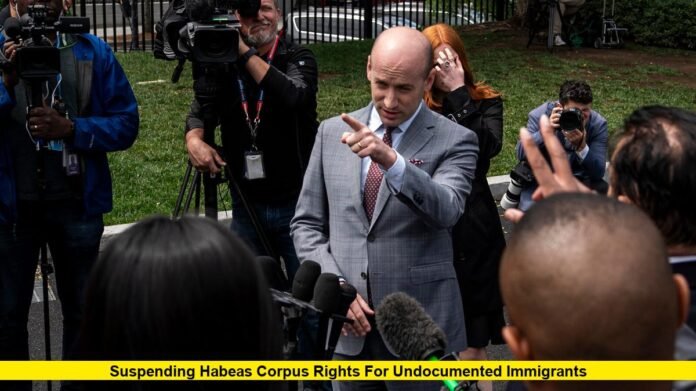

The Trump administration’s approach to immigration enforcement reached a new constitutional frontier in the early months of the president’s second term — one that legal scholars say could fundamentally alter the rights of millions of people living in the United States. According to a report published Monday by The New York Times, White House officials seriously considered suspending habeas corpus rights for undocumented immigrants, a move that would strip detained migrants of their constitutional ability to challenge their imprisonment in court.
What Is Habeas Corpus — and Why Does It Matter?
Habeas corpus, a Latin phrase meaning “you shall have the body,” is one of the oldest and most fundamental legal protections in the Anglo-American legal tradition. As a legal principle, it guarantees that any person detained by the government has the right to appear before a judge and challenge the legality of their imprisonment.
In the United States, this right is enshrined in Article I, Section 9 of the Constitution, which states that the privilege of the writ of habeas corpus “shall not be suspended, unless when in Cases of Rebellion or Invasion the public Safety may require it.” Known as the Suspension Clause, this provision has historically been interpreted to mean that only extraordinary national emergencies can justify removing this protection — and even then, the power to suspend it lies primarily with Congress, not the executive branch.
Legal experts have long described habeas corpus as one of the cornerstones of due process. Without it, the government can detain individuals indefinitely without ever being required to justify that detention to a court.
Stephen Miller’s Bombshell Statement at the White House
The debate over suspending habeas corpus broke into public view on May 9, 2025, when White House Deputy Chief of Staff Stephen Miller made a stunning announcement outside the West Wing. Asked by reporters whether President Trump was weighing a suspension of habeas corpus to handle the immigration situation, Miller confirmed that the option was on the table.
“The Constitution is clear — and that of course is the supreme law of the land — that the privilege of the writ of habeas corpus can be suspended in a time of invasion,” Miller told reporters. “So it’s an option we’re actively looking at. A lot of it depends on whether the courts do the right thing or not.”
Miller’s remarks marked a significant escalation in the administration’s rhetoric, framing the federal judiciary’s rulings against Trump’s deportation agenda as a “judicial coup” — and suggesting that the White House could respond by dismantling one of the most fundamental constitutional protections available to people on American soil.
CNN, citing unnamed sources, separately reported that President Trump himself was personally involved in internal discussions around the habeas corpus suspension.
Why the Administration Was Considering This Step
The Trump administration’s push toward suspending habeas corpus was rooted in a broader and increasingly contentious battle with the federal court system. Throughout early 2025, judges across the country repeatedly blocked key elements of the president’s immigration enforcement agenda.
Among the most prominent setbacks: a federal judge in New York blocked the administration’s invocation of the Alien Enemies Act of 1798, a wartime law the White House had been using to justify the deportation of alleged Venezuelan gang members without formal hearings. While the Supreme Court later allowed limited use of the Act, it also imposed restrictions requiring detainees to have a chance to challenge their deportations.
These judicial interventions frustrated the White House. Trump had argued in an April social media post that giving every immigration detainee a trial would “take, without exaggeration, 200 years.” The administration also contended that the wave of undocumented immigration constituted an “invasion,” a legal framing they argued triggered the Suspension Clause of the Constitution.
The habeas corpus suspension idea was part of a package of aggressive legal options under review as courts continued to stymie deportation efforts.
The Constitutional Debate: Who Can Actually Suspend Habeas Corpus?
One of the central legal controversies surrounding the White House’s consideration of a habeas corpus suspension was a fundamental question: Does the president even have the authority to do it?
The Constitution’s text places the Suspension Clause in Article I — the legislative article — leading most constitutional scholars to argue that only Congress, not the president, has the power to suspend the writ. This position was reinforced during the Civil War when Chief Justice Roger B. Taney ruled that President Lincoln could not unilaterally suspend habeas corpus for civilians, insisting that authority belonged to the legislature.
“Congress has the authority to suspend habeas corpus — not Stephen Miller, not the president,” Democratic attorney Marc Elias told MSNBC in the wake of Miller’s comments.
Hofstra Law School professor Eric Freedman was equally dismissive of the administration’s legal reasoning. “This idea should be taken no more seriously than many political sound bites,” he told Newsweek. “The reason habeas corpus has been celebrated for centuries as the great writ of liberty is that it protects everyone against wrongful imprisonment. It can only be suspended by Congress.”
A Boston University professor similarly told Newsweek that framing illegal immigration as an “invasion” to trigger the Suspension Clause was “absurd,” noting that the occasions for suspension “are vanishingly rare, and essentially only in cases where there is such pervasive violence that it’s, as a practical matter, impossible to get to a judge.”
A Right Suspended Only Four Times in U.S. History
To understand the gravity of what the Trump administration was contemplating, it helps to look at how rarely habeas corpus has ever been suspended in American history. According to the National Constitution Center, it has happened only four times:
1. Andrew Jackson (1814): To protect New Orleans from British invasion during the War of 1812.
2. Abraham Lincoln (1861): Multiple times during the Civil War to detain suspected Confederate sympathizers and spies, though this triggered significant constitutional controversy.
3. Theodore Roosevelt (1905): In two provinces of the Philippines during a rebellion.
4. Franklin D. Roosevelt (1941): In Hawaii following the Japanese attack on Pearl Harbor.
In each prior instance, the suspension was tied to active warfare or the immediate threat of armed conflict. Critics argue that applying the same power to immigration enforcement represents a radical and unprecedented expansion of executive authority.
Republican Reaction: Caution and Deflection
Even within the Republican Party, the idea drew measured responses and public deflection. Senator John Barrasso of Wyoming, appearing on NBC News’ “Meet the Press,” repeatedly dodged questions about whether he would support suspending habeas corpus, ultimately saying he did not believe the matter would come before Congress.
Representative Michael McCaul of Texas, speaking on CBS’s “Face the Nation,” acknowledged the seriousness of the step. “It’s a very extreme measure to take,” McCaul said. “Any person in the United States under the Constitution has due process rights, so I think the courts are going to decide this one.”
The White House declined to offer further comment on the specifics of what was under consideration.
Courts Push Back — and the Legal Battle Escalates Into 2026
The administration’s aggressive detention policies set off a legal firestorm that extended well into 2026. With immigration courts issuing rulings that eliminated or severely limited bond opportunities for detained migrants, thousands of detainees were left with no option but to file habeas corpus petitions in federal court. By early 2026, federal judges were facing more than 30,000 lawsuits from immigrants locked up under the administration’s mass deportation campaign.
According to a February 2026 report, federal judges across the country had largely rejected the administration’s mandatory detention policy, setting the stage for a significant Fifth Circuit Court of Appeals decision that could reshape immigration bond rights on a national level. In April 2026, a federal appeals court ruled that the Trump administration could not jail immigrants without giving them the chance to seek bond, citing “serious constitutional questions” — a ruling widely expected to head toward the Supreme Court.
Legal experts warned that the administration’s refusal to comply with certain court orders was effectively achieving through defiance what a formal suspension of habeas corpus would accomplish through law. “Just Security” editor-in-chief Ryan Goodman called one such ruling “mind-blowing,” arguing it exposed a broader strategy tied to Stephen Miller’s long-stated goal of suspending the right altogether — potentially beginning with undocumented immigrants but not necessarily ending there.
The Broader Stakes: A Constitutional Line in the Sand
The Trump administration’s consideration of suspending habeas corpus rights for undocumented immigrants is not merely an immigration policy debate. Constitutional scholars and civil liberties advocates warn that it raises profound questions about the limits of executive power, the independence of the judiciary, and the durability of rights that have existed in English and American law for centuries.
As federal courts continue to serve as the last line of defense for detained migrants — many of whom have U.S. citizen children, long-standing community ties, and legitimate legal claims — the question of whether those courts will be allowed to function without executive interference remains one of the defining legal battles of the Trump era.
The New York Times’ June 2026 reporting that White House officials had seriously considered this suspension in the administration’s earliest months suggests the idea was far more than political bluster. Whether it resurfaces — in the courts, in Congress, or in a future executive order — remains an open and deeply consequential question.
What do you think — should a president ever have the power to suspend habeas corpus, or is this a constitutional line that must never be crossed? Drop your thoughts in the comments below and follow us for the latest updates.