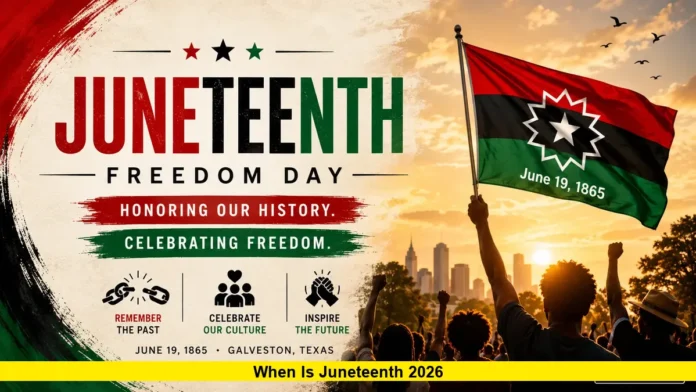

Juneteenth 2026 will be observed on Friday, June 19, commemorating the day in 1865 when enslaved African Americans in Texas learned of their freedom, and it is celebrated across the United States with parades, cultural events, educational programs, music, and community gatherings.
Juneteenth is one of the most historically significant holidays on the American calendar, and in 2026 it falls on a date that gives millions of workers an extended summer weekend. Whether you are planning to attend a local festival, support Black-owned businesses, or simply learn more about this powerful day, here is everything you need to know about Juneteenth 2026.
When Is Juneteenth 2026?
Juneteenth 2026 falls on Friday, June 19, 2026, giving many Americans an extended weekend to take part in celebrations, educational programs, and community events. The holiday is observed on the same date every year—June 19—and commemorates the day in 1865 when enslaved African Americans in Texas learned they were free, more than two years after the Emancipation Proclamation. Because the holiday falls on a Friday in 2026, many people may use the long weekend for travel, family gatherings, cultural festivals, historical observances, and volunteer activities. Communities across the United States are expected to host events recognizing the significance and legacy of Juneteenth.
Is Juneteenth a Federal Holiday in 2026?
Yes, Juneteenth is a fully recognized federal holiday in 2026 and will be observed nationwide on Friday, June 19. The holiday commemorates the end of slavery in the United States and honors the day when enslaved African Americans in Texas learned of their freedom in 1865. Juneteenth became a federal holiday after President Joe Biden signed the Juneteenth National Independence Day Act into law on June 17, 2021. The legislation made Juneteenth the first new federal holiday established since Martin Luther King Jr. Day was created in 1983.
As a federal holiday, Juneteenth is included on the official U.S. federal holiday calendar alongside other major observances such as Memorial Day, Independence Day, and Labor Day. Most federal government offices are closed, and federal employees generally receive a paid day off. Many banks, financial institutions, and businesses may also adjust their schedules in recognition of the holiday.
Since gaining federal recognition, Juneteenth has continued to grow in prominence across the country, with communities hosting educational programs, cultural celebrations, parades, concerts, and events that reflect on the history of emancipation and the ongoing pursuit of equality and civil rights in the United States.
What Is Juneteenth? The History Behind the Holiday
Juneteenth is a holiday that commemorates the end of slavery in the United States and marks one of the most significant moments in American history. Observed annually on June 19, the holiday traces its origins to events that unfolded in Texas at the end of the Civil War.
To understand why June 19 holds such importance, it is necessary to look back to 1865. Although President Abraham Lincoln issued the Emancipation Proclamation on January 1, 1863, declaring enslaved people in Confederate states to be free, enforcement depended on the advance of Union troops. In many parts of the Deep South, slavery continued because federal authorities lacked the military presence needed to implement the proclamation.
That changed on June 19, 1865, when Gordon Granger arrived in Galveston with Union forces and issued General Order No. 3. The order informed enslaved African Americans in Texas that they were free and that the relationship between enslavers and the enslaved had legally ended. For approximately 250,000 enslaved people living in Texas, this announcement represented the first practical realization of freedom and equality under the law.
The historic event quickly became a reason for annual remembrance. In 1866, formerly enslaved communities organized some of the first Juneteenth celebrations. These gatherings featured prayer services, music, family reunions, educational activities, and public readings of the Emancipation Proclamation. The celebrations also served as opportunities for communities to preserve their history and honor those who endured slavery.
Despite facing segregation, discrimination, and limited access to public spaces, Black communities continued observing Juneteenth throughout the late nineteenth and twentieth centuries. When public venues were unavailable, celebrations often took place in churches, community centers, and privately owned land purchased specifically for Juneteenth events.
The holiday gained renewed national attention during the Civil Rights Movement. In 1968, the Poor People’s Campaign organized a Solidarity Day gathering in Washington, D.C., on June 19, introducing many Americans outside Texas to the significance of Juneteenth. Recognition continued to grow in subsequent decades, and in 1980, Texas became the first state to officially recognize Juneteenth as a state holiday.
Over time, additional states adopted formal observances, and public awareness expanded nationwide. Today, Juneteenth stands as a celebration of freedom, resilience, and progress while also serving as an opportunity to reflect on the history of slavery and the ongoing pursuit of equality in the United States. More than 160 years after the events in Galveston, the holiday remains an important reminder of a pivotal chapter in American history.
Read Also-Kroger Juneteenth Cakes Spark Controversy in 2025
Why Is Juneteenth Called Freedom Day?
Juneteenth is often referred to as Freedom Day because it commemorates the moment when enslaved African Americans in Texas finally learned that they were free. On June 19, 1865, Union troops arrived in Galveston, Texas, and announced that slavery had ended, bringing freedom to approximately 250,000 enslaved people who had remained in bondage despite the issuance of the Emancipation Proclamation more than two years earlier. For many families, this date represented the first tangible realization of liberty, making “Freedom Day” one of the most meaningful names associated with the holiday.
Over the years, Juneteenth has become known by several other names, including Liberation Day, Jubilee Day, and Emancipation Day. Each title highlights a different aspect of the holiday’s significance, but all emphasize the end of slavery and the celebration of freedom. Some people also refer to Juneteenth as Black Independence Day, reflecting the belief that the promise of American independence was not fully realized until freedom reached all people living in the United States.
Symbols associated with Juneteenth further reinforce its message. One of the most recognizable is the Juneteenth flag, created in 1997 by activist Ben Haith and collaborators. The flag features red, white, and blue—the colors of the American flag—to emphasize that African Americans are an inseparable part of the nation’s history and identity. Its design includes a bursting star, symbolizing a new beginning and the spread of freedom across the country.
In 2007, the date June 19, 1865 was added to the flag, permanently linking it to the historic day when freedom was formally announced in Texas. Today, the flag is displayed at parades, festivals, educational events, and commemorative ceremonies across the United States, serving as a powerful reminder of resilience, progress, and the enduring importance of freedom.
Which States Recognize Juneteenth as a Legal Holiday in 2026?
As of 2026, Juneteenth is recognized across the United States as a federal holiday, and a growing number of states have also granted it official status as a legal state holiday. More than 30 states, along with Washington, D.C., provide state employees with a paid day off to observe Juneteenth, reflecting the holiday’s increasing importance in public life and civic education.
Several states have gone beyond symbolic recognition by establishing Juneteenth as a permanent legal holiday through state legislation. States such as Massachusetts, New Jersey, New York, and Virginia officially recognize Juneteenth as a paid state holiday, allowing most government offices to close and enabling state employees to participate in commemorative events and community activities.
Other states have adopted alternative approaches. For example, New Mexico, Kansas, and Kentucky provide paid leave or holiday benefits to state employees even though Juneteenth may not be formally designated as a permanent legal holiday under state law. These policies ensure that workers can observe the day while state governments continue evaluating long-term holiday legislation.
In California, legislation enacted in 2022 expanded recognition of Juneteenth by allowing eligible state employees to use the day as a paid personal holiday. This approach gives workers flexibility while acknowledging the significance of the occasion.
The continued expansion of state-level recognition demonstrates how Juneteenth has evolved from a regional commemoration into a widely observed national holiday. As awareness of the holiday’s history and meaning has grown, more states have taken steps to honor June 19 through official observances, educational programs, and paid leave policies. These efforts underscore the importance of remembering the end of slavery and celebrating the ongoing pursuit of freedom, equality, and civil rights in the United States.
What Is Open and Closed on Juneteenth 2026?
Because Juneteenth is a federal holiday, many government agencies, financial institutions, and public services operate on modified schedules. In 2026, Juneteenth falls on Friday, June 19, creating a long weekend for many Americans. While some services will pause operations for the day, many businesses and essential services will continue functioning normally.
Federal Offices and Government Agencies
All federal government offices are closed on Juneteenth. Federal employees receive a paid holiday, and most government services that require in-person visits will not be available until the next business day. In addition, many state and local government offices may also close depending on state laws and local observance policies.
Banks and Financial Services
Most major banks observe Juneteenth as a federal banking holiday. Institutions such as JPMorgan Chase, Bank of America, and Wells Fargo typically close their branch locations for the day. However, customers can still access online banking platforms, mobile banking apps, and ATMs for routine transactions, account monitoring, and cash withdrawals.
U.S. Postal Service and Package Delivery
The United States Postal Service does not deliver regular mail on federal holidays, including Juneteenth. Most post offices are closed, and mail processing is suspended until the next business day. Private carriers such as UPS and FedEx may continue operations, although some services could operate on modified schedules.
Stock Markets
Financial markets also observe the holiday. Both the New York Stock Exchange and Nasdaq are expected to be closed on June 19, 2026. As a result, no regular stock trading takes place during the holiday.
Schools and Educational Institutions
By mid-June, many schools across the United States have already begun summer vacation. However, school calendars vary by district and state. Educational institutions that remain in session may close for the holiday or hold special programs focused on the history and significance of Juneteenth.
Retail Stores, Grocery Stores, and Restaurants
Unlike federal offices and banks, most retail stores, supermarkets, pharmacies, shopping malls, and restaurants remain open on Juneteenth. Some businesses may adjust their operating hours or host special holiday promotions and community events. Consumers are encouraged to verify local store hours before visiting.
Essential Services Remain Available
Hospitals, emergency medical services, police departments, fire departments, and other critical public safety agencies continue operating throughout the holiday. Public transportation systems may run on reduced or holiday schedules depending on the city.
Overall, Juneteenth 2026 will bring closures for government offices, banks, postal services, and financial markets, while most retail businesses, restaurants, and essential services remain open. The holiday also provides an opportunity for communities nationwide to participate in celebrations, educational programs, cultural festivals, and events honoring the history of freedom and emancipation in the United States.
How Is Juneteenth 2026 Being Celebrated?
Juneteenth 2026 is expected to draw millions of participants to events across the country. Because the holiday falls on a Friday, many communities have planned multi-day celebrations spanning the full weekend.
Community festivals and parades: Major cities host large-scale Juneteenth festivals featuring live music, vendor markets, art, and children’s activities. Galveston, Texas, which played a central role in the holiday’s history, continues to host events of particular historical significance.
Music and cultural performances: Gospel, jazz, blues, and R&B are central to Juneteenth celebrations. Parks and outdoor stages host live performances throughout the weekend in cities nationwide.
Food and cookouts: Community cookouts are one of the most beloved Juneteenth traditions. Red foods — including red velvet cake, strawberry soda, and hibiscus drinks — hold special cultural significance and are featured prominently at gatherings. Soul food and barbecue remain central to the celebration.
Educational programming: Museums, libraries, cultural institutions, and universities host lectures, film screenings, and exhibitions that explore African American history and the meaning of Juneteenth. The holiday serves as a powerful opportunity for education across generations.
Supporting Black-owned businesses: Many people choose to honor Juneteenth by intentionally shopping at and dining with Black-owned businesses. This practice has become a meaningful way to combine cultural celebration with economic empowerment.
Historical site visits: The extended weekend gives families an opportunity to visit African American historical sites, museums, and landmarks that tell the broader story of the struggle for freedom and equality in America.
Why Juneteenth 2026 Matters
More than 160 years after the events in Galveston, Juneteenth continues to grow in national and global significance. Since becoming a federal holiday in 2021, participation in Juneteenth observances has expanded dramatically. Schools, businesses, civic organizations, and government agencies across the country now recognize the day as both a celebration of freedom and a call to continue the work of racial equity and justice.
The holiday holds both joy and gravity at once. It honors how far the United States has come while honestly acknowledging how much further the country has yet to go. Juneteenth serves as a bridge between the past and the present, connecting the history of emancipation with ongoing conversations about equality, community, and the meaning of American freedom.
As the UW Combined Fund Drive noted in 2026, Juneteenth is both a celebration and a call to action — and that dual purpose is what gives the holiday its enduring power.
Frequently Asked Questions About Juneteenth 2026
Q: When is Juneteenth 2026? A: Juneteenth 2026 is on Friday, June 19, 2026.
Q: Is Juneteenth a federal holiday in 2026? A: Yes. Juneteenth has been a U.S. federal holiday since 2021 and is fully observed in 2026. Federal employees receive a paid day off on June 19.
Q: What does Juneteenth celebrate? A: Juneteenth commemorates June 19, 1865, when Union soldiers arrived in Galveston, Texas, and announced the end of slavery — more than two years after the Emancipation Proclamation was signed.
Q: Will banks be closed on Juneteenth 2026? A: Most major banks close on Juneteenth since it is a federal holiday. ATMs and online banking services remain accessible.
Q: Does USPS deliver mail on Juneteenth 2026? A: No. The U.S. Postal Service does not deliver mail on federal holidays. Mail service resumes on Saturday, June 20.
Q: How many states recognize Juneteenth as a legal holiday in 2026? A: More than 30 states plus Washington, D.C., recognize Juneteenth as a permanent legal holiday with paid time off for most state government employees as of June 2026.
Q: Is the stock market open on Juneteenth 2026? A: No. Both the New York Stock Exchange and Nasdaq are closed on Juneteenth.
Q: How can I celebrate Juneteenth 2026? A: You can attend local festivals, cookouts, or cultural events; support Black-owned businesses; visit African American historical sites; or engage with educational programming offered by museums and libraries in your area.
Whether you are marking the day with community, reflection, or celebration, Juneteenth 2026 is your chance to connect with one of America’s most meaningful holidays — drop a comment below to share how you plan to honor Freedom Day this June 19!