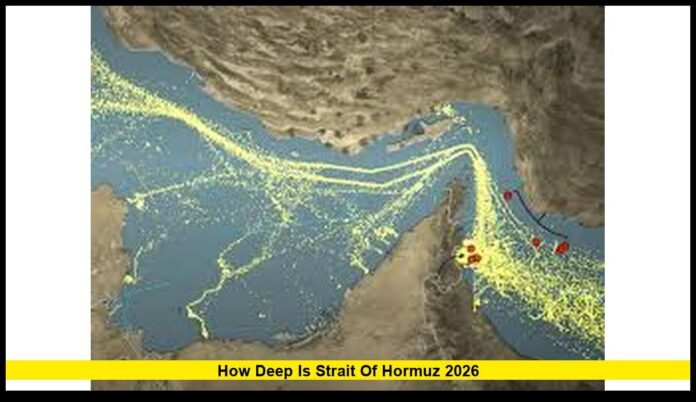

The question how deep is strait of hormuz has become increasingly relevant as global attention intensifies around this narrow yet powerful maritime corridor. As tensions, military patrols, and economic concerns converge in the region, understanding the physical depth of the strait offers critical insight into why it remains one of the most strategically important waterways on the planet.
This is more than a matter of geography. The depth of the Strait of Hormuz directly affects how oil tankers move, how naval forces operate, and how global markets respond during periods of instability.
Why the Strait of Hormuz Holds Global Importance
The Strait of Hormuz connects the Persian Gulf to the Gulf of Oman and the Arabian Sea. It serves as the primary export route for oil-producing nations in the region, making it a vital artery for the global energy system.
Every day, millions of barrels of crude oil and petroleum products pass through this corridor. A significant portion of the world’s liquefied natural gas shipments also relies on this route.
Because of its central role, even small disruptions can trigger:
- Rapid increases in oil prices
- Supply shortages in energy-importing countries
- Higher transportation costs
- Inflationary pressure across multiple industries
This is why governments, energy companies, and financial markets closely monitor any development in this region.
Understanding the Depth of the Strait
To answer the core question, the Strait of Hormuz is generally deep enough to support large-scale maritime traffic, but its depth varies significantly across different sections.
On average, the strait ranges between 60 and 100 meters (approximately 200 to 330 feet) in depth. However, certain areas extend deeper, while others are relatively shallow compared to the main shipping routes.
The most important factor is not just the overall depth, but where that depth is located.
Shipping lanes are carefully positioned in the deepest parts of the strait to allow safe passage for large vessels. These routes are continuously monitored and maintained to ensure that ships can navigate without risk of grounding.
Why Depth Is Critical for Modern Tankers
The global oil trade depends heavily on massive vessels known as supertankers. These ships are designed to carry enormous quantities of crude oil, but they also require deep water to operate safely.
Fully loaded, some of these tankers can draw more than 20 meters of water beneath them. This means:
- Only specific sections of the strait can accommodate them
- Navigation must follow strict, predefined routes
- Even minor obstructions can create major disruptions
The Strait of Hormuz is one of the few locations where such large vessels can pass efficiently between major oil-producing regions and global markets.
Narrow Lanes, Deep Channels: A Unique Structure
While the overall width of the Strait of Hormuz is relatively broad, the actual usable space for large ships is limited.
At its narrowest point, the strait is about 21 miles wide. However, the designated shipping lanes are much narrower, typically only a few miles across.
These lanes are divided into:
- One channel for inbound traffic
- One channel for outbound traffic
- A buffer zone separating the two
Each lane is positioned in the deepest part of the strait, ensuring that large vessels can pass safely.
This combination of limited width and specific depth requirements creates a natural bottleneck, making the strait both efficient and vulnerable.
How Geography Influences Global Risk
The physical layout of the Strait of Hormuz makes it highly sensitive to disruption.
Because ships must travel through narrow, depth-specific channels:
- Any obstruction can affect multiple vessels
- Traffic can slow down quickly
- Delays can ripple across global supply chains
Natural factors such as currents and seabed conditions also play a role, but human activity has the most immediate impact.
Military presence, patrol operations, and heightened security measures can all influence how ships move through the region.
Recent Developments Elevate the Stakes
In 2026, increased military activity and heightened tensions have brought renewed focus to the Strait of Hormuz.
Naval forces are actively operating in the region, conducting patrols and monitoring vessel movement. These activities are aimed at maintaining navigation safety while addressing security concerns.
At the same time, shipping companies are adjusting routes, increasing security measures, and preparing for potential disruptions.
These developments highlight how quickly conditions in the strait can change—and how those changes can impact the global economy.
Economic Impact of a Depth-Dependent Chokepoint
The global economy is closely tied to the smooth operation of the Strait of Hormuz.
Because such a large volume of oil flows through a limited and depth-dependent area:
- Prices react immediately to any perceived risk
- Energy markets become highly volatile
- Supply chains face sudden pressure
When uncertainty increases, traders often respond by driving prices higher, reflecting concerns about future supply.
This, in turn, affects consumers, businesses, and governments around the world.
Why Closing the Strait Is Difficult but Disruption Is Easy
Despite frequent concerns about potential closures, completely blocking the Strait of Hormuz is extremely challenging.
The depth and size of the waterway make it difficult to shut down entirely. However, that does not mean it is immune to disruption.
Because ships rely on specific lanes:
- Targeted interference can slow or redirect traffic
- Increased risk can discourage shipping activity
- Insurance and operational costs can rise sharply
This creates a situation where even limited disruptions can have outsized effects on global markets.
The Role of Depth in Military Strategy
The depth of the strait is also a critical factor in military planning.
Naval forces must consider:
- Submarine operations in deeper waters
- Mine detection and removal
- Maneuvering large vessels in confined spaces
- Maintaining surveillance over key routes
The combination of deep water and narrow lanes creates a complex environment where strategic positioning is essential.
Control over key areas of the strait can influence both security outcomes and economic stability.
Environmental Considerations and Risks
The high volume of traffic in the Strait of Hormuz increases the risk of environmental incidents.
Depth plays a role in how such incidents unfold. In deeper areas, oil spills can spread differently, complicating containment and cleanup efforts.
Other risks include:
- Collisions in narrow shipping lanes
- Mechanical failures in high-traffic zones
- Delays in emergency response
These challenges make safety protocols and monitoring systems essential for maintaining stability in the region.
Regional Geography and Strategic Location
The Strait of Hormuz sits between Iran to the north and Oman to the south, with the United Arab Emirates located nearby.
Its geographic position makes it the gateway for energy exports from several major producers. Without this route, global oil distribution would face significant challenges.
Alternative routes exist, but they lack the capacity to fully replace the volume handled by the strait.
This reinforces its importance as a central hub in the global energy network.
Why This Question Matters More Than Ever
The question how deep is strait of hormuz is not just about numbers—it is about understanding how geography shapes global events.
The depth of the strait influences:
- The movement of oil and gas
- The behavior of global markets
- The strategies of military forces
- The stability of international trade
As developments continue to unfold in 2026, these factors are playing a direct role in shaping outcomes that affect millions of people worldwide.
Conclusion
The Strait of Hormuz remains one of the most critical and closely watched waterways on Earth. Its depth, combined with its narrow shipping lanes and strategic location, gives it an outsized influence on global energy, trade, and security.
Understanding its physical characteristics provides valuable insight into why this region continues to command global attention.
As economic and geopolitical pressures evolve, the importance of this narrow passage will only continue to grow.
What are your thoughts on the global impact of this vital waterway? Share your perspective and stay tuned for more updates.