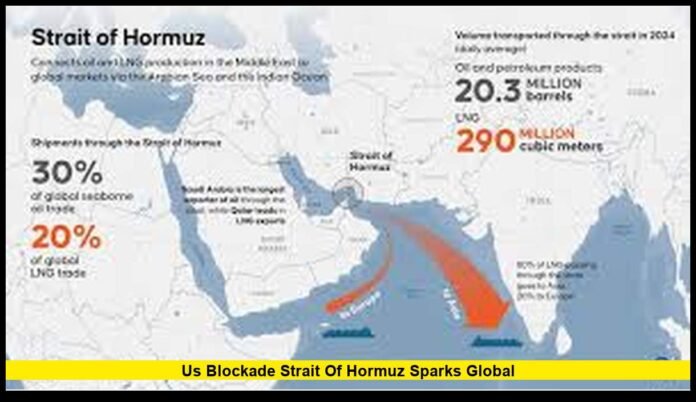

The unfolding situation surrounding the us blockade strait of hormuz has rapidly become one of the most consequential global developments of 2026. With the United States moving to restrict access to one of the world’s most vital maritime corridors, the impact is already rippling across energy markets, international trade routes, and geopolitical alliances.
What began as a high-stakes diplomatic standoff has now evolved into a direct show of military and economic power, placing the global economy on edge and raising urgent questions about what comes next.
A Strategic Waterway at the Center of Global Trade
The Strait of Hormuz is a narrow passage connecting the Persian Gulf to the open ocean, but its significance far outweighs its size.
Every day, millions of barrels of oil pass through this route, supplying major economies across Asia, Europe, and North America. The waterway also serves as a critical transit point for liquefied natural gas and other essential commodities.
Even minor disruptions in this corridor can lead to:
- Immediate spikes in global oil prices
- Supply shortages in energy-dependent countries
- Increased shipping costs
- Market instability across multiple sectors
With a blockade now in place, the stakes have escalated dramatically.
How the Situation Reached a Breaking Point
Tensions had been building for months before this latest escalation.
Negotiations between U.S. and Iranian officials intensified in recent weeks, focusing on key issues such as nuclear activity, maritime security, and control over shipping routes. Despite prolonged discussions, the talks ended without agreement.
A major sticking point involved the regulation of commercial vessels passing through the strait. Reports indicated that ships were being subjected to new restrictions and financial demands, prompting strong opposition from U.S. officials.
Following the collapse of negotiations, the United States announced a decisive shift in strategy—moving from deterrence to enforcement.
The blockade aims to:
- Prevent unauthorized control over international waters
- Maintain open and secure shipping lanes
- Counter perceived threats to global commerce
This decision marks one of the most significant military actions in the region in recent years.
👉 Follow along as we break down what this means for energy prices, global security, and everyday costs in the U.S.
Military Operations Expand in the Gulf
The implementation of the blockade has been accompanied by a visible increase in military activity.
U.S. naval forces are now actively monitoring and controlling access points within the Strait of Hormuz. Operations include:
- Continuous surveillance of maritime traffic
- Strategic positioning of naval vessels
- Mine detection and clearance efforts
- Interception of ships under certain conditions
These measures are designed to enforce the blockade while maintaining safety in one of the busiest shipping lanes in the world.
The presence of military assets has also heightened tensions, with the risk of miscalculation or confrontation remaining a serious concern.
Immediate Shockwaves in Global Oil Markets
Energy markets reacted swiftly to the news.
Within hours of the blockade announcement, oil prices surged as traders anticipated supply disruptions. The uncertainty surrounding access to the strait has made it difficult for buyers and sellers to plan shipments, increasing volatility across the market.
Key developments include:
- Sharp increases in short-term oil contract prices
- Reduced availability of tanker shipments
- Higher insurance costs for vessels operating near the region
- Increased competition for alternative supply routes
Because such a large share of global oil exports depends on this single passage, even temporary restrictions can have outsized effects.
Rising Fuel Costs in the United States
American consumers are already experiencing the consequences.
As oil prices climb, gasoline prices are following suit. In several regions, drivers are seeing noticeable increases at the pump, adding pressure to household budgets.
Beyond fuel, higher energy costs are influencing:
- Transportation expenses
- Food prices due to increased shipping costs
- Airline ticket prices
- Manufacturing and production costs
Inflation concerns are once again taking center stage, with energy playing a key role in shaping broader economic trends.
Shipping Industry Faces Unprecedented Challenges
For global shipping companies, the blockade has introduced a new level of uncertainty.
Many operators are adjusting their strategies in real time, including:
- Rerouting vessels to avoid high-risk areas
- Delaying departures until conditions stabilize
- Paying elevated insurance premiums
- Reducing cargo volumes to limit exposure
Even with these adjustments, the flow of goods has slowed, affecting industries that rely on timely deliveries.
The Strait of Hormuz is not just an energy corridor—it is a critical link in global supply chains.
Geopolitical Tensions Intensify Across the Region
The blockade has further strained relations between the United States and Iran, with both sides maintaining firm positions.
Iran has indicated that it will not accept external control over access to the strait and continues to assert its influence in the region. This has added another layer of complexity to an already volatile situation.
Regional dynamics are also shifting, as neighboring countries monitor developments closely. Many nations depend on the uninterrupted flow of oil through the strait and are now reassessing their economic and security strategies.
The potential for broader escalation remains a key concern for global leaders.
Economic Ripple Effects Beyond Energy
While oil markets are at the forefront, the broader economic impact is equally significant.
The us blockade strait of hormuz is influencing multiple sectors worldwide, including:
- Manufacturing, due to rising input costs
- Retail, as shipping delays affect inventory
- Agriculture, where fuel costs impact production and transport
- Financial markets, with increased volatility and uncertainty
Countries heavily dependent on imported energy are particularly vulnerable, facing challenges in maintaining stable supply levels.
Businesses are also preparing for prolonged disruption, adjusting forecasts and operational plans accordingly.
Why the Strait’s Stability Is Critical
The Strait of Hormuz has long been recognized as one of the most sensitive points in the global economy.
Its importance lies not only in the volume of resources that pass through it but also in its lack of viable alternatives. While some pipelines and alternative routes exist, they cannot fully replace the capacity of the strait.
This makes any disruption—especially one involving military action—a matter of global concern.
Maintaining stability in this region is essential for:
- Energy security
- Economic growth
- International trade
- Geopolitical balance
The current situation underscores how quickly that stability can be challenged.
What to Watch in the Coming Days
As events continue to unfold, several key factors will shape the trajectory of the crisis:
- Whether diplomatic efforts resume
- The duration and scope of the blockade
- Responses from major global economies
- Adjustments in oil production by key exporters
Each of these elements will play a role in determining how long the disruption lasts and how severe its impact becomes.
Implications for U.S. Policy and Strategy
For the United States, the decision to enforce a blockade reflects broader strategic priorities.
These include:
- Protecting international shipping routes
- Ensuring stability in global energy markets
- Countering regional threats
- Maintaining influence in a critical geopolitical region
While the U.S. is less dependent on oil passing through the Strait of Hormuz than some other countries, it remains deeply connected to global market dynamics.
Any disruption in supply affects prices, trade, and economic stability at home.
A Defining Moment for Global Markets
This development represents more than a regional conflict—it is a defining moment for the global economy.
The interconnected nature of modern markets means that events in one part of the world can quickly impact consumers and businesses everywhere.
From rising gas prices in the United States to supply challenges in Asia and Europe, the effects of the blockade are already being felt.
Conclusion
The situation surrounding the Strait of Hormuz is evolving rapidly, with significant implications for energy markets, international relations, and everyday life.
As military operations continue and global markets react, the world is entering a period of heightened uncertainty.
For consumers, businesses, and policymakers alike, the coming days will be critical in determining how this crisis unfolds—and how far its impact will reach.
What are your thoughts on how this could affect fuel prices and global stability? Share your perspective and keep checking back for the latest developments.