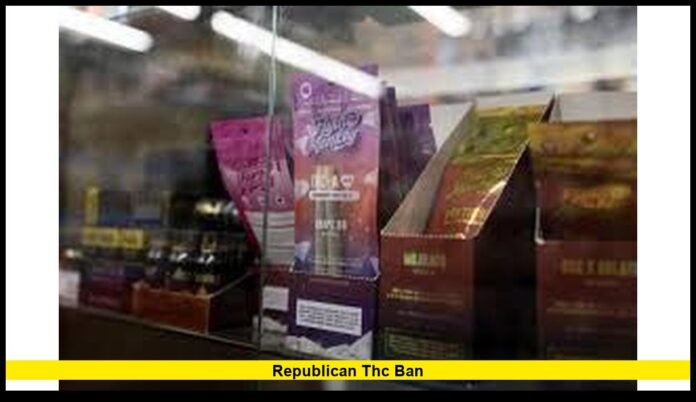

A sweeping Republican THC ban initiative is sending shockwaves through the American hemp and cannabis sectors, marking one of the most significant shifts in federal drug and agricultural policy since the 2018 Farm Bill. The proposal, tucked into a key federal spending package, seeks to outlaw most hemp-derived THC products—including delta-8 THC, THCA flower, and other cannabinoids that have surged in popularity across the nation.
The move has created an intense debate within Congress, especially among Republican lawmakers, as it pits public safety and regulation advocates against hemp farmers, business owners, and consumers who depend on this fast-growing market.
A Turning Point in Federal Hemp Regulation
Since the legalization of hemp in 2018, hemp-derived THC products have occupied a gray legal space—technically legal under federal law but psychoactive enough to compete with regulated marijuana. These products are now widely sold in gas stations, convenience stores, and online retailers, often marketed as “legal highs.”
Republican lawmakers argue that this unregulated expansion has gone too far. The new legislation would redefine hemp to mean any cannabis plant and derivative containing no more than 0.3% total THC on a dry-weight basis. That small adjustment would make nearly all intoxicating hemp products federally illegal, closing what many describe as the “Farm Bill loophole.”
Supporters of the measure say the ban is about protecting consumers, especially minors, from untested, high-potency hemp products that mimic marijuana but fall outside regulated systems. Critics, however, call it an economic disaster in the making—one that could wipe out an entire industry almost overnight.
Deep Republican Divisions Over the THC Ban
While the proposal has been labeled a Republican THC ban, the GOP itself is far from united.
Senate Minority Leader Mitch McConnell, who played a leading role in writing the original 2018 Farm Bill, supports the crackdown. He argues that intoxicating hemp derivatives were never meant to be part of federal hemp legalization and that the loophole needs to be closed to preserve the “integrity” of the hemp industry.
In stark contrast, Senator Rand Paul, also from Kentucky, has fiercely opposed the measure. He’s warned that the bill would “destroy” the livelihoods of thousands of American farmers and small business owners who followed federal guidance when entering the hemp market. Paul has called for regulation, not prohibition—urging lawmakers to create age restrictions and product testing requirements instead of an outright ban.
The disagreement between McConnell and Paul reflects a broader rift in the Republican Party: one faction sees the ban as a necessary public safety measure, while another views it as government overreach that undermines free enterprise and rural economies.
Impact on Hemp Farmers and Small Businesses
If passed, the Republican THC ban would hit hemp producers and retailers hardest. The hemp-derived THC sector has become a vital lifeline for thousands of small farms and independent shops across the country, particularly in states like Kentucky, Tennessee, Texas, and Minnesota.
- Hemp farmers: Many growers have shifted from CBD and fiber production to cultivating high-THCA hemp strains—plants that test below the 0.3% limit while growing but convert into potent THC when smoked. Under the new definition, these crops would become illegal, forcing farmers to destroy or repurpose their plants.
- Retailers: Small stores and vape shops that rely on delta-8 gummies, hemp flower, and infused beverages could lose a major portion of their sales. Many business owners warn of layoffs, closures, and bankruptcy if the law passes.
- Consumers: Millions of Americans who use hemp-derived THC products for stress, pain relief, or recreational use would suddenly find themselves without legal options.
This disruption could ripple through rural economies, eliminating jobs, slashing tax revenue, and pushing more people toward the illicit market.
Economic Stakes of the Republican THC Ban
The hemp-derived THC market has exploded over the past three years, generating billions in annual revenue and supporting tens of thousands of jobs nationwide. Analysts estimate that nearly 90% of hemp businesses now depend, at least partially, on products that would fall under the ban.
A total prohibition could:
- Reduce the overall U.S. hemp market value by more than half.
- Cause large-scale crop destruction, as existing hemp fields may exceed new THC limits.
- Force farmers to revert to low-profit industrial hemp cultivation.
- Shift consumer spending back toward state-regulated cannabis markets or illegal sellers.
While some Republicans argue this economic loss is necessary to protect public health, industry experts warn it could lead to another agricultural collapse, similar to what many farmers faced when CBD prices plummeted in 2020.
Why Republican Lawmakers Are Driving the Ban
Supporters of the Republican THC ban cite several motivations:
- Youth safety concerns: Hemp-derived THC products are often sold in candy or drink form, attracting underage users.
- Regulatory confusion: The current hemp laws make it difficult to distinguish legal hemp from illegal marijuana, creating enforcement challenges for law enforcement.
- Pressure from other industries: The regulated cannabis and alcohol sectors have lobbied for tighter restrictions, arguing that hemp-derived THC competes unfairly without paying the same taxes or meeting safety standards.
- Political optics: Some Republican strategists believe that taking a firm stance on THC aligns with conservative voters’ priorities on family and community safety.
Critics Say It’s an Overreach
Opponents of the proposed ban believe Congress is overstepping and punishing an entire industry instead of implementing smarter regulation. They argue the law would:
- Punish law-abiding farmers who grew hemp under federal licenses.
- Kill small businesses while benefiting large corporate cannabis producers who can afford to comply with new restrictions.
- Hurt rural communities, many of which have invested heavily in hemp production infrastructure.
- Push consumers to unregulated markets, where safety and quality control are nonexistent.
These critics suggest a better path forward would include national standards for product testing, age limits, labeling requirements, and dosage restrictions—approaches already implemented successfully by some states.
States Bracing for Federal Fallout
States with large hemp industries are closely watching the debate unfold.
- Kentucky, once a pioneer in hemp production, stands to lose millions if its farmers can no longer sell hemp flower or delta-8 products.
- Texas, which fought off its own statewide hemp ban earlier this year, may see federal law override its local policies.
- Minnesota and Florida, both of which recently passed laws to regulate rather than ban hemp-derived THC, could face direct conflict with federal enforcement.
Many states are expected to challenge the ban if it becomes law, arguing that it violates states’ rights to regulate their own hemp and cannabis industries.
The Legislative Road Ahead
The Senate has already passed the spending bill containing the ban language. The measure now heads to the House of Representatives, where the vote is expected to be close. If the House approves it and the President signs it into law, the THC restrictions will take effect one year later—giving businesses only a limited time to adapt.
Some lawmakers are working behind the scenes to propose amendments that could soften the blow, such as:
- Exempting certain hemp products that test below a set potency limit.
- Allowing medical or research exceptions.
- Providing federal grants to help hemp farmers transition to compliant crops.
However, with the provision tied to essential government funding, few expect it to be removed completely.
Industry Preparing for Major Transition
Across the country, hemp businesses are bracing for change. Manufacturers are already exploring non-intoxicating cannabinoids such as CBD, CBG, and CBN as alternative product lines. Others are shifting toward industrial hemp, fiber production, or even exporting to markets outside the United States.
Legal experts expect several lawsuits if the law passes, particularly from hemp associations claiming the measure exceeds Congress’s intent under the 2018 Farm Bill. Until then, many farmers and retailers are stockpiling products, restructuring supply chains, or planning layoffs in anticipation of the new rules.
Consumer Impact: A Shrinking Market for Hemp THC
For everyday consumers, the Republican THC ban could mean the disappearance of many popular hemp-based items found in gas stations and vape shops—gummies, pre-rolls, oils, and beverages that provide mild intoxication.
Without clear federal guidance on alternatives, consumers may face higher prices or limited access to THC altogether. This could drive a new wave of demand toward state-regulated marijuana dispensaries, where legal cannabis is heavily taxed but more consistently tested and labeled.
Conclusion
The Republican THC ban marks a pivotal moment for America’s evolving relationship with hemp and cannabis. What began as a loophole in the 2018 Farm Bill has grown into a billion-dollar market now on the brink of federal prohibition. Whether this move will protect public safety or cripple an emerging industry remains to be seen.
As the debate continues, farmers, business owners, and consumers across the country are waiting anxiously for Congress’s final decision—one that could redefine the future of hemp in the United States.
What are your thoughts on the potential ban? Do you believe it safeguards the public or hurts small business owners? Share your perspective below and join the discussion.