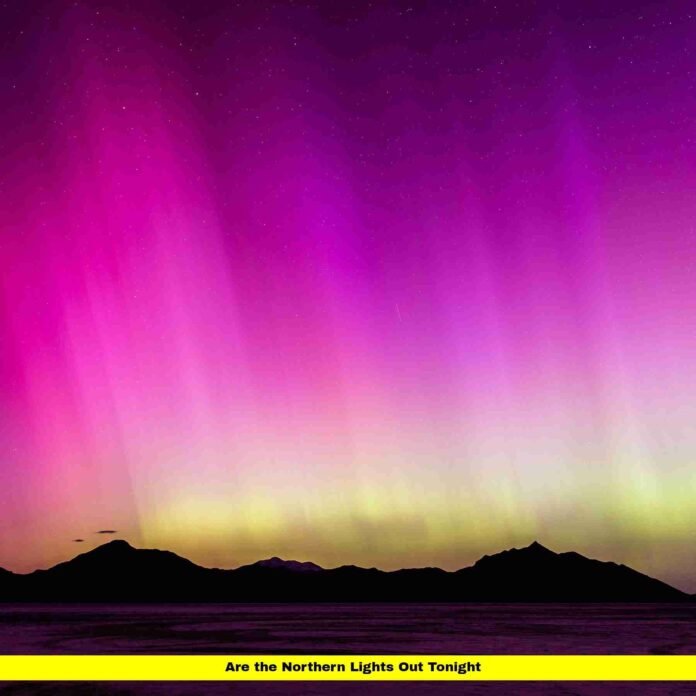

If you’re wondering “are the northern lights out tonight”, the answer is yes — there’s a high chance of auroral activity visible across parts of North America and Europe. Increased solar wind and geomagnetic activity have created ideal conditions for breathtaking displays of the aurora borealis.
Key Points Summary
- High geomagnetic activity tonight could make the Northern Lights visible in several mid-latitude regions.
- Best viewing window: Between 10 p.m. and 2 a.m. local time.
- Regions with visibility: Northern U.S., parts of Canada, Alaska, and Northern Europe.
- Viewing tip: Find a dark, open area with minimal light pollution facing north.
- Key factor: Clear skies and patience are essential for seeing vivid colors and movement.
Why the Northern Lights Are Visible Tonight
The increased aurora activity tonight is caused by a strong burst of solar wind and charged particles released from the sun earlier this week. When these particles collide with Earth’s magnetic field, they produce glowing light patterns that fill the sky — known as the Northern Lights.
Scientists have observed heightened geomagnetic storm levels, particularly a G3 category, which allows the auroral oval to expand further south. That means even regions not typically known for aurora visibility could have a chance tonight.
These auroras usually occur near the poles, but when solar storms are strong, the lights may reach lower latitudes — offering a rare opportunity for millions of people to witness them.
Regions Most Likely to See the Northern Lights Tonight
Visibility depends heavily on latitude, cloud cover, and light pollution. Here’s a breakdown of where your best chances are tonight:
| Region | Visibility Chance | Tips |
|---|---|---|
| Alaska & Northern Canada | Very High | Look overhead between 10 p.m. and 2 a.m.; minimal city lights. |
| Southern Canada (Ontario, Alberta) | High | Clear weather and open landscapes give best visibility. |
| Northern U.S. (Michigan, Minnesota, Montana, North Dakota) | Moderate to High | Find dark skies away from urban lighting. |
| Central U.S. (Nebraska, Iowa, Illinois) | Low to Moderate | Possible faint glow near the horizon. |
| Southern U.S. | Very Low | Only visible during major geomagnetic storms. |
Understanding What Causes the Northern Lights
The Northern Lights are formed when charged solar particles interact with gases in Earth’s upper atmosphere.
- Oxygen molecules produce green or red hues.
- Nitrogen molecules cause blue and purple shades.
- The intensity and color depend on the type of particles and their altitude.
When the Sun emits a coronal mass ejection (CME), it sends billions of particles streaming toward Earth. These particles are drawn toward the poles by Earth’s magnetic field lines, leading to the mesmerizing light shows seen tonight.
How to Watch the Northern Lights Tonight
If you’re planning to step outside to watch, preparation is key. Here’s how to make the most of your night:
- Check the Sky Conditions
Before heading out, look at local weather forecasts. Clear skies are essential. Even thin clouds can obscure faint auroras. - Go Somewhere Dark
The farther you are from city lights, the better your chances. Rural areas, lakesides, or open fields with an unobstructed northern horizon are perfect. - Watch Between 10 p.m. and 2 a.m.
This is the peak viewing window when auroral activity is typically strongest. - Use a Camera
Cameras can capture more than the naked eye. Set your phone or DSLR to “night mode” or use a long exposure to capture the full color spectrum. - Be Patient
Auroras come and go in waves. Even if you don’t see anything at first, stay outside for at least an hour. - Dress Warmly
Temperatures drop quickly at night. Wear layers, gloves, and a hat if you’re planning a long viewing session.
What the Aurora Will Look Like
Depending on your location and the strength of the storm, you might notice:
- A greenish glow on the northern horizon at first.
- Then, curtains or rays of light dancing across the sky.
- Colors changing from green to purple or red during intense bursts.
- The lights may move and ripple as solar energy interacts with the atmosphere.
Even a faint aurora can look magnificent on camera — so take a few long-exposure shots if possible.
Factors That Could Limit Visibility Tonight
Even with a strong aurora forecast, several natural factors can reduce visibility:
- Cloud Cover: Overcast conditions can completely block the view, especially in the Great Lakes region and the U.K.
- Moonlight: A bright moon can wash out faint auroras, making them harder to see with the naked eye.
- Light Pollution: Urban lighting is one of the biggest obstacles for observers in cities.
- Timing: The aurora can appear for only a short time — missing the window by an hour can mean missing the show.
Checking updated aurora maps or the Kp Index before heading out can help plan your viewing time.
Scientific Insights: The Power Behind the Lights
The Sun is currently near a solar maximum phase — the most active part of its 11-year cycle. During this period, solar flares and CMEs are more frequent, sending waves of plasma and magnetic energy toward Earth.
When this energy interacts with our atmosphere, it excites gas molecules, creating colorful emissions of light.
The stronger the solar wind, the more vibrant and widespread the lights become.
Tonight’s increased visibility is directly linked to a recent CME impact, which has temporarily boosted geomagnetic storm levels. As the storm continues, the auroral oval expands, reaching regions that rarely experience such activity.
Tips for Photographing the Northern Lights
Capturing the aurora requires some preparation and patience. Here’s how you can do it:
- Use a tripod to keep your camera steady during long exposures.
- Set ISO between 800–3200, depending on brightness.
- Keep exposure time between 5–20 seconds for clear, defined colors.
- Manual focus your lens to infinity.
- Avoid flash, which will overexpose the foreground and ruin your shot.
Even modern smartphones with night mode can produce stunning photos if kept stable on a tripod or surface.
When Will the Northern Lights End Tonight?
The aurora is expected to be visible until the early morning hours, tapering off around 3 a.m. local time. However, activity levels can change rapidly based on solar conditions.
If the Kp index stays high (above 6), it’s worth stepping outside periodically through the night — especially if the sky clears unexpectedly.
Final Thoughts
So, are the northern lights out tonight?
Yes — and it’s shaping up to be one of the more impressive nights for sky watchers in recent weeks. Whether you’re in northern Canada, Alaska, or even parts of the northern U.S., step outside and look north after dark.
Even a faint glimpse of the green glow is worth the effort. Keep your camera handy, stay warm, and enjoy this celestial performance.
If you capture photos or have a viewing experience tonight, share your stories in the comments to help others know what to expect next time.