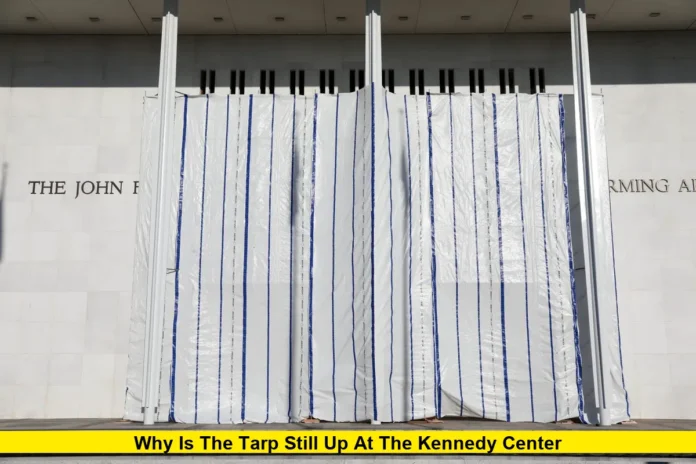

The tarp remains up at the Kennedy Center as ongoing renovations, operational adjustments, and leadership changes continue at the landmark venue, prompting growing public questions about when normal appearances and activities will fully resume.
Visitors arriving at Washington’s famed performing arts complex continue to ask why is the tarp still up at the kennedy center, as the prominent covering remains visible amid a period of institutional transition, facility updates, and intense public attention. While temporary construction coverings are not uncommon at major cultural venues, the timing has fueled widespread speculation about what is taking place behind the scenes.
The curiosity surrounding the structure comes as the nationally recognized arts institution faces a combination of legal, administrative, and financial developments that have placed it at the center of a broader national conversation.
A Visible Change Sparks Public Interest at the Kennedy Center
The large tarp covering part of the Kennedy Center has become an unexpected point of interest for visitors, arts supporters, and members of the public. As one of the most recognizable cultural landmarks in the United States, the Kennedy Center attracts millions of people each year, making any noticeable change to its appearance a topic of discussion.
Many observers have wondered whether the tarp is related to routine maintenance, renovation work, infrastructure improvements, or other ongoing operational changes. While major cultural venues frequently undergo repairs and modernization projects to preserve their facilities, the prominent placement of the covering has naturally sparked curiosity among those who regularly visit or follow developments at the center.
The visibility of the tarp has also coincided with a period of transition and heightened attention surrounding the institution. As a result, what might otherwise be viewed as a standard construction feature has become a subject of public conversation, highlighting the strong interest people continue to have in the Kennedy Center and its future.
The Institution Faces a Period of Transformation
The questions surrounding the Kennedy Center’s appearance come at a time when the institution is navigating a period of significant change. Recent developments involving leadership, governance, branding discussions, and long-term planning have placed the organization under increased public and media scrutiny.
As one of the nation’s most prominent cultural institutions, the Kennedy Center often serves as a focal point for broader conversations about the arts, public engagement, and institutional direction. Consequently, even routine physical changes to the building can attract heightened attention when they occur alongside organizational transitions.
Observers have increasingly linked visible activity at the venue—including construction work, maintenance projects, and temporary coverings such as the tarp—to larger discussions about the center’s future. While there is no indication that every visible alteration is directly connected to these broader developments, the timing has fueled speculation and public curiosity.
In this environment, seemingly minor changes can take on greater significance, reflecting the intense interest that surrounds the Kennedy Center as it continues to evolve and adapt for the years ahead.
Construction and Maintenance Remain Likely Factors
While public interest has focused on the tarp’s presence, facility management experts note that such coverings are a standard feature of large-scale maintenance and renovation projects. Major cultural venues like the Kennedy Center require continuous upkeep to ensure that their structures remain safe, functional, and visually appealing for visitors and performers alike.
Over time, exposure to weather, aging building materials, and evolving infrastructure requirements can make repairs and upgrades necessary. Temporary tarps are often installed to protect work areas while projects are underway and to help maintain normal operations within the facility.
These coverings can serve several practical purposes, including protecting construction crews and equipment, shielding renovation zones from rain and other weather conditions, concealing active work sites from public view, supporting structural maintenance efforts, and facilitating exterior restoration projects.
For an institution that welcomes guests throughout the year, carefully managing construction activities is essential. Temporary measures such as tarps allow necessary improvements to proceed while minimizing disruptions to performances, events, and daily visitor experiences.
Financial Planning Takes Center Stage
Beyond questions about the Kennedy Center’s physical appearance, growing attention has focused on the institution’s long-term financial strategy. As one of the nation’s leading cultural organizations, the center relies on a combination of earned revenue, donations, sponsorships, and philanthropic support to sustain its operations and programming.
Recent discussions surrounding fundraising initiatives and endowment planning have highlighted the importance of securing stable financial resources for the future. Reports of proposals tied to new endowment efforts have sparked debate among observers, drawing interest from both cultural and political audiences.
Supporters view such initiatives as opportunities to strengthen the institution’s financial foundation, while critics have raised questions about branding, recognition, and public perception. Regardless of differing viewpoints, the conversation underscores the growing role that fundraising and donor engagement play in the operation of major nonprofit organizations.
Like many arts institutions across the United States, the Kennedy Center faces rising operational costs and evolving financial challenges. As a result, leadership continues to place significant emphasis on long-term sustainability, ensuring that the organization can support its mission and programming for future generations.
Understanding the Role of Endowments
Endowments play a critical role in the long-term financial health of nonprofit organizations, universities, museums, and performing arts institutions. Unlike traditional fundraising campaigns that often support immediate needs, endowments are designed to create a permanent source of financial stability. Donations placed into an endowment are typically invested over time, with only a portion of the investment earnings used each year to support the organization’s mission and operations.
This approach allows institutions to build a sustainable financial foundation that can continue generating support for decades. During periods of economic uncertainty, fluctuating attendance, or rising operational expenses, endowment income can provide an important financial cushion and help organizations maintain key programs without relying solely on annual fundraising efforts.
Educational Programs
One of the most common uses of endowment income is supporting educational initiatives. Cultural institutions frequently invest in school partnerships, student workshops, teacher resources, youth performances, and community learning opportunities. Stable funding enables organizations to expand educational outreach and reach audiences that may not otherwise have access to arts programming.
Artistic Development
Endowment resources can also strengthen artistic programming. Funding may be directed toward developing new productions, commissioning original works, supporting emerging artists, hosting artist residencies, and bringing innovative performances to audiences. Long-term financial support gives organizations greater flexibility to pursue ambitious creative projects that might otherwise be difficult to finance.
Public Access Initiatives
Many nonprofit arts organizations use endowment earnings to improve public access. These funds can help provide discounted tickets, free performances, community engagement programs, and outreach efforts aimed at underserved populations. By reducing financial barriers, institutions can broaden participation and ensure that cultural experiences remain accessible to a wider audience.
Facility Improvements and Preservation
Maintaining major cultural venues requires substantial investment. Endowment income can help support building maintenance, infrastructure upgrades, technology improvements, accessibility enhancements, and preservation efforts. These investments help ensure that facilities remain safe, modern, and capable of serving future generations of visitors and performers.
Supporting Long-Term Strategic Goals
Beyond individual programs, endowments provide leadership with greater flexibility to pursue long-term objectives. Financial stability allows organizations to plan years ahead, respond to changing audience needs, invest in innovation, and navigate economic challenges with greater confidence.
As discussions continue regarding new fundraising initiatives and potential endowment expansions, financial experts note that the creation of a significant new fund could have lasting implications for organizational priorities. The way such resources are structured and managed may influence programming decisions, community engagement efforts, facility investments, and institutional planning for many years to come. For major cultural institutions, endowments are often viewed not simply as financial assets but as strategic tools that help secure their future and sustain their mission over the long term.
Why the Building Continues to Draw Attention
The Kennedy Center holds a distinctive place in American cultural life, serving as far more than a traditional performing arts venue. As the nation’s premier center for the performing arts, it functions as both a cultural landmark and a symbol of national artistic achievement. Because of this unique status, developments involving the institution often attract attention well beyond regular theatergoers, artists, and arts organizations.
Unlike many performance venues that primarily serve local audiences, the Kennedy Center is closely associated with national events, prestigious honors, educational initiatives, and public celebrations. Its visibility means that even relatively minor changes to the building or its operations can quickly become topics of broader public interest.
The continued presence of the tarp has become especially noteworthy because it comes during a period of heightened attention surrounding the institution. Discussions about leadership transitions, fundraising efforts, organizational priorities, institutional identity, and long-term planning have already placed the center under an intense public spotlight. As a result, visible changes to the facility are often viewed through the lens of these larger conversations.
Whether the tarp is connected to routine maintenance, renovation work, or other operational needs, its prominence has encouraged speculation and curiosity among visitors and observers. In many ways, the unanswered questions surrounding the covering have become part of the larger narrative unfolding at the Kennedy Center.
For a landmark that occupies such an important place in American cultural and civic life, public interest is unlikely to fade until clearer explanations emerge. Until then, the tarp remains both a practical feature of the building and a visible symbol of a period of transition that continues to capture national attention.
The Challenge of Balancing Tradition and Change
Major cultural institutions such as the Kennedy Center face a constant balancing act between preserving their historic identity and adapting to the demands of a changing world. As nationally recognized landmarks, these organizations are expected to honor longstanding traditions while also evolving to remain relevant, financially stable, and accessible to future generations.
This challenge extends across nearly every aspect of operations. Leadership teams must maintain aging facilities, invest in modern technology, improve accessibility, respond to shifting audience preferences, and secure reliable sources of funding. At the same time, they must protect the values, traditions, and cultural legacy that have helped establish the institution’s reputation over decades.
In recent years, this balancing act has become even more complex. Rising operating costs, evolving entertainment habits, increased competition for philanthropic support, and changing public expectations have placed additional pressure on nonprofit arts organizations. Institutions are increasingly required to demonstrate both financial responsibility and cultural relevance while navigating a rapidly changing environment.
Public scrutiny has also intensified. Social media and 24-hour news coverage mean that decisions once discussed primarily within organizational circles can quickly become subjects of national debate. Leadership changes, fundraising initiatives, branding decisions, and facility projects are now often examined through broader cultural and political lenses.
The ongoing attention surrounding the Kennedy Center reflects this reality. What might otherwise be viewed as routine operational matters—including construction activity, maintenance work, or strategic planning—can become intertwined with larger conversations about institutional identity, governance, public perception, and the future direction of prominent cultural organizations.
As the center continues to navigate this period of change, it exemplifies a challenge faced by many major institutions: how to embrace modernization and long-term sustainability while preserving the traditions and values that have made them enduring national symbols.
Looking Ahead
While questions remain about the exact timeline for removing the tarp and completing any associated work, the institution appears poised to continue evolving in response to legal, financial, and operational realities.
Observers will be watching closely for updates regarding facility improvements, branding decisions, and the proposed endowment initiative.
What began as a simple question about a visible covering on a building has evolved into a wider discussion about the future of one of America’s most important cultural organizations.
As those conversations continue, visitors can expect ongoing interest in both the physical appearance of the venue and the decisions shaping its next chapter.
In the meantime, why is the tarp still up at the kennedy center remains one of the most frequently asked questions surrounding the landmark, reflecting the broader public fascination with an institution undergoing a period of notable change.