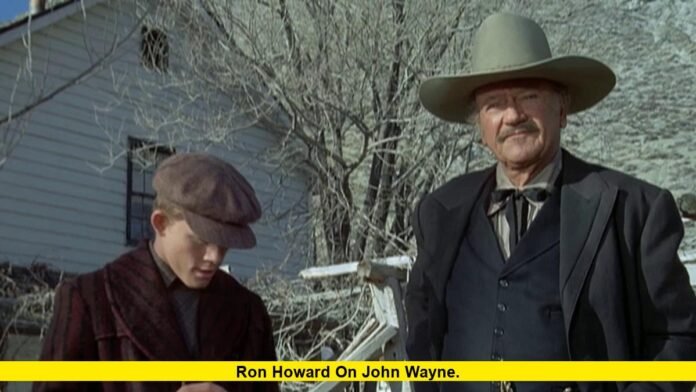

Ron Howard on John Wayne has become a hot topic again after the veteran director opened up about one of the most formative experiences of his early career: sharing the screen with the Hollywood legend during what turned out to be Wayne’s very last film. In a recent podcast appearance, Howard revisited the making of the 1976 Western “The Shootist,” describing a set thick with tension between its aging star and its equally strong-willed director. The story has resurfaced widely because it offers a rare, candid glimpse into how two towering figures of American cinema clashed behind the scenes, and how a young actor caught in the middle came away with lessons that shaped the rest of his career.
Background: Two Careers on Very Different Trajectories
By 1976, John Wayne was already a cinematic institution. Over a career spanning several decades, he had become the defining face of the American Western, known for his commanding screen presence in classics that shaped an entire genre. By the mid-1970s, however, his health was declining, and “The Shootist” would end up being his final on-screen role before his death in 1979 at the age of 72.
Ron Howard, by contrast, was just 22 years old and riding high on his popularity as a young television star. He was simultaneously building a name for himself in front of the camera while quietly preparing for a very different future behind it, studying filmmaking at the University of Southern California’s Cinema School. Landing a role opposite Wayne and Lauren Bacall in “The Shootist” placed him in a rare position: acting alongside a screen icon while absorbing everything he could about the craft of directing.
The Making of “The Shootist”
“The Shootist” tells the story of an aging gunfighter, J.B. Books, who learns he is dying and spends his final days confronting his legacy. Howard played Gillom Rogers, the son of Bacall’s character, in a role that required extensive scenes and heavy dialogue opposite Wayne. The film was directed by Don Siegel, a filmmaker respected for his work on gritty, character-driven pictures.
According to Howard, the working relationship between Wayne and Siegel was strained almost from the start. The two men reportedly disagreed over creative approach and pacing, and their differences created an atmosphere that Howard has described as tense and, at times, uncomfortable. Rather than staying quiet on the sidelines, Howard found himself building a rapport with both men individually, even as the professional relationship between them deteriorated.
What Ron Howard Said About Working With John Wayne
Speaking on Ben Mankiewicz’s “Talking Pictures” podcast, Howard offered new detail about how he navigated the friction on set. He recalled that few people on the production were willing to approach Wayne directly during breaks between setups, which left the actor somewhat isolated. Howard said he took the initiative himself, asking Wayne if he wanted to run lines together. Wayne agreed, and the two spent time rehearsing their scenes, an experience Howard described as genuinely rewarding.
Howard has said Wayne was consistently friendly toward him personally, even while venting frustrations about the production. He recalled getting “an earful” from Wayne about the actor’s dissatisfaction with how Siegel was directing certain scenes. At the same time, Howard said he bonded with Siegel separately, peppering the director with questions about his process during quieter moments, a habit that reflected his own growing ambitions as a future filmmaker.
Howard also recounted a striking conversation in which Siegel explained the harsh realities of directing a major star: that if tensions between a director and a lead actor stretch on too long, it is almost always the director who gets replaced, since studios cannot afford the cost of reshoots. Despite that pressure, Siegel reportedly told Howard he intended to see the project through because he believed in the script and the film itself.
Looking back, Howard suggested that both men may have shared more common ground than either realized at the time, but that Siegel did not always do enough to bridge the gap between their differing approaches. It is worth noting that there is no official confirmation from Siegel’s estate or additional firsthand sources fully corroborating every detail of these recollections beyond Howard’s own account, so the story is best understood as Howard’s personal recollection of events nearly five decades later.
Public Interest in the Story
The renewed attention around Ron Howard on John Wayne reflects a broader fascination audiences continue to have with the inner workings of classic Hollywood productions. “The Shootist” holds a special place in film history as Wayne’s farewell performance, and any new insight into how that final production actually unfolded tends to generate significant interest among film historians, classic Western fans, and general audiences alike.
Part of the appeal also comes from the contrast between the two men’s positions at the time. Wayne was a legend nearing the end of an era-defining career, while Howard was a young performer on the cusp of becoming one of the most respected directors of his generation. Howard has often pointed to his early acting years as formative training ground for his later work behind the camera, and his time on “The Shootist” appears to be one of the clearest examples of that influence.
Fans and entertainment outlets have also highlighted how the story humanizes both men. Wayne, often remembered primarily through his tough, larger-than-life screen persona, comes across in Howard’s telling as someone who could be personable and generous with a young co-star even while frustrated with his director. Siegel, meanwhile, is portrayed as a filmmaker under real pressure, determined to protect his creative vision despite the risk to his own position on the project.
Latest Updates
As of mid-July 2026, Howard’s comments have circulated widely across entertainment outlets, with many outlets independently reporting on the “Talking Pictures” podcast appearance. Reporting has largely centered on Howard’s recollection of the Wayne-Siegel tension, the personal bond Howard formed with Wayne during line readings, and the guidance Howard received from Siegel about the realities of directing under pressure. There is no indication that Howard has released further extended commentary on the subject beyond what was shared in that podcast conversation, and no official statement has been issued disputing his account.
Howard has continued to reflect publicly, on this and other occasions, on how his early acting career shaped his instincts as a director. The “Talking Pictures” episode reportedly touched on broader themes as well, including his early career anxieties and the mentors who influenced his approach to filmmaking, with “The Shootist” serving as one notable example among several formative experiences he described.
Final Thoughts
Ron Howard on John Wayne offers a compelling window into a pivotal moment in film history, when a legendary star closed out his career under difficult circumstances while a future award-winning director quietly absorbed lessons that would guide him for decades. Howard’s willingness to reach out to Wayne when others hesitated, paired with his parallel curiosity about Siegel’s directing choices, illustrates the instincts that would eventually define his own filmmaking career. While the full picture of what happened on that set decades ago remains shaped primarily by Howard’s own memory, his account adds valuable context to the legacy of “The Shootist” and to the complicated, human side of working with one of Hollywood’s most enduring icons.
Share your thoughts on this story in the comments below, and stay tuned for more updates on classic Hollywood history and entertainment news.