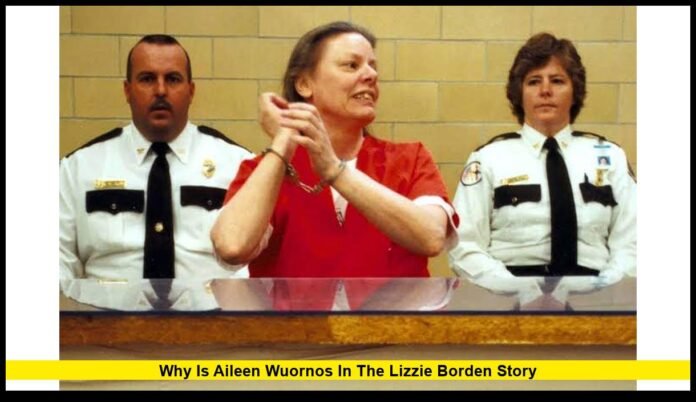

The question why is Aileen Wuornos in the Lizzie Borden story has attracted attention from viewers of Netflix’s Monster: The Lizzie Borden Story. Wuornos and Borden lived in completely different eras, and there was no personal relationship between them. Their connection exists because the series deliberately brings their stories together for its larger examination of women, violence, crime, and public perception.
Lizzie Borden became one of America’s most recognizable criminal cases after her father, Andrew Borden, and stepmother, Abby Borden, were murdered in Fall River, Massachusetts, in 1892. Lizzie was accused of the killings but was acquitted after her 1893 trial. Nearly a century later, Aileen Wuornos became notorious after being convicted of murdering multiple men in Florida.
The Netflix production uses Wuornos as a modern counterpart to Borden. That connection is part of the show’s storytelling rather than a documented relationship between the two women.
Key Points Summary
╔════════════════════════════════════════════════════════════════════╗
║ – Aileen Wuornos and Lizzie Borden never knew each other. ║
║ – Their lives were separated by nearly a century. ║
║ – Wuornos appears in the Netflix series as a thematic connection to Borden. ║
║ – Sarah Paulson portrays Aileen Wuornos in the series. ║
║ – Lizzie Borden was accused of killing her father and stepmother but was acquitted. ║
║ – The real Wuornos case and the Borden murders are separate historical events. ║
╚════════════════════════════════════════════════════════════════════╝
Why is Aileen Wuornos in the Lizzie Borden Story?
Aileen Wuornos is included because the Netflix series wants to connect two famous cases involving women accused or convicted of serious violence.
The historical timelines make a direct relationship impossible. Lizzie Borden was born in 1860 and died in 1927. Wuornos was born in 1956 and died in 2002. Their lives therefore never overlapped in a way that could have created a personal relationship.
The series instead places Wuornos into Borden’s story through a fictionalized narrative device.
Wuornos serves as a bridge between the 19th-century Borden case and a much more modern criminal case. Her inclusion allows the show to move beyond the circumstances of one household murder investigation and examine broader questions about female violence and how notorious women become part of popular culture.
That distinction is important for viewers researching the case after watching the program.
The show is based on real people and historical events, but it also uses dramatization. Not every relationship, conversation, or connection shown on screen comes from historical records.
The Real Story Behind Lizzie Borden
The Borden case began on August 4, 1892, when Andrew Borden and his wife, Abby Borden, were found dead inside their home in Fall River.
Both victims had suffered numerous blows. Andrew was found in the sitting room, while Abby was discovered upstairs.
Lizzie Borden, Andrew’s daughter from his first marriage, quickly became the central suspect. Investigators examined her movements and statements as they tried to determine who was responsible.
The case attracted enormous public attention.
Lizzie was eventually charged with the murders and went to trial in 1893. The prosecution attempted to build a case using circumstantial evidence, while the defense challenged the state’s interpretation of what had happened.
The jury ultimately acquitted Lizzie.
That verdict is one of the defining facts of the case. Lizzie Borden was never convicted of murdering her father or stepmother.
Despite the acquittal, questions surrounding the murders continued for generations. The absence of a definitive alternative culprit helped turn the case into one of America’s most enduring unsolved murder mysteries.
How Aileen Wuornos’ Story Is Different
Aileen Wuornos belongs to a completely different period of American criminal history.
Wuornos became nationally known after a series of killings in Florida between 1989 and 1990. Authorities linked her to the deaths of seven men.
Unlike Borden, Wuornos was ultimately convicted in multiple murder cases.
She received death sentences and remained on death row for years. Florida executed her in 2002.
Her case generated extensive media coverage and later became the subject of films, documentaries, books, and other works of popular culture.
Wuornos’ life and crimes also became part of wider discussions about women who commit violent crimes.
That makes her useful to the Netflix series from a storytelling perspective. Her case offers a modern example that can be placed beside the much older Borden mystery.
However, the two cases should not be treated as one continuous criminal story.
Did Aileen Wuornos Really Have a Connection to Lizzie Borden?
There is no established historical relationship between Wuornos and Borden.
The real Wuornos could not have met Borden. Borden died decades before Wuornos was born.
There is also no reliable basis for treating the fictional relationship presented by the series as a documented part of Wuornos’ life.
This is one of the most important points for viewers to understand.
Television dramatizations often combine historical material with invented scenes or connections. Those changes can help create a coherent narrative, but they can also make fictional elements appear historical.
In this case, Wuornos’ presence should be understood within the structure of Monster: The Lizzie Borden Story, rather than as evidence of a real-world relationship.
Why Netflix Connects Two Different Criminal Cases
The connection allows the series to examine similar themes across very different time periods.
Borden’s case involves an accused woman who was ultimately acquitted. Wuornos’ case involves a woman who was convicted of multiple murders and executed.
The difference between those outcomes is significant.
Borden became a cultural mystery. Her name remained associated with an unresolved question of guilt despite the jury’s decision.
Wuornos became known as a convicted serial killer whose case generated intense public debate.
Putting the two stories alongside each other gives the series an opportunity to explore how society responds to women accused of violence.
The show also examines how these women are remembered after their cases leave the courtroom.
That broader theme explains why Wuornos can appear in a story centered on Borden even though they have no historical connection.
Sarah Paulson’s Role as Aileen Wuornos
Sarah Paulson portrays Aileen Wuornos in the Netflix production.
Her appearance represents a major shift in the series’ timeline. Instead of remaining entirely within the 1890s, the narrative introduces a figure from a much later period.
Wuornos therefore becomes more than another character.
She helps connect two eras of American true crime.
Paulson’s role also gives the production a recognizable modern figure whose story is already familiar to many true-crime audiences. Wuornos’ case has received substantial attention over the years, making her inclusion immediately understandable to viewers familiar with her history.
At the same time, her presence can create confusion if viewers assume the series is presenting a literal historical connection.
It is not.
The relationship between Wuornos and Borden belongs to the show’s narrative framework.
What Is the Real Story of Lizzie Borden?
For people searching what is the real story of Lizzie Borden, the basic historical record is relatively straightforward.
Andrew Borden and Abby Borden were murdered at their Fall River home on August 4, 1892.
Lizzie Borden was suspected and eventually prosecuted.
Her trial took place in 1893.
After hearing the evidence, the jury found her not guilty.
Lizzie spent the rest of her life living under the shadow of the case. Although she was never convicted, the mystery surrounding the murders continued to attract public interest.
The famous rhyme associated with the case helped preserve Borden’s name in American popular culture. However, a nursery rhyme should not be treated as a historical record.
The actual case involved an investigation, conflicting interpretations of evidence, a highly publicized trial, and an acquittal.
That is the foundation on which later books, films, television productions, and other adaptations have built.
Why the Borden Case Remains Famous
More than a century later, the Borden murders continue to attract attention because they combine several elements that have historically fascinated the public.
The victims were killed inside their own home.
Lizzie, a member of the household, became the primary suspect.
The prosecution failed to secure a conviction.
The identity of the person responsible was never conclusively established through a later conviction.
Those facts left room for continued debate.
Over time, the case became larger than the original investigation. Lizzie Borden transformed into a recognizable figure in American true-crime culture.
That cultural legacy is one reason a modern television production can still build an entire story around the case.
The Major Difference Between Borden and Wuornos
The most significant difference is their legal history.
Lizzie Borden was accused but acquitted. The verdict means that she was not found guilty in court of murdering Andrew and Abby Borden.
Aileen Wuornos, on the other hand, was convicted of multiple murders and sentenced to death.
Their cases therefore produced very different legal outcomes.
Their public reputations also developed differently.
Borden became associated with an unresolved historical mystery. Wuornos became associated with a documented series of murders and a highly publicized criminal prosecution.
The Netflix series uses those differences as part of its broader narrative.
Important Timeline
August 4, 1892: Andrew Borden and Abby Borden are murdered in their Fall River home.
1892: Lizzie Borden becomes the principal suspect in the investigation.
1893: Borden stands trial for the murders and is acquitted.
1927: Lizzie Borden dies in Fall River.
1956: Aileen Wuornos is born.
1989–1990: Wuornos kills seven men in Florida.
1990s: Wuornos is prosecuted and convicted in multiple murder cases.
2002: Florida executes Wuornos.
2026: Netflix’s Monster: The Lizzie Borden Story brings the two cases together through a fictionalized television narrative.
The timeline makes the historical separation clear. Borden and Wuornos belonged to different generations and never had a real-life personal relationship.
What Viewers Should Know Before Treating the Series as History
The biggest mistake would be to assume that every scene represents documented history.
Monster: The Lizzie Borden Story is a dramatic production. Its creators can combine real events with fictionalized interactions to tell a larger story.
That approach is common in historical dramas.
For the Borden case, viewers should distinguish between established facts and dramatic interpretation. Her parents’ deaths, her prosecution, and her acquittal are historical facts.
The supposed connection with Wuornos is a storytelling element.
The same distinction applies to scenes that portray private conversations, motivations, relationships, or events for which no historical documentation exists.
Understanding that difference does not require dismissing the series. It simply helps viewers separate entertainment from the historical record.
Why Is Aileen Wuornos in the Lizzie Borden Story? The Answer in Context
The answer becomes clearer when the two cases are viewed separately.
Lizzie Borden represents a famous 19th-century murder mystery involving an accused woman who was acquitted.
Aileen Wuornos represents a late-20th-century case involving a woman convicted of multiple killings.
Netflix connects them because their stories allow the production to examine related themes surrounding women, violence, criminal accusations, media attention, and public memory.
The connection is therefore thematic and fictional rather than biographical.
The most important takeaway is that Aileen Wuornos was not part of the historical Lizzie Borden case. Her appearance in the Netflix story is a creative decision that connects two separate true-crime histories.
Frequently Asked Questions
Q: Why is Aileen Wuornos in the Lizzie Borden story?
A: Netflix uses Wuornos as a thematic and fictional connection to Lizzie Borden. The two women did not have a real-life relationship.
Q: Did Aileen Wuornos know Lizzie Borden?
A: No. Lizzie Borden died in 1927, while Aileen Wuornos was born in 1956.
Q: Did Aileen Wuornos visit the Lizzie Borden house?
A: There is no established historical evidence that the real Wuornos visited the Borden home because of Lizzie Borden. The idea belongs to the series’ fictional storyline.
Q: Was Lizzie Borden convicted of killing her father and stepmother?
A: No. Lizzie Borden was tried for the murders of Andrew and Abby Borden in 1893 and was acquitted.
Q: Who plays Aileen Wuornos in the Netflix series?
A: Sarah Paulson portrays Aileen Wuornos in Monster: The Lizzie Borden Story.
Q: What is the real story of Lizzie Borden?
A: Andrew and Abby Borden were murdered in their Fall River home in 1892. Lizzie was accused, tried in 1893, and acquitted. The murders were never resolved through a later conviction.
Q: Was Aileen Wuornos inspired by Lizzie Borden?
A: There is no established evidence that the real Wuornos was inspired by Borden. The connection comes from the Netflix dramatization.