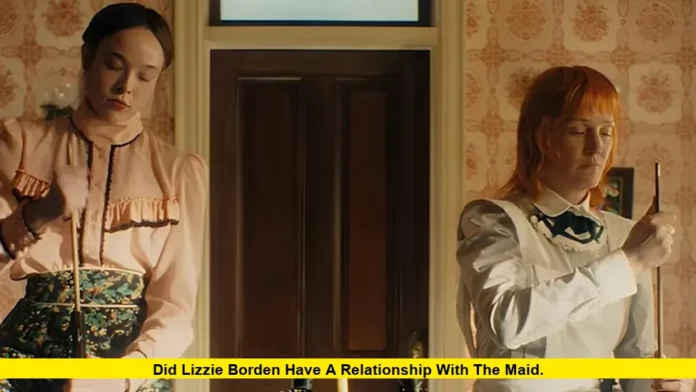

The question did Lizzie Borden have a relationship with the maid has attracted renewed attention following the release of Netflix’s Monster: The Lizzie Borden Story. The series portrays Lizzie Borden and her maid, Bridget Sullivan, as romantic partners who become involved in the murders of Andrew and Abby Borden. However, the historical record tells a very different story. There is no verified historical evidence that Lizzie Borden and Bridget Sullivan were romantically or sexually involved.
Bridget Sullivan was a real person and an important figure in the 1892 Borden murder case. She worked as a live-in domestic servant for the Borden family and was at the house on the day Andrew and Abby Borden were killed. She later testified at Lizzie Borden’s highly publicized 1893 murder trial.
The romantic relationship between Lizzie and Bridget is a later theory that became popular through fictional books, movies and, most recently, television. It is important to separate those dramatic interpretations from what can actually be established from historical records.
Who Was Bridget Sullivan?
Bridget Sullivan was an Irish immigrant who worked for Andrew and Abby Borden in Fall River, Massachusetts. She was in her mid-20s when the murders occurred and had worked in the Borden household for nearly three years.
Her responsibilities included washing, ironing, cooking and sweeping. She lived in a small room on the third floor of the Borden house.
Sullivan testified that Lizzie and her sister, Emma Borden, sometimes called her “Maggie,” which had been the name of a previous household servant. Andrew and Abby, by contrast, referred to her as Bridget.
Her position became historically significant because she was one of the few people known to have been at the Borden property on the morning of August 4, 1892.
Andrew Borden and his wife, Abby Borden, were found dead inside their home that day. Lizzie was subsequently accused of killing them, although she was ultimately acquitted.
Did Lizzie Borden and Bridget Sullivan Have a Romantic Relationship?
There is no reliable contemporary evidence proving that Lizzie Borden and Bridget Sullivan had a romantic relationship.
The surviving court testimony does not establish an affair between them. Sullivan did not testify that she and Lizzie were romantically involved, and no authenticated letter, diary or other contemporary document has emerged that confirms such a relationship.
This does not allow historians to prove that absolutely nothing private happened between the two women. Historical records from the period are incomplete, and private relationships were not necessarily documented.
However, there is an important difference between saying something cannot be completely ruled out and saying that historical evidence confirms it.
In this case, the evidence does not confirm a romance.
Why Does Netflix Portray Lizzie and Bridget as Lovers?
The renewed interest in the question comes from Monster: The Lizzie Borden Story, the Netflix series released in September 2026.
Ella Beatty portrays Lizzie Borden, while Vicky Krieps plays Bridget Sullivan, referred to as “Maggie” in the series. The program presents the two women as having a romantic relationship and eventually becoming partners in the murders.
That storyline is part of the show’s fictionalized interpretation of the Borden case.
Netflix’s own promotional and behind-the-scenes material makes clear that the series dramatizes historical events. Several elements of the story go beyond what is established by surviving historical evidence.
Therefore, scenes showing Lizzie and Bridget kissing, having an affair or conspiring together should not be treated as documentary evidence of a real relationship.
Where Did the Lizzie-Bridget Romance Theory Come From?
The idea that Lizzie and Bridget were lovers is not entirely new.
One significant early source was Evan Hunter’s 1984 novel Lizzie. Hunter, who was also known as crime writer Ed McBain, created a fictional interpretation of the Borden murders that included a sexual relationship between Lizzie and Bridget.
The idea later appeared in the 2018 film Lizzie, starring Chloë Sevigny as Lizzie Borden and Kristen Stewart as Bridget Sullivan. That film also portrayed the women as lovers and connected their relationship to the murders.
The 2026 Netflix series has now introduced the same basic concept to a much larger modern audience.
As a result, some viewers may encounter the romantic relationship in several different works and assume that it must have been historically documented.
It was not.
The fact that the idea has appeared repeatedly in entertainment does not make it a confirmed part of Lizzie Borden’s biography.
What Did Bridget Sullivan Say at Lizzie Borden’s Trial?
Bridget Sullivan’s testimony is one of the most important primary sources for understanding her actual relationship with the Borden family.
At the 1893 trial, she described her work in the household and provided information about what happened on the morning of the murders.
She testified that she had been working for the Bordens for approximately two years and nine months at the time of Andrew Borden’s death.
Sullivan also explained that she was responsible for household chores and described where she was during important portions of the morning.
Her testimony did not establish a romantic relationship with Lizzie.
Instead, it focused on household events, the movements of the people inside the home and what she personally observed.
The historical trial record therefore provides no basis for treating the Netflix romance as a documented fact.
Why Was Bridget Sullivan Important to the Murder Investigation?
Sullivan was particularly important because she was present at the Borden residence when the murders occurred.
She was outside the house for part of the morning, including time spent washing windows. She later returned inside and encountered the events that followed the discovery of Andrew Borden’s body.
Investigators questioned her because she was one of the people who could provide information about the household and its occupants.
However, Sullivan was not an eyewitness to either killing.
She did not testify that she saw Lizzie murder Andrew or Abby.
Her testimony became part of the broader evidence considered during Lizzie’s trial.
Did Bridget Sullivan Help Lizzie Commit the Murders?
There is also no established historical evidence that Bridget Sullivan was Lizzie Borden’s accomplice.
Because Sullivan was present at the property and survived the events, theories about her possible involvement began to develop around the Borden case.
Some later writers have suggested that she might have known more than she revealed. Other theories have imagined that she could have assisted Lizzie or helped conceal evidence.
But these remain theories.
No court established that Sullivan participated in the murders, and no reliable evidence has demonstrated that she and Lizzie planned the killings together.
The romantic-accomplice storyline presented in modern entertainment therefore combines two separate speculative ideas: the theory that Lizzie and Bridget were lovers and the theory that Bridget helped Lizzie commit the murders.
Neither has been established historically.
Did Lizzie Borden and Bridget Stay in Contact After the Trial?
There is also no strong historical evidence establishing that Lizzie and Bridget maintained a close personal relationship after the trial.
Following the Borden case, Sullivan eventually left Fall River. She later moved to Montana, where she married John Sullivan and lived a largely private life.
Lizzie, meanwhile, remained in Fall River and eventually lived with her sister Emma at Maplecroft.
Their lives went in different directions after the sensational trial.
There are later stories suggesting that Sullivan knew more about the murders than she revealed, but these accounts do not provide proof of a romantic relationship with Lizzie.
Why Was Lizzie Borden’s Personal Life So Heavily Speculated About?
Part of the continuing speculation comes from the fact that Lizzie never married.
She was 32 years old when her parents were murdered and was unmarried throughout the remainder of her life.
That fact has encouraged later writers to speculate about her sexuality and romantic relationships. However, being unmarried does not establish a person’s sexual orientation or prove that they had a secret relationship.
Another major source of speculation concerns actress Nance O’Neil.
After her acquittal, Lizzie developed a close friendship with O’Neil, an actress who was well known in theatrical circles. Their relationship has subsequently been interpreted by some writers as potentially romantic.
However, the historical evidence does not provide a definitive basis for labeling their relationship as a romantic partnership either.
The speculation surrounding O’Neil has sometimes been used to reinforce theories about Lizzie and Bridget, even though the two relationships occurred at different times and involved different evidence.
Was Lizzie Borden Ever Confirmed to Have Had a Relationship With a Woman?
No.
There is no definitive historical documentation establishing that Lizzie Borden had a romantic relationship with a woman.
That includes Bridget Sullivan.
Modern discussions about Lizzie’s sexuality often combine circumstantial details, later interpretations and fictional portrayals.
Those materials can be interesting when examining how the Borden story has evolved in popular culture, but they should not be confused with primary historical evidence.
The responsible historical conclusion is that Lizzie Borden’s sexuality remains uncertain.
What Does the Historical Record Say About Lizzie and Bridget?
The documented facts are considerably simpler than the Netflix storyline.
Bridget Sullivan worked for the Borden family.
She lived in the Borden home.
Lizzie and Emma sometimes called her “Maggie.”
She was present in the household on the morning Andrew and Abby Borden were killed.
She was questioned by investigators.
She testified during Lizzie Borden’s trial.
She was not convicted of participating in the murders.
There is no contemporary evidence proving that she and Lizzie were lovers.
There is also no established evidence proving that she and Lizzie planned the murders together.
Those distinctions are essential when discussing the case today.
How the 2018 Film Also Shaped the Theory
The romantic interpretation of Lizzie and Bridget had already entered popular culture before Netflix’s series.
The 2018 film Lizzie portrayed Lizzie Borden and Bridget Sullivan as lovers. The film used their relationship as an important element of its fictional interpretation of the events leading to the murders.
That movie helped familiarize a modern audience with the idea.
The Netflix series has now taken the concept even further by making the relationship a major component of its story.
Consequently, people discovering the Borden case through entertainment may reasonably wonder whether the relationship actually happened.
The answer from the historical record remains the same: there is no verified evidence that it did.
What Is Fact and What Is Fiction?
The difference between history and dramatization can be summarized simply.
| Claim | Historical Status |
|---|---|
| Bridget Sullivan worked for the Borden family | Documented |
| Bridget was living in the Borden home | Documented |
| Bridget was present around the time of the murders | Documented |
| Bridget testified at Lizzie’s trial | Documented |
| Lizzie and Bridget were romantically involved | Not historically established |
| Lizzie and Bridget were lovers | No verified evidence |
| Bridget helped Lizzie commit the murders | Unproven theory |
| Lizzie and Bridget planned the murders together | No established evidence |
| Netflix portrays them as lovers | Fictionalized portrayal |
| The 2018 film portrayed them as lovers | Fictionalized portrayal |
| Evan Hunter’s 1984 novel included the relationship | Fictional work |
This distinction is especially relevant following the release of Monster: The Lizzie Borden Story.
Did the Historical Trial Reveal a Secret Relationship?
No.
The trial generated enormous public interest, and Lizzie’s personal life was examined closely.
Yet the prosecution did not establish that Lizzie and Bridget had a romantic relationship.
Sullivan’s testimony was concerned primarily with the household and the events surrounding the murders.
The prosecution’s case against Lizzie ultimately failed to convince the jury.
On June 20, 1893, Lizzie Borden was found not guilty of murdering her father and stepmother.
Her acquittal did not solve the murders. Instead, it left the case open to decades of competing theories.
Could Lizzie and Bridget Have Had a Private Relationship That Was Never Recorded?
It is theoretically possible that private events were never preserved in historical documents.
Historians frequently work with incomplete evidence, particularly when investigating the private lives of people who lived more than a century ago.
However, that possibility should not be presented as evidence.
There is a major difference between:
- “There is no evidence that it happened.”
- “It is impossible that it happened.”
- “It definitely happened.”
The first statement is supported by the surviving record.
The second cannot be established.
The third is not supported by reliable historical evidence.
For that reason, the most accurate answer is that a romantic relationship between Lizzie and Bridget has not been historically confirmed.
What Happened to Bridget Sullivan After Lizzie’s Acquittal?
After the trial, Bridget Sullivan eventually left Fall River.
She later moved to Montana, married and lived outside the intense public attention that had surrounded the Borden case.
Unlike Lizzie, Sullivan did not spend the rest of her life as a famous public figure.
Lizzie continued living in Fall River and eventually moved into Maplecroft with Emma. The sisters later became estranged.
Sullivan died in 1948.
Lizzie Borden died in 1927.
Neither woman left behind a definitive historical account confirming that they had been romantic partners.
Why Does the Question Matter Today?
The question has become especially relevant because the latest Netflix series has introduced the theory to a new generation.
Historical crime stories often blend documented events with speculation, and entertainment productions have considerable freedom to fill gaps in the historical record.
That can make it difficult for viewers to determine which scenes represent established facts and which were created for dramatic purposes.
In the case of Lizzie Borden and Bridget Sullivan, the distinction is particularly important.
Their presence in the same household is historical.
Their involvement in the same murder investigation is historical.
Their testimony and connection to the Borden case are historical.
Their romantic relationship, however, is not established by the surviving evidence.
The Bottom Line: Did Lizzie Borden Have a Relationship With the Maid?
So, did Lizzie Borden have a relationship with the maid?
The historical answer is that there is no verified evidence that Lizzie Borden and Bridget Sullivan had a romantic or sexual relationship.
Bridget Sullivan was a real maid in the Borden household and an important witness in the murder case. She was present at the property when Andrew and Abby Borden were killed and later testified at Lizzie’s trial.
The idea that she and Lizzie were lovers emerged much later through fictional treatments and theories surrounding the case. It was explored in Evan Hunter’s 1984 novel Lizzie, portrayed in the 2018 film Lizzie, and has now become a central part of Netflix’s Monster: The Lizzie Borden Story.
The Netflix version should therefore be understood as a dramatization rather than proof of a historical romance.
More than 130 years after the Borden murders, many questions remain unanswered. The exact circumstances of the killings, the full extent of what Bridget Sullivan knew and the private details of Lizzie Borden’s life continue to attract speculation. But based on the evidence currently available, there is no documented basis for stating that Lizzie and Bridget were lovers or that they formed a romantic partnership before the murders.
What do you think about the difference between the real Lizzie Borden case and the Netflix portrayal? Share your thoughts and stay tuned for the latest verified updates on the story.