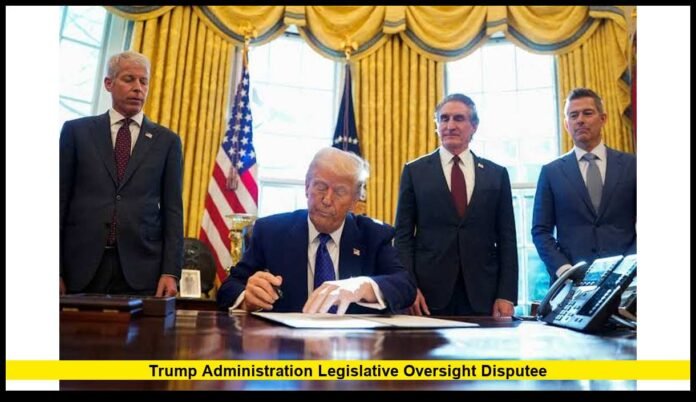

The trump administration legislative oversight dispute is developing into a major constitutional and political confrontation as Democrats prepare to use their incoming congressional majorities to investigate President Donald Trump’s administration. The conflict intensified after White House Counsel Will Scharf warned Democratic lawmakers that certain investigative tactics could potentially cross legal boundaries, raising questions about congressional authority, executive power, and the independence of federal oversight.
The disagreement comes after Democrats secured significant victories in the November 2026 midterm elections, positioning the party to control both the House of Representatives and the Senate when the new Congress begins in January 2027. Democratic lawmakers have already outlined plans to examine several controversial areas of the administration, including Justice Department operations, immigration enforcement, presidential business interests, federal spending, and the funding of a proposed White House ballroom.
President Trump and his administration have strongly resisted the prospect of aggressive congressional investigations. The White House argues that lawmakers cannot use subpoenas and investigative authority to intimidate government officials or private citizens. Democrats, however, maintain that investigating potential misconduct is a fundamental responsibility of Congress.
The confrontation is attracting national attention because it could influence how much information the executive branch must provide to lawmakers and how effectively Congress can hold the administration accountable during the final two years of Trump’s current presidential term.
Key Points Summary
╔════════════════════════════════════════════════════════════════════╗
║ – Democrats’ victories in the 2026 midterm elections will give them control of both chambers of Congress in January 2027. ║
║ – White House Counsel Will Scharf warned Representative Robert Garcia about the potential legal consequences of abusive investigative tactics. ║
║ – Robert Garcia is expected to lead the House Oversight Committee and pursue investigations into the Trump administration. ║
║ – Senator Richard Blumenthal is facing a separate dispute involving his investigation into donors supporting the White House ballroom project. ║
║ – Democrats are preparing inquiries into immigration enforcement, Justice Department activities, presidential business interests, and government spending. ║
║ – The confrontation raises significant questions about constitutional oversight, executive privilege, congressional subpoenas, and government accountability. ║
╚════════════════════════════════════════════════════════════════════╝
How the Congressional Oversight Conflict Began
The latest confrontation developed as Democratic lawmakers began discussing their plans for investigating the Trump administration after taking control of Congress.
During the current Congress, Republicans have generally provided the White House with a more favorable political environment. Committee leadership and investigative priorities have largely reflected Republican interests, limiting the likelihood of extensive Democratic-led inquiries into administration decisions.
The political situation changed dramatically after the November 3 midterm elections. Democrats won control of both chambers, creating opportunities to establish new investigative committees, request government documents, conduct public hearings, and question administration officials.
Several Democratic lawmakers publicly indicated that officials connected to controversial government decisions should prepare to answer questions.
Representative Robert Garcia became one of the most prominent figures in this developing confrontation. His comments about holding administration officials accountable prompted a direct response from the White House.
Rather than waiting until the new Congress officially begins, the administration has started challenging the proposed investigations and questioning whether certain threats involving subpoenas could constitute unlawful conduct.
Will Scharf’s Warning to Robert Garcia Escalates the Disagreement
A major development occurred when White House Counsel Will Scharf sent a letter to Representative Robert Garcia in November 2026.
Scharf addressed statements made by Garcia concerning the investigations Democrats intend to pursue after taking control of Congress.
The White House lawyer argued that congressional investigative authority has constitutional limits and must be connected to legitimate legislative responsibilities.
He specifically raised concerns about public threats directed toward executive branch employees and statements suggesting that subpoenas could be issued broadly against individuals connected to the administration.
According to Scharf, investigative procedures cannot legally be used simply to intimidate government employees, punish political opponents, or discourage individuals from participating in public service.
His letter warned that certain conduct could potentially cross the boundary into criminality.
The communication also made clear that the Trump administration would resist investigative procedures it considers unlawful or motivated by improper political objectives.
The warning was significant because it indicated that the administration might challenge future congressional inquiries not only through ordinary political negotiations but also through legal arguments involving potential criminal conduct.
Robert Garcia Pushes Back Against White House Pressure
Representative Robert Garcia rejected the administration’s position and defended Congress’s authority to investigate federal government activities.
Garcia argued that the White House does not have the power to approve or reject legitimate congressional investigations.
He has maintained that lawmakers have a responsibility to examine possible corruption, government misconduct, and questionable decisions involving public resources.
His expected leadership of the House Oversight and Government Reform Committee gives him an influential position in determining the direction of Democratic investigations.
The committee has extensive responsibilities involving federal agencies, government operations, public spending, and executive branch accountability.
Once Democrats take control, Garcia is expected to use the committee’s investigative resources to seek documents, organize hearings, and question administration officials.
The disagreement therefore represents more than a personal exchange between a White House lawyer and a congressional representative. It reflects a broader conflict over the limits of executive authority and the independence of legislative investigations.
Why the 2026 Midterm Elections Changed Everything
The November elections transformed the political balance in Washington.
Democrats secured majorities in both congressional chambers, giving them control over committee leadership, legislative priorities, and the direction of congressional investigations.
The change is especially important because President Trump will continue serving as president even though his party will no longer control Congress.
This creates the possibility of a divided-government environment in which congressional Democrats and the Republican administration disagree over legislation, government spending, executive decisions, and investigations.
The incoming majority will have the ability to schedule hearings, establish investigative priorities, and use congressional procedures to demand information.
Democrats are also expected to coordinate investigations across multiple committees rather than concentrating every inquiry within the House Oversight Committee.
However, taking control of Congress does not automatically guarantee that every investigation will succeed. Lawmakers will still need to establish legitimate investigative purposes, follow congressional rules, and address legal challenges from the executive branch.
Five Major Areas Democrats Want to Investigate
The incoming Democratic leadership has indicated that several areas of Trump’s administration could receive closer examination.
1. Justice Department Independence and Federal Investigations
The Justice Department is likely to become one of the most important subjects of congressional scrutiny.
Democrats have expressed concerns about the department’s leadership, personnel decisions, federal investigations, and the handling of cases involving individuals viewed as political opponents of the president.
Lawmakers may seek information about prosecutorial decisions, internal communications, enforcement priorities, and changes in the department’s operations.
They are also expected to examine whether federal law enforcement resources have been used appropriately.
These investigations could involve hearings with senior Justice Department officials and requests for internal records.
The administration may respond by arguing that certain documents are protected by legal privileges, confidentiality requirements, or restrictions involving ongoing investigations.
2. Immigration Enforcement and ICE Operations
Immigration policy is another significant area of potential congressional investigation.
Democratic lawmakers have indicated interest in examining Immigration and Customs Enforcement operations, detention conditions, deportation procedures, and the implementation of federal immigration policies.
The Department of Homeland Security could face requests for records involving enforcement operations and the treatment of individuals held in federal immigration detention facilities.
Congressional committees may also question officials about operational procedures, funding decisions, and compliance with existing laws.
These inquiries could generate substantial political disagreement because immigration enforcement remains one of the most divisive issues of Trump’s presidency.
3. Trump Family Business Interests and Potential Conflicts of Interest
Democrats are also interested in examining the financial activities and business relationships connected to President Trump and his family.
Potential areas of inquiry include corporate arrangements, government contracts, business transactions, and whether individuals or organizations with financial interests before the federal government have received favorable treatment.
Lawmakers may seek information about relationships between private businesses and administration officials.
The administration and the president’s representatives have denied allegations of wrongdoing. Any congressional investigation would need to establish specific questions and examine available evidence before reaching conclusions.
Nevertheless, this subject could become a major component of the incoming majority’s oversight agenda.
4. White House Ballroom Funding and Corporate Donations
The proposed White House ballroom project has become a particularly sensitive subject.
Senator Richard Blumenthal has raised questions about private donations supporting the project and whether major corporate contributors could have benefited from favorable government decisions.
His inquiries have focused on the identities of donors, the circumstances surrounding their contributions, and possible relationships between those donations and federal regulatory or business interests.
The project has attracted attention because of its substantial reported cost and the involvement of private financial contributions.
Democrats want greater transparency about how the funding was organized and whether any potential conflicts of interest exist.
The administration has faced questions about the project, while the investigation has now developed into a separate dispute involving federal prosecutors and congressional oversight authority.
5. Jeffrey Epstein Records and Government Transparency
Another subject likely to receive attention is the federal government’s handling of records connected to Jeffrey Epstein.
Democratic lawmakers have indicated interest in examining how federal agencies managed relevant records, what information has been released, and whether government officials have provided adequate transparency.
The issue has attracted public attention because of longstanding questions surrounding Epstein’s activities and his connections to influential individuals.
Congressional investigators may seek explanations from officials responsible for maintaining, reviewing, and releasing relevant records.
Any inquiry would also need to respect legal restrictions involving victims’ privacy, confidential information, and protected investigative materials.
Richard Blumenthal’s Dispute With Federal Prosecutor Aaron Reitz
The confrontation has expanded beyond the House of Representatives.
Senator Richard Blumenthal has challenged a letter from Aaron Reitz, the U.S. attorney for the Southern District of Texas, concerning his investigation into White House ballroom donors.
Reitz sent Blumenthal a document-preservation notice on November 11, 2026, raising concerns about the senator’s investigative activities and the constitutional rights of individuals associated with the president.
The letter requested that Blumenthal preserve documents, communications, and electronically stored information connected to his inquiries.
It also referenced federal civil-rights statutes and warned of potential legal consequences.
Blumenthal strongly rejected the allegations, describing the action as an attempt to discourage congressional oversight.
He has insisted that his investigation is a legitimate effort to examine potential conflicts of interest and the use of private contributions for a major government-related project.
The senator has also indicated that he intends to continue his investigations when Democrats take control of the Senate.
The dispute is particularly important because Blumenthal is positioned to take a leading role in the Senate Permanent Subcommittee on Investigations.
His future position could provide significant authority to examine financial relationships, federal contracts, and potential government misconduct.
Can the White House Stop Congress From Investigating?
The disagreement raises an important constitutional question: Can a president prevent Congress from investigating his administration?
Generally, the answer is no. Congressional oversight is an established part of the American constitutional system.
Congress needs information to develop legislation, examine government spending, evaluate federal programs, and determine whether existing laws are being properly implemented.
The Supreme Court has recognized that congressional investigations can be an important part of the legislative process.
However, congressional investigative authority is not unlimited.
Committees must have legitimate legislative purposes, comply with applicable procedures, and respect constitutional protections.
For example, individuals may have rights involving privacy, due process, and protections against compelled self-incrimination. The executive branch may also assert executive privilege in certain circumstances.
Consequently, disagreements over particular requests can lead to negotiations, legal challenges, and potentially court proceedings.
The central issue is not whether Congress can conduct oversight, but whether a particular investigation or subpoena satisfies the applicable constitutional and legal requirements.
Could the Dispute Lead to Federal Court Battles?
Legal proceedings are a possibility if the White House and congressional committees cannot resolve their disagreements.
One potential conflict involves subpoenas for documents or testimony from administration officials.
If federal agencies refuse to provide requested information, congressional committees may consider enforcement procedures available under their rules.
The administration could challenge subpoenas by arguing that they lack a legitimate legislative purpose or seek privileged information.
Congress could respond by pursuing negotiations, contempt procedures, or litigation.
Another important question concerns the limits of federal prosecutors’ authority when investigating the conduct of sitting members of Congress.
The dispute involving Blumenthal could bring additional attention to the relationship between federal law enforcement and congressional oversight.
However, neither the White House warning to Garcia nor the preservation notice sent to Blumenthal should automatically be treated as proof that the lawmakers have committed criminal offenses.
Any criminal allegation would require an appropriate legal process and evidence.
What the Oversight Battle Means for American Democracy
Congressional oversight is not simply a political tool used by the party opposing the president.
It is an important mechanism for ensuring that government institutions remain accountable to the public.
Through investigations, lawmakers can examine how taxpayer money is spent, whether agencies follow federal laws, and whether executive branch officials properly exercise their authority.
The current confrontation raises concerns about whether congressional investigations can proceed independently when they involve a sitting president and senior administration officials.
It also highlights the importance of preventing investigative powers from being used improperly against private citizens.
Both branches have constitutional responsibilities, and neither should assume unlimited authority.
For Americans, the outcome could influence government transparency, public confidence in federal institutions, and the ability of elected representatives to investigate important public issues.
What Happens Next in the Congressional Oversight Dispute?
The next major turning point will come in January 2027, when the newly elected Democratic majorities take control of Congress.
The House Oversight Committee is expected to establish its investigative priorities under incoming Democratic leadership.
The Senate will also have opportunities to examine federal agencies, financial arrangements, and administration decisions through its committee system.
Several developments deserve particular attention:
- Whether House Democrats issue formal subpoenas to senior administration officials.
- Whether federal agencies cooperate with requests for documents and testimony.
- Whether the White House invokes executive privilege to protect certain communications.
- Whether the Justice Department continues challenging congressional investigative activities.
- Whether disagreements involving the White House ballroom project lead to further legal proceedings.
- Whether congressional investigations produce new evidence of misconduct or potential conflicts of interest.
The administration is likely to defend its policies and challenge investigations it considers improper.
Democratic lawmakers, meanwhile, will need to demonstrate that their inquiries are based on evidence, legitimate legislative objectives, and established congressional procedures.
The coming months could therefore produce an extended confrontation involving political negotiations, public hearings, federal investigations, and constitutional questions.
Conclusion
The growing disagreement between President Trump’s administration and incoming Democratic congressional leaders represents a significant test of the American system of checks and balances.
The White House has warned lawmakers against investigative practices it considers abusive, while Democrats insist that congressional oversight cannot be restricted simply because investigations involve the president or his administration.
With both chambers expected to come under Democratic control in January 2027, the number of potential investigations could increase substantially.
The outcome will depend on how both branches exercise their constitutional powers, whether they can resolve disputes through established procedures, and whether federal courts are ultimately asked to determine the boundaries of their authority.
The coming congressional session will be important not only for the Trump administration but also for the broader question of government accountability in the United States.
What do you think about the growing battle between Congress and the White House? Share your views in the comments and stay tuned for the latest developments.