
Latest developments after August 2, 2026
The renewed public interest has been driven primarily by the success of the Netflix/BBC dramatization “The Bombing of Pan Am 103,” released on July 30, 2026. Recent reporting accompanying the series reiterates that:
- investigators believe Libyan intelligence orchestrated the attack,
- Abu Agila Masud is accused by U.S. prosecutors of building the bomb,
- but the identity of the person who physically transported the bomb suitcase has not been officially confirmed.
In short, despite nearly four decades of investigation, authorities have not publicly identified with certainty who actually carried the bomb-laden suitcase onto the baggage system. That question remains one of the enduring unresolved aspects of the Lockerbie bombing.
Who carried the bomb on Pan Am 103
Who carried the bomb on Pan Am 103 is a question that continues to generate interest decades after the Lockerbie disaster. Despite years of investigations, court proceedings, and international cooperation, authorities have never identified a passenger who physically carried the explosive device onto the aircraft. Instead, investigators concluded that the bomb was hidden inside a checked suitcase that moved through the airline baggage system before being loaded onto Pan Am Flight 103. Today, that conclusion remains at the center of the official account, while a separate criminal case in the United States continues against an alleged Libyan bomb-maker.
The destruction of Pan Am Flight 103 on December 21, 1988, remains one of the deadliest acts of terrorism in aviation history. The Boeing 747 exploded over Lockerbie, Scotland, killing all 259 passengers and crew members on board, along with 11 people on the ground. The attack devastated families across several countries, particularly in the United States, and led to lasting changes in global aviation security.
Why People Still Ask Who Carried the Bomb on Pan Am 103
Many people assume the explosive device was carried onto the aircraft by a passenger. That belief is understandable because several other airline attacks have involved individuals bringing explosives onto planes.
However, the Lockerbie investigation reached a different conclusion.
After years of forensic work and analysis, investigators determined that the bomb traveled inside a suitcase that had been checked into the airline baggage system before reaching Pan Am Flight 103. The evidence did not identify any passenger who knowingly transported that suitcase onto the aircraft.
As a result, the investigation focused on those accused of preparing and placing the explosive device into the baggage network rather than someone boarding the plane with it.
What Happened to Pan Am Flight 103
Pan Am Flight 103 was a regularly scheduled transatlantic passenger flight that departed London Heathrow Airport on the evening of December 21, 1988, with New York City’s John F. Kennedy International Airport as its destination. Operated by a Boeing 747, the flight carried 259 people, including passengers and crew. Among those on board were students returning home for the Christmas holidays, families preparing to celebrate with loved ones, business travelers, airline employees, and tourists.
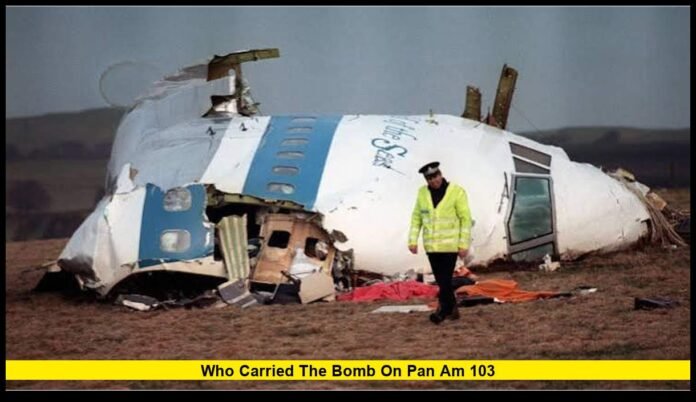
Approximately 38 minutes after takeoff, while the aircraft was cruising at high altitude over southern Scotland, a bomb hidden inside a suitcase exploded in the forward cargo hold. The powerful blast tore a hole in the fuselage, causing the aircraft to break apart in midair within seconds. The cockpit separated from the rest of the plane, and debris scattered across Lockerbie and the surrounding countryside over an area spanning several miles.
The impact of the falling wreckage devastated the quiet Scottish town. Large sections of the aircraft crashed into residential neighborhoods, destroying homes, igniting fires, and causing extensive damage. In addition to the 259 people aboard the aircraft, 11 residents of Lockerbie were killed when debris struck the ground, bringing the total death toll to 270.
The disaster remains one of the deadliest terrorist attacks in British history and one of the most significant aviation tragedies ever investigated. Recovery teams, emergency responders, and forensic specialists spent months collecting and examining thousands of pieces of wreckage spread across the countryside. Their painstaking work ultimately enabled investigators to reconstruct much of the aircraft and identify evidence pointing to a suitcase bomb, laying the foundation for one of the longest and most complex international criminal investigations ever conducted.
How Investigators Reconstructed the Bombing
The investigation into the Pan Am Flight 103 bombing became one of the largest and most complex forensic operations in aviation history. After the aircraft broke apart over Lockerbie, investigators faced the enormous challenge of recovering evidence scattered across towns, farmland, forests, roads, and hillsides in southern Scotland. The debris field stretched for dozens of miles, requiring months of coordinated search efforts by police officers, military personnel, forensic experts, and volunteers.
Every piece of wreckage, regardless of its size, was carefully documented, photographed, and cataloged before being transported for detailed examination. Investigators collected thousands of fragments from the aircraft, passengers’ belongings, and cargo in an effort to reconstruct exactly what had happened in the moments before the disaster.
The investigation brought together specialists from numerous fields, including explosives analysis, aviation safety, forensic science, electronics, criminal investigation, intelligence, and disaster victim identification. Their combined expertise helped identify subtle clues that would eventually prove critical to understanding the cause of the explosion.
Using recovered wreckage, investigators painstakingly reconstructed large sections of the Boeing 747 inside a hangar. By analyzing blast damage, metal deformation, and the distribution of debris, they determined that the explosion originated inside a luggage container located in the aircraft’s forward cargo hold.
Forensic examination also revealed traces of high explosives and fragments of the bomb’s components, allowing investigators to determine how the device had been concealed and detonated. These discoveries became pivotal pieces of evidence, helping authorities trace the bomb’s construction and movement through the baggage system. The reconstruction of the aircraft ultimately provided the foundation for the international criminal investigation that followed and remains one of the most significant achievements in modern aviation forensic science.
HoHow the Bomb Was Hidden
Investigators concluded that the explosive device used in the Pan Am Flight 103 bombing had been carefully concealed inside a Toshiba portable radio cassette player, allowing it to blend in with ordinary luggage. According to the forensic investigation, the modified cassette player was placed inside a hard-sided Samsonite suitcase along with clothing and other personal items to disguise the bomb and avoid attracting attention during baggage handling.
Detailed forensic analysis revealed that the device contained several key components designed to ensure it would detonate while the aircraft was in flight. These included a quantity of plastic explosive, an electronic timer mechanism, concealed wiring, and other electronic components that allowed the bomb to operate without human intervention. Investigators recovered fragments of these components from the extensive debris field and used them to reconstruct how the device had been assembled.
The evidence showed that the bomb was activated by a timer rather than a remote control or manual trigger. As a result, investigators determined that no one on board the aircraft needed to activate or monitor the device after it had been placed in the baggage system. Once the timer was set, the explosion would occur automatically at the predetermined time.
This conclusion became a crucial part of the investigation because it indicated that the bombing could be carried out without the bomber traveling on the aircraft. It also reinforced the long-standing finding that investigators have never identified a passenger who physically carried or triggered the explosive during the flight. Instead, authorities concluded that the bomb was hidden in checked luggage before departure and detonated automatically while Pan Am Flight 103 was en route across southern Scotland.
The Route of the Suitcase
According to the official investigation, the suitcase containing the bomb followed a complex international journey before it was loaded onto Pan Am Flight 103. After years of forensic analysis and the review of airline records, investigators concluded that the luggage entered the airline baggage system in Malta, where they believe it began its route toward the United States.
Authorities determined that the suitcase was then transferred to Frankfurt Airport in Germany through the normal baggage handling process. From Frankfurt, investigators concluded that it was placed on a connecting flight to London Heathrow Airport, where it was transferred once again before being loaded into the forward cargo hold of Pan Am Flight 103 for its scheduled departure to New York City on December 21, 1988.
The reconstruction of the suitcase’s journey was based on a wide range of evidence gathered over several years. Investigators examined airline baggage records, cargo documentation, airport security procedures, forensic findings, witness statements, and other investigative material to piece together the route. This extensive review formed a central part of the prosecution’s case and supported the conclusion that the explosive device had entered the baggage system before the aircraft departed London.
Over the decades, some legal experts, investigators, and commentators have questioned aspects of the evidence supporting this baggage route, and debates about certain elements of the case have continued. Nevertheless, the official findings of Scottish and U.S. investigators have remained unchanged. Authorities continue to state that the bomb suitcase originated in Malta, passed through Frankfurt, reached London Heathrow, and was ultimately loaded onto Pan Am Flight 103, where it exploded in flight over Lockerbie, Scotland.
Who Was Held Responsible?
After years of international investigation, Scottish and U.S. authorities charged two Libyan intelligence officials in connection with the bombing of Pan Am Flight 103: Abdelbaset al-Megrahi and Lamin Khalifah Fhimah. Both men denied the allegations, and diplomatic negotiations eventually led to an unprecedented agreement for them to stand trial before a special Scottish court sitting in the Netherlands under Scottish law.
The trial began in 2000 at Camp Zeist, a specially established court in the Netherlands. Prosecutors presented forensic evidence, witness testimony, airline records, and intelligence findings in an effort to prove the defendants’ involvement in the attack. After months of hearings, the court delivered its verdict in January 2001.
The judges found Abdelbaset al-Megrahi guilty of murder for his role in the bombing and sentenced him to life imprisonment. The court concluded that he had participated in the plot that placed the bomb aboard the aircraft. In contrast, Lamin Khalifah Fhimah was acquitted after the judges determined there was insufficient evidence to convict him.
Al-Megrahi served several years in prison before being granted compassionate release by Scottish authorities in 2009 after he was diagnosed with terminal prostate cancer. His release generated significant international controversy, with victims’ families and political leaders expressing sharply differing views. He returned to Libya and died in 2012.
To this day, Abdelbaset al-Megrahi remains the only person ever convicted in connection with the Lockerbie bombing. Although additional suspects have since been identified and new criminal proceedings have been launched in the United States, no other individual has been convicted for the 1988 terrorist attack.
The Current U.S. Criminal Case
The investigation did not end with the conviction of al-Megrahi.
American prosecutors later filed criminal charges against Abu Agila Mohammad Mas’ud Kheir Al-Marimi.
The allegations differ from the earlier case.
Prosecutors accuse him of helping build the explosive device used in the attack.
They do not allege that he personally boarded Pan Am Flight 103 or physically carried the bomb onto the aircraft.
He has pleaded not guilty.
Under the U.S. legal system, every criminal defendant is presumed innocent unless guilt is established beyond a reasonable doubt in court.
The federal case remains active, with additional proceedings continuing as the judicial process moves forward.
Why No Passenger Has Been Identified
One of the biggest misunderstandings surrounding the disaster involves the idea that a passenger secretly carried the bomb onto the plane.
The official investigation has never reached that conclusion.
Instead, investigators found evidence indicating that:
- The bomb traveled inside checked baggage.
- The suitcase entered the baggage system before the aircraft departed.
- The explosive relied on a timer rather than human activation.
- No passenger has been publicly identified as knowingly transporting the device.
Those findings explain why official court cases have focused on individuals accused of planning or assembling the attack instead of someone seated on the aircraft.
The Importance of Forensic Evidence
The Lockerbie investigation is often cited as one of the greatest forensic investigations ever completed.
Investigators recovered remarkably small fragments from the crash scene.
Among the most significant discoveries were:
- Pieces of the suitcase
- Fragments of electronic circuitry
- Remains of the cassette recorder
- Clothing packed around the explosive
- Components linked to the timing device
These items helped investigators reconstruct the bomb and trace several parts of the alleged operation.
Even tiny fragments proved critical.
Some pieces measured only a few millimeters across but provided valuable clues that investigators followed for years.
International Cooperation
The Lockerbie investigation required cooperation among numerous governments and agencies.
Authorities from several countries worked together to analyze evidence, interview witnesses, examine airline records, and coordinate criminal proceedings.
This international effort became a model for future terrorism investigations involving multiple countries.
The case also demonstrated how modern forensic science could solve highly complex crimes despite massive destruction.
How the Bombing Changed Aviation Security
The destruction of Pan Am Flight 103 exposed weaknesses in international airport security.
Governments around the world introduced significant improvements after the attack.
Several important changes included:
- More advanced baggage screening
- Improved explosive detection technology
- Better tracking of checked luggage
- Stronger airport security procedures
- Greater intelligence sharing between countries
- Enhanced international aviation standards
Many of these improvements remain part of airport operations today.
Although technology has advanced considerably since 1988, the lessons learned from Lockerbie continue to influence aviation security policies.
Remembering the Victims
The Lockerbie bombing claimed 270 lives.
Among those killed were:
- College students returning home
- Families celebrating the holiday season
- Airline crew members
- Business travelers
- Children
The disaster deeply affected communities in both the United States and Scotland.
Each year, memorial ceremonies honor those who lost their lives and recognize the lasting impact the attack had on victims’ families.
The tragedy also strengthened international cooperation in supporting families affected by acts of terrorism.
Why the Case Still Receives Attention Today
Even after more than three decades, the Lockerbie bombing remains one of the most closely followed terrorism investigations.
Several factors keep the case in public discussion.
First, the attack represented an unprecedented loss of American lives in an act of terrorism before the events of September 11, 2001.
Second, criminal proceedings have continued long after the bombing itself.
Finally, many families continue seeking complete accountability for everyone believed to have participated in the attack.
As long as legal proceedings remain active, public interest in the case is likely to continue.
FAQs
Q: Did someone board the plane carrying the bomb?
A: Investigators have never identified a passenger who physically carried the explosive onto Pan Am Flight 103. The prevailing investigative theory is that the bomb suitcase entered the baggage system before the flight, but no individual has been conclusively identified as the person who transported or checked it.
Q: Where was the bomb found?
A: The bomb was never recovered intact because it exploded in flight. Investigators reconstructed the explosive device from hundreds of fragments collected across the Lockerbie crash site, allowing forensic experts to determine how the bomb had been concealed and detonated.
Q: Who has been convicted?
A: Abdelbaset al-Megrahi is the only person convicted in connection with the Lockerbie bombing. He was found guilty by a Scottish court in 2001 for his role in the attack.
Q: Is another criminal case still underway?
A: Yes. A separate federal prosecution in the United States against Abu Agila Masud, who is accused of helping build the bomb used in the attack, remains pending. He has pleaded not guilty, and the case has not yet been resolved.
The Lasting Legacy of the Investigation
The Lockerbie investigation changed the way authorities investigate acts of aviation terrorism.
It demonstrated the importance of international cooperation, advanced forensic science, and long-term criminal investigations.
The case also showed that complex terrorism investigations can continue for decades as new evidence emerges and additional suspects face prosecution.
For many families, justice has always meant continuing the search for accountability regardless of how much time has passed.
Final Answer
The answer to who carried the bomb on Pan Am 103 remains consistent with the official findings reached after years of investigation. Authorities have never identified any passenger who physically carried the explosive device onto the aircraft. Instead, investigators concluded that the bomb was hidden inside a checked suitcase that entered the airline baggage system before ultimately being loaded onto Pan Am Flight 103.
The only person convicted in connection with the bombing was Abdelbaset al-Megrahi. Meanwhile, a separate U.S. criminal case involving Abu Agila Mohammad Mas’ud Kheir Al-Marimi continues through the federal court system. Until that case reaches its conclusion, the official record remains centered on the evidence gathered during one of the largest and most detailed terrorism investigations in modern history.
The Lockerbie bombing remains a defining event in aviation history, and its investigation continues to draw attention as legal proceedings move forward and the victims are remembered around the world.