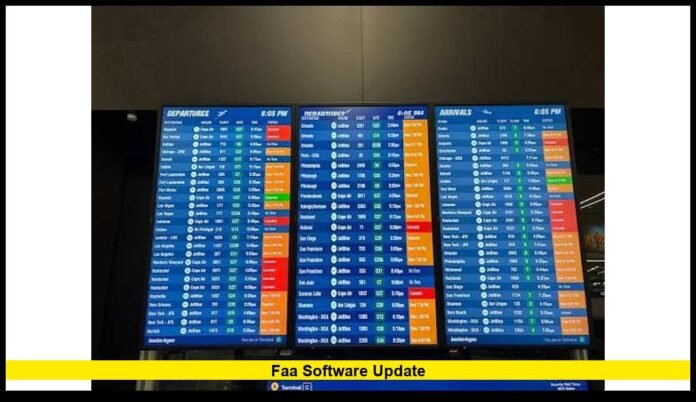

The FAA Software Update has become a critical issue for the American aviation industry after a major communications failure forced the Federal Aviation Administration to suspend flight departures nationwide on November 13, 2026. Although the ground stop was lifted Friday evening, the incident has continued affecting airline schedules, airport operations and passengers across the country.
The disruption exposed serious concerns about the technology supporting America’s air traffic control network. Transportation officials pointed to aging equipment, overloaded network infrastructure and inconsistent radar and communications data. Meanwhile, reports that investigators are examining a possible connection to a recent software update have raised additional questions about how the failure occurred.
The FAA confirmed that the nationwide ground stop was issued because communication problems affected multiple Air Route Traffic Control Centers. Departures were subsequently permitted to resume after technicians tested the affected systems and officials determined that operations could restart.
The immediate shutdown is over, but the technical investigation is not. Federal officials have not publicly established a definitive root cause, and the aviation industry is still working through the operational consequences.
The incident has also intensified pressure on the federal government to accelerate its long-term air traffic control modernization program, which aims to replace outdated technology with more reliable digital infrastructure.
FAA Software Update Latest News: What Happened on November 13, 2026?
Friday’s disruption developed after the FAA experienced instability involving radar information and communications at multiple air traffic control facilities.
The agency issued a nationwide ground stop, preventing departing aircraft from taking off under normal operations.
The decision affected commercial airlines, regional carriers, international departures and passengers traveling through major American airports.
The problem was particularly serious because air traffic controllers depend on accurate information and dependable communication channels to coordinate aircraft movements.
Transportation Secretary Sean Duffy subsequently explained that inconsistencies in radar and communications data created operational concerns. Officials decided that restricting departures was the appropriate safety response.
The FAA later lifted the ground stop at approximately 8:15 p.m. Eastern Time on November 13.
Before allowing departures to resume, the agency tested its systems to determine whether they were stable enough to support flight operations.
The FAA’s initial announcement described the disruption as a communications issue affecting multiple centers. Its official nationwide ground stop statement provides the agency’s initial account.
Why the Incident Matters
A problem affecting one airport can create localized delays. However, when communications infrastructure supporting multiple air traffic control centers experiences instability, the consequences can extend across the national aviation network.
That is what made the November 13 incident particularly significant.
Airlines could not simply continue operating their normal departure schedules while essential air traffic information was unreliable. The ground stop was intended to maintain safety while the affected systems were assessed.
Was a Recent FAA Software Update Responsible for the Outage?
One of the most important questions surrounding the incident is whether a recent software or network update contributed to the communications failure.
Reports published on November 14 indicate that investigators are examining a possible connection between a telecommunications network update and the outage.
The FBI is reportedly looking into whether a software update played a role in the failure. However, the investigation has not established that a particular update directly caused the nationwide ground stop.
Officials have discussed problems involving older network equipment, including routers and switches that reportedly struggled with incoming data.
Several technical possibilities are therefore receiving attention:
- Software compatibility: A recent update may have interacted unexpectedly with older network equipment.
- Network instability: Communications infrastructure reportedly experienced problems that affected the exchange of information.
- Overloaded equipment: Older routers and switches may have struggled to process the incoming data.
- System recovery: Officials had to assess whether the affected equipment could reliably support normal air traffic operations.
- Infrastructure limitations: The incident has renewed concerns about maintaining decades-old technology within an increasingly demanding aviation network.
These are areas of investigation, not a confirmed explanation of the failure.
A software update can introduce compatibility problems, but establishing responsibility requires technical evidence showing what changed, how the equipment responded and why the network became unstable.
Did the FAA Experience a Cyberattack?
The possibility of a cyberattack has also attracted considerable attention.
A nationwide communications failure involving critical aviation infrastructure naturally raises questions about cybersecurity, particularly when investigators are examining a possible software update.
However, officials have indicated that they have not found evidence establishing a cyberattack as the cause.
Homeland Security Secretary Markwayne Mullin said there was no indication that the incident resulted from malicious cyber activity during the November 13 briefing.
That distinction is important.
A technical failure, software compatibility problem or equipment malfunction is not automatically evidence of hacking.
Federal investigators must determine whether the disruption resulted from an accidental technical problem, a configuration issue, an update or another cause.
Until that assessment is complete, claims that hackers brought down the FAA system should not be treated as established facts.
How Many Flights Were Canceled and Delayed?
The nationwide ground stop created substantial disruption for the U.S. aviation industry.
Flight cancellations and delays accumulated throughout Friday, with additional problems continuing into Saturday as airlines attempted to restore their schedules.
According to figures reported by ABC News using FlightAware data, the disruption had resulted in the following numbers by the morning of November 14:
Reported flight disruption
12,506
Cancellations across Friday and Saturday
9,132
Friday cancellations
3,374
Saturday cancellations reported by 6:52 a.m. ET
7,030
Friday delays
Figures are a dated snapshot from November 14, 2026, at approximately 6:52 a.m. ET. Totals can change as flight-tracking data is updated.
These figures demonstrate that the impact extended well beyond the hours when the ground stop was officially active.
The aviation network needed time to recover because aircraft, pilots and flight attendants were no longer necessarily located where airlines expected them to be.
A canceled departure can also affect several later flights involving the same aircraft or crew.
Which U.S. Airports Experienced Flight Disruptions?
The incident affected airports across the United States rather than being confined to a particular state.
Major aviation hubs experienced operational difficulties as airlines dealt with delayed departures, cancellations and aircraft repositioning.
Some of the affected locations included:
| Airport or region | Reported operational concerns |
|---|---|
| New York | Departure cancellations and passenger delays |
| Atlanta, Georgia | Airline schedule disruptions |
| Chicago, Illinois | Flight delays and airport congestion |
| Dallas-Fort Worth, Texas | Disrupted departures and arrivals |
| Los Angeles, California | Delayed flights and schedule changes |
| Boston, Massachusetts | Significant cancellations |
| Seattle, Washington | Nationwide ground stop affected departures at SEA |
| Miami, Florida | Airline schedule interruptions |
| Denver, Colorado | Flight diversions and disruptions |
Seattle-Tacoma International Airport confirmed that the FAA ground stop had affected departures at SEA and other airports nationwide. The airport remained open, and passengers were advised to contact their airlines for individual flight information.
The important point is that an airport remaining open does not mean all flights can operate normally during a nationwide FAA restriction.
Has the FAA Fixed the Problem? Latest November 14 Status
The FAA has lifted the nationwide ground stop, and departures have been allowed to resume.
Ground stop lifted
However, there is a difference between restoring flight operations and permanently correcting the technical problem.
As of November 14, three developments need to be considered.
1. Flight Operations Have Resumed
The nationwide departure restriction ended Friday evening after the FAA assessed its systems.
Airlines have been able to continue operations, although delays and cancellations have remained significant.
2. The Technical Investigation Continues
Investigators are examining the telecommunications failure and the possibility that a software or network update contributed to the problem.
A definitive explanation has not yet been publicly established.
3. Modernization Remains a Priority
The incident has increased attention on the FAA’s efforts to replace aging technology.
Modernizing communications, radar, information displays and air traffic management systems will be essential to reducing dependence on outdated infrastructure.
Therefore, the most accurate description is that the immediate operational emergency has been addressed, while the underlying technical and modernization questions remain unresolved.
What Is the FAA’s New SMART Software System?
Another important development in the FAA’s technology program is the Strategic Management of Airspace, Routes and Trajectories, commonly known as SMART.
On November 10, 2026, the FAA announced that SMART was expanding across the national airspace system.
Following its initial rollout in the National Capital Region in September, the agency planned to use the system across all 22 air traffic control centers.
SMART is designed to help aviation specialists make more informed decisions about airspace management and flight scheduling.
Its functions include:
- Identifying potential air traffic congestion.
- Supporting more efficient flight routes.
- Helping specialists anticipate operational problems.
- Improving coordination between aviation facilities.
- Supporting decisions intended to reduce unnecessary delays and fuel consumption.
The system uses multiple information sources to provide recommendations to aviation personnel.
Its purpose is to improve the management of air traffic rather than replace the responsibilities of human controllers.
Did SMART Cause the November 13 Outage?
There is no established evidence that SMART caused the nationwide communications disruption.
The two developments should be understood separately.
SMART is an air traffic management and planning technology. The November 13 incident involved communications and network instability affecting multiple air traffic control facilities.
The fact that the FAA recently introduced a new technology does not establish that it was responsible for an unrelated infrastructure failure.
The agency’s November 10 announcement about SMART is available through its official statements and updates.
FAA’s Larger Air Traffic Control Modernization Program
The November incident has renewed interest in the government’s broader effort to replace outdated aviation technology.
The Brand New Air Traffic Control System, known as BNATCS, is one of the most important initiatives in this effort.
The project is intended to replace aging infrastructure and provide controllers with modern systems capable of supporting the growing demands of American aviation.
The modernization effort includes several major components.
Replacing Outdated Radar and Hardware
Radar systems are essential for tracking aircraft and providing controllers with information about their positions.
Older equipment can become expensive to maintain and may not offer the flexibility of modern systems.
The modernization program aims to replace outdated equipment with newer technology.
Upgrading Communications Networks
Reliable communication is essential for pilots and air traffic controllers.
The November 13 incident demonstrated the importance of having dependable network infrastructure connecting different aviation facilities.
Modern telecommunications technology is expected to provide better reliability and reduce the limitations associated with older equipment.
Replacing Legacy Software
The FAA operates numerous interconnected systems that manage flight information, aircraft movements and operational coordination.
Some older applications were developed decades ago.
Replacing them requires careful testing to ensure that new software works correctly with existing infrastructure and does not interrupt essential operations.
Improving Information Sharing
Controllers need accurate and timely information to manage aircraft safely.
Modern information systems are intended to make essential data more accessible and reduce dependence on separate legacy platforms.
The FAA’s modernization initiative has a target of delivering a new national air traffic control system by the end of 2028.
The official BNATCS fact sheet explains the program and its major technology objectives.
FAA’s Enterprise Information Display System: Another Important Upgrade
On November 5, 2026, the FAA announced progress on the Enterprise Information Display System, or E-IDS.
This project focuses on replacing four older information systems dating back to the 1980s.
The technology is used across more than 400 FAA facilities.
E-IDS is intended to provide a unified platform through which controllers can access operational information.
The replacement is important because older systems often require specialized maintenance and workarounds that can make technology management more difficult.
A more standardized information platform could offer several benefits:
- Faster access to operational information.
- Reduced dependence on aging equipment.
- More consistent information displays.
- Lower maintenance complexity.
- Better support for future technology upgrades.
The first facilities receiving the new system represent an important step in the wider modernization program.
However, E-IDS is not a complete replacement for the FAA’s telecommunications infrastructure. It addresses a separate part of the national aviation technology network.
Why Does the FAA Need to Replace Its Older Technology?
The U.S. air traffic control system has evolved over many decades.
Some of its technology was introduced when aviation traffic volumes, communication requirements and computer capabilities were very different from those of today.
Modern air travel requires the FAA to coordinate commercial passenger aircraft, cargo operations, private aviation, international arrivals and other types of airspace activity.
The challenge is that these operations depend on multiple systems working together.
Older equipment creates several potential problems:
Higher Maintenance Requirements
Legacy hardware can become difficult to repair when replacement parts are no longer readily available.
Limited Compatibility
Older technology may not integrate easily with newer software and communications equipment.
Operational Complexity
Maintaining multiple generations of technology increases the complexity of managing a national aviation network.
Reliability Concerns
When essential infrastructure becomes unstable, the impact can extend beyond a single facility.
Modernization Costs
Replacing national aviation infrastructure requires substantial funding, technical expertise and long-term planning.
These challenges help explain why the FAA’s modernization program is being treated as a major national infrastructure priority.
Could More FAA Technology Failures Cause Another Nationwide Ground Stop?
The November 13 disruption has raised concerns about whether similar incidents could happen again.
Transportation Secretary Sean Duffy warned that additional disruptions could occur if the underlying infrastructure is not sufficiently upgraded.
However, there is no confirmed announcement of another nationwide ground stop.
The possibility of future disruptions depends on several factors:
- Whether the FAA identifies and corrects the technical cause of the November incident.
- Whether older network equipment receives necessary upgrades.
- Whether software and security updates are adequately tested before deployment.
- Whether backup communications systems can maintain operations during equipment failures.
- Whether the modernization program receives sufficient funding and technical resources.
One important lesson from the incident is that introducing new software is not enough. The hardware, telecommunications infrastructure and supporting systems must also be capable of handling the technology.
Will the FAA Outage Affect Thanksgiving Travel 2026?
The timing of the incident is particularly important because Thanksgiving is approaching.
The holiday period traditionally brings substantial passenger traffic, creating additional pressure on airlines and airports.
The November 13 disruption has already affected aircraft positioning and crew schedules. Some of those consequences could continue into the following days.
Passengers planning Thanksgiving travel should pay attention to:
Airline schedule recovery: Airlines need to restore aircraft and crew availability before normal schedules can fully stabilize.
Airport congestion: Busy airports may experience additional pressure when delayed passengers and rescheduled flights accumulate.
Weather disruptions: Winter weather can create additional delays, particularly in regions experiencing snow, ice or severe storms.
FAA operational updates: Any further technical announcements could influence how airlines manage their schedules.
There is no confirmed evidence that the FAA expects another nationwide ground stop during Thanksgiving.
Nevertheless, travelers should check their flight status regularly and allow additional flexibility when making connections.
What Should Travelers Do If Their Flight Is Affected?
Passengers affected by the disruption should take practical steps rather than relying on the assumption that all operations will immediately return to normal.
- Check flight status: Review your airline’s website or application before traveling to the airport.
- Enable notifications: Turn on airline alerts for cancellations, delays and gate changes.
- Contact the airline: If your flight is canceled, ask about alternative departures and available rebooking options.
- Keep receipts: Retain documentation for expenses that may be relevant to an airline reimbursement request.
- Review refund eligibility: Under U.S. Department of Transportation rules, passengers generally qualify for a refund when an airline cancels a flight or makes a significant change and they decline the alternative transportation.
- Check connecting flights: A disruption affecting your first flight may also affect later travel arrangements.
Passengers should remember that an airline ticket refund and additional compensation are different matters. Additional assistance depends on applicable requirements and the airline’s policies.
What Happens Next in the FAA Software Investigation?
The next stage of the investigation will be important for determining whether the November 13 failure was caused by a software update, older network equipment or another technical problem.
Several developments deserve attention.
Identification of the Technical Failure
Investigators will need to establish which components failed and how the disruption spread across multiple facilities.
Review of Recent Updates
If a software or security update contributed to the incident, officials will need to determine whether compatibility testing or deployment procedures were inadequate.
Assessment of Backup Infrastructure
The investigation may also examine whether existing backup communication systems were sufficient to maintain operations.
Additional Modernization Announcements
The incident could increase pressure on federal officials to accelerate technology replacement projects and address equipment reliability concerns.
Congressional Funding Decisions
The modernization program requires substantial financial resources. Funding decisions will influence how quickly the FAA can replace aging systems.
The most important development will be an official explanation of the failure, supported by technical findings rather than preliminary assumptions.
Frequently Asked Questions
1. What is the latest FAA Software Update news?
The latest major development is the November 13 nationwide ground stop caused by communications problems affecting multiple air traffic control centers. The restriction was lifted at approximately 8:15 p.m. ET, but the technical investigation continues.
2. Why did the FAA stop flights nationwide?
The FAA restricted departing flights after experiencing instability involving radar information and communications at multiple facilities. Officials considered the situation a safety concern and temporarily halted departures.
3. Was the FAA outage caused by a software update?
Investigators are examining reports that a recent telecommunications network update may have contributed to the failure. However, no definitive technical cause has been publicly established.
4. Has the FAA resumed normal flight operations?
The nationwide ground stop has been lifted, and departures have resumed. However, airline cancellations, aircraft repositioning and crew scheduling problems have continued affecting operations.
5. Was the November 13 FAA outage a cyberattack?
Officials said they had not identified evidence of a cyberattack. The investigation is continuing, and the technical cause remains under examination.
Final Outlook
The nationwide ground stop on November 13 has demonstrated how heavily the American aviation industry depends on reliable communications, radar information and computer infrastructure.
Although the FAA restored flight departures, the incident has exposed concerns that extend beyond one software update or one network failure.
The investigation must establish exactly what happened, whether older equipment contributed to the disruption and what safeguards are necessary to prevent similar incidents.
At the same time, the FAA’s modernization efforts offer an opportunity to improve the technology supporting millions of American air travelers.
The coming days will be important for understanding the investigation’s findings, monitoring airline recovery and assessing whether additional infrastructure improvements are needed.
Do you believe the FAA should accelerate its technology modernization after the November 13 shutdown? Share your opinion in the comments and follow the latest FAA Software Update developments for further news.