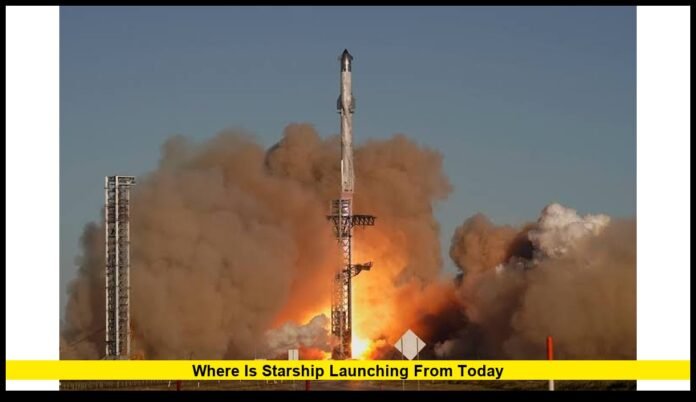

Where is Starship launching from today is attracting significant attention as SpaceX moves forward with another important test of its next-generation rocket. The company operates its Starship launch program from Starbase, a major aerospace development and launch facility near Boca Chica in Cameron County, South Texas. The latest mission, Starship Flight 15, lifted off from Orbital Launch Pad 2 on Friday, November 13, 2026, marking another milestone in the company’s effort to develop a fully reusable launch system.
The November mission is especially important because SpaceX is attempting to demonstrate the recovery of both major parts of its Starship rocket. While the Super Heavy booster did not complete its planned return to the launch tower, the upper-stage spacecraft reached low Earth orbit and successfully deployed 26 next-generation Starlink satellites.
The mission is not limited to the initial launch. SpaceX also plans to bring the spacecraft back toward Starbase for an attempted tower catch after its extended orbital journey. This makes Flight 15 an important test of the technologies needed to support future commercial spaceflight, lunar exploration, and potentially human missions to Mars.
Where Is SpaceX Starship Launching From?
Starship launches from SpaceX’s Starbase facility in South Texas. The site sits near Boca Chica, a coastal community close to Brownsville and the Gulf of Mexico.
Starbase serves as the central location for the development and operation of the Starship and Super Heavy rocket system. SpaceX carries out vehicle manufacturing, assembly, engine testing, launch preparation, and flight operations at the facility.
For the latest Flight 15 mission, SpaceX used Orbital Launch Pad 2 at Starbase. This is the specific launch location readers should associate with the November 13 flight.
The facility offers several advantages for large rocket operations. Its coastal position provides access to flight paths over the Gulf of Mexico, while its extensive industrial infrastructure allows SpaceX to conduct multiple stages of vehicle development in one location.
Starbase also contains specialized equipment designed for the unusual size and recovery requirements of Starship. The launch infrastructure includes a large steel tower, propellant storage systems, ground support equipment, and mechanical catching arms.
These systems support SpaceX’s objective of returning rocket hardware to the launch facility rather than routinely discarding it after a mission.
Starship Flight 15 Launches From Texas
SpaceX successfully launched Starship Flight 15 on November 13, 2026. The vehicle lifted off from Starbase at approximately 4:47 p.m. Central Time, beginning one of the company’s most ambitious test missions.
The launch involved the integrated Starship and Super Heavy system, which stands approximately 407 feet tall. Its Super Heavy first stage uses 33 Raptor 3 engines to provide the enormous thrust required to lift the vehicle away from Earth.
The initial ascent proceeded successfully. The rocket cleared the launch tower, climbed through the atmosphere, and completed its planned main engine cutoff and stage separation sequence.
One particularly important part of the flight was hot staging. During this operation, Starship’s upper-stage engines begin firing while the spacecraft separates from the Super Heavy booster. This allows the upper stage to continue accelerating toward orbit.
After separation, the two vehicles followed different flight paths.
Super Heavy began its planned return toward Starbase, while Starship continued its journey toward low Earth orbit.
The successful launch demonstrated that the upgraded rocket could complete another major stage of its development program. However, the recovery of the booster presented a separate challenge.
Super Heavy Booster Recovery Does Not Go as Planned
One of the main objectives of Flight 15 was to recover the Super Heavy booster using the mechanical arms attached to the Starbase launch tower.
SpaceX has previously demonstrated this recovery technique with earlier versions of Super Heavy. During those operations, the booster returned toward the tower under controlled engine power, allowing the mechanical arms to capture it before it reached the ground.
The system is commonly associated with the nickname chopsticks because of the appearance and movement of the large mechanical arms.
For Flight 15, SpaceX attempted to demonstrate the recovery of its upgraded Version 3 Super Heavy booster. This was an important opportunity to test whether the newer vehicle could complete the same type of controlled return.
However, the company called off the planned tower catch.
Instead of returning to the launch tower, the booster followed its contingency flight path and splashed down in the Gulf of Mexico approximately six and a half minutes after liftoff. The booster subsequently caught fire.
SpaceX had not provided a confirmed explanation for the decision to abandon the catch in the immediate post-launch coverage.
The outcome was a setback for the booster recovery objective, but it did not end the upper stage’s mission.
The distinction is important: a rocket can successfully complete its ascent and stage separation even when its planned first-stage recovery does not happen.
Starship Reaches Orbit and Deploys 26 Starlink Satellites
Despite the booster recovery problem, the Starship upper stage continued its flight and achieved an important milestone.
The spacecraft completed its engine burns and entered low Earth orbit at an altitude of approximately 170 miles, or 275 kilometers.
This marked the second time Starship had successfully reached orbit, following the achievement during Flight 14 in September 2026.
Another major objective involved deploying 26 Starlink Version 3 satellites.
These satellites are designed to support SpaceX’s next generation of satellite internet services. They are intended to provide greater network capacity and support improvements to the company’s global broadband infrastructure.
The deployment began approximately 35 minutes after launch and continued over a period of around 42 minutes.
The satellites are particularly relevant to Starship’s development because the spacecraft is designed to carry larger payloads than SpaceX’s existing Falcon launch vehicles.
The ability to transport next-generation Starlink hardware demonstrates one of the commercial applications SpaceX expects to support through regular Starship operations.
The successful deployment also means Flight 15 achieved a meaningful payload objective despite the unsuccessful booster catch attempt.
Why Starship Flight 15 Includes a 22-Hour Mission
Flight 15 is different from a short demonstration flight because SpaceX designed the mission around an extended orbital journey.
After reaching orbit and deploying its satellites, Starship is expected to remain in space for approximately 22 hours before beginning its return sequence.
The extended flight allows engineers to evaluate how the spacecraft performs during orbital operations and whether its systems remain suitable for atmospheric reentry.
The mission also involves monitoring the spacecraft’s condition before the planned recovery.
A particularly important area is the heat shield. Starship must withstand extremely high temperatures when returning through Earth’s atmosphere. Its thermal protection system therefore plays a central role in determining whether the vehicle can safely complete a return to the launch facility.
The planned mission includes an assessment of the spacecraft’s condition using cameras carried by three of the deployed Starlink satellites.
This information can help SpaceX evaluate the vehicle before committing to the more demanding return and landing operations.
The extended mission is therefore not simply about keeping Starship in orbit for a longer period. It gives the company an opportunity to test several systems that must work together before the spacecraft can be recovered and reused.
Starship’s Planned Return to Starbase on November 14
Following its November 13 launch, Starship is scheduled to attempt its return to the Starbase facility on Saturday, November 14.
This is one of the most closely watched parts of Flight 15 because SpaceX has not previously completed a tower catch of the Starship upper stage.
The company wants to bring the spacecraft back to the same launch facility from which it departed.
The planned return involves several demanding operations, including atmospheric reentry, controlled descent, engine relighting, final landing maneuvers, and alignment with the launch tower.
The FAA’s published operational planning information identifies a primary Starship reentry window beginning at 20:56 UTC on November 14 and extending into the early hours of November 15 UTC.
That window is an operational planning period rather than confirmation of a completed recovery.
SpaceX must first determine whether the spacecraft remains healthy enough to attempt the return. If the vehicle does not meet the required conditions, the company has contingency options that can direct it toward an ocean splashdown instead.
The planned spacecraft recovery is therefore a separate mission milestone from the launch and satellite deployment.
At the latest available reporting point, the outcome of the Flight 15 spacecraft recovery attempt had not yet been confirmed.
How SpaceX Plans to Catch the Starship Spacecraft
The launch tower at Starbase has a specialized recovery system designed to capture returning rocket vehicles.
Its mechanical arms are large structures that can move into position around a descending booster or spacecraft.
Rather than allowing the rocket to land on conventional legs, SpaceX aims to use the tower to catch the vehicle directly.
This approach could eventually make vehicle turnaround faster and reduce the need for extensive recovery equipment.
However, catching the Starship upper stage presents a different challenge from catching Super Heavy.
The booster returns relatively soon after launch, while Starship must first travel into orbit, complete its mission, and survive atmospheric reentry.
The upper stage must also approach the tower with sufficient control and precision to allow the mechanical arms to capture it safely.
A successful catch would demonstrate that SpaceX can recover an orbital spacecraft directly at its launch facility.
It would also provide valuable engineering information about the vehicle’s guidance, propulsion, thermal protection, and landing systems.
Nevertheless, one successful catch would represent an important demonstration rather than proof that Starship is already ready for routine commercial reuse.
Why Starbase Is the Center of SpaceX’s Starship Program
Starbase is more than a launch facility. It is the primary development center for SpaceX’s next-generation transportation system.
The company has built manufacturing facilities, testing areas, launch infrastructure, and vehicle assembly operations around the site.
This arrangement allows engineers to work on different parts of the Starship program without moving vehicles between multiple distant facilities.
The location also supports SpaceX’s long-term plans for increasing launch frequency.
Traditional rockets often require substantial refurbishment or replacement after completing a mission. Starship is being developed around a different approach in which both the booster and spacecraft can return and potentially fly again.
The launch tower is an important part of that strategy. Its mechanical arms are designed to catch returning vehicles, potentially reducing the time and resources required to prepare them for another flight.
SpaceX wants to move toward a system in which rocket launches become more frequent and the cost of transporting payloads into orbit decreases.
Starbase provides the infrastructure needed to develop and test that approach.
Is Starship Launching From Florida or California?
SpaceX operates several launch facilities across the United States, but not all of them support Starship.
Florida and California are important locations for the company’s Falcon rocket operations.
For example, Kennedy Space Center and Cape Canaveral Space Force Station in Florida support numerous Falcon 9 and Falcon Heavy missions. Vandenberg Space Force Base in California also hosts Falcon 9 launches, particularly missions that use western launch corridors.
Starship operations are different.
The company’s Starship and Super Heavy development program is based at Starbase in South Texas.
This distinction is useful for people following multiple SpaceX missions because a Falcon 9 launch from Florida does not mean Starship is launching from the same location.
For the November 13 Flight 15 mission, the launch location was Orbital Launch Pad 2 at Starbase.
How Starship Could Support NASA’s Artemis Program
Starship development also has significant implications for NASA’s future lunar exploration plans.
NASA selected SpaceX to develop a Starship-based human landing system for the Artemis program.
The proposed lunar lander is intended to transport astronauts between lunar orbit and the Moon’s surface during future missions.
However, converting Starship into a reliable lunar transportation system requires more than successful launches.
The company must demonstrate dependable vehicle operations, orbital refueling, long-duration spaceflight, and the ability to transport large amounts of cargo and equipment.
Orbital refueling is particularly important because a lunar mission requires substantially more propellant than a typical satellite deployment.
SpaceX is working toward a system in which Starship vehicles can transfer propellant in orbit, allowing another spacecraft to receive the fuel required for a longer journey.
The company must demonstrate these capabilities through additional testing before Starship can perform its intended lunar transportation role.
Flight 15 contributes to this broader development program by testing vehicle performance, payload deployment, and recovery technologies.
What Happens After Starship Flight 15?
The next stages of the Starship program will depend on the results of Flight 15 and the technical information collected during the mission.
SpaceX can use flight data to identify areas that require improvements before subsequent test flights.
Several development priorities remain important:
- Improving the reliability of Super Heavy booster recovery.
- Demonstrating a successful Starship upper-stage return.
- Increasing the durability of the spacecraft’s thermal protection system.
- Improving engine performance during ascent and landing.
- Developing reliable orbital refueling operations.
- Preparing Starship for more frequent commercial and government missions.
The booster recovery outcome from Flight 15 will provide useful information for future Super Heavy operations.
The spacecraft’s planned return is equally important because it represents a new challenge for the program.
If the upper stage successfully returns to Starbase and is caught by the tower, SpaceX will gain an important demonstration of its full-vehicle recovery concept.
If the attempt does not succeed, the flight can still provide valuable engineering information for future development.
The company has designed contingency procedures to avoid forcing a tower recovery when the spacecraft does not meet the required safety conditions.
How to Follow the Latest Starship Launch Updates
Space enthusiasts can follow Starship developments through SpaceX’s official launch communications and live mission coverage.
For Flight 15, the most important developments include the spacecraft’s orbital progress, the assessment of its heat shield, and the final decision about attempting a return to Starbase.
Viewers should pay attention to the difference between scheduled mission activities and confirmed outcomes.
A published recovery window does not guarantee that the spacecraft will return at the exact advertised time. Technical assessments, weather, regulatory requirements, and operational conditions can affect the schedule.
The launch itself has already taken place, so the primary focus has shifted from liftoff to the spacecraft’s remaining mission objectives.
The most significant outstanding milestone is the attempted recovery of Starship’s upper stage.
Final Thoughts
For anyone searching where is Starship launching from today, the confirmed answer is SpaceX’s Starbase facility near Boca Chica in South Texas.
Starship Flight 15 launched from Orbital Launch Pad 2 on November 13, 2026, at approximately 4:47 p.m. Central Time.
The mission successfully sent the upper-stage spacecraft into low Earth orbit and deployed 26 Starlink Version 3 satellites. However, the Super Heavy booster did not complete its planned tower catch and instead splashed down in the Gulf of Mexico.
The next major focus is the spacecraft’s planned return to Starbase on November 14. SpaceX is aiming to demonstrate that the upper stage can complete an orbital mission, survive atmospheric reentry, and return to the launch tower for a mechanical-arm catch.
The result could represent an important step toward making Starship a fully reusable orbital transportation system.
Starbase will remain central to this effort as SpaceX continues developing the hardware and operational capabilities needed for future satellite launches, lunar missions, and deeper space exploration.
Follow the latest SpaceX Starship news and share your thoughts about Flight 15’s recovery attempt in the comments.