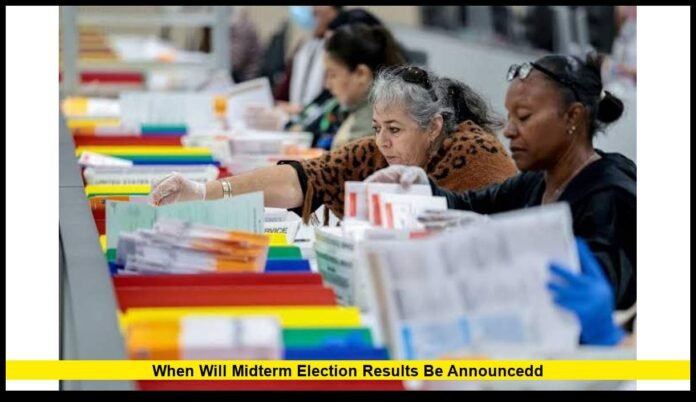

Americans across the country are closely following the 2026 congressional elections, with millions of voters seeking to understand when will midterm election results be announced and how long it will take to determine which political party controls Congress. Election Day is Tuesday, November 3, 2026, and preliminary results are expected to emerge throughout the evening as polling locations close and election officials begin reporting vote totals.
Unlike countries that announce nationwide election results at a predetermined time, the United States follows a decentralized election system. Each state administers its own voting procedures, establishes ballot-counting rules, and reports results independently. This means voters will see results arrive at different times depending on their location.
Some congressional races may have clear outcomes on election night, while others could remain undecided until additional ballots are counted. The most competitive contests deserve particular attention because a small number of seats could determine control of the House of Representatives or Senate.
Election-night reporting will provide an early picture of the political landscape, but preliminary totals should not be confused with officially certified results. Understanding the election schedule, poll closing times, ballot-counting procedures, and reporting process will help Americans follow developments throughout the night and in the days that follow.
Key Points Summary
╔════════════════════════════════════════════════════════════════════╗
║ – The 2026 U.S. midterm elections take place on Tuesday, November 3. ║
║ – The first polls close at 6 p.m. Eastern Time in parts of Indiana and Kentucky. ║
║ – Most major election-night results will arrive between 7 p.m. and midnight Eastern Time. ║
║ – All 435 House seats and 35 Senate seats are being contested. ║
║ – Close congressional races may take days to resolve as officials count outstanding ballots. ║
║ – Alaska’s ranked-choice voting process could delay the final outcome of its Senate race until later in November. ║
╚════════════════════════════════════════════════════════════════════╝
2026 Election Night: What Time Will Results Start Coming In?
The first election results will become available after polls close in individual jurisdictions. The earliest polling locations close at 6 p.m. Eastern Time, but statewide results from Indiana and Kentucky cannot be fully reported until their remaining polling locations close.
The next major reporting period begins at 7 p.m. Eastern Time, when polls close in Georgia, South Carolina, Virginia, Vermont, and parts of other states. North Carolina, Ohio, and West Virginia follow at 7:30 p.m.
The 8 p.m. hour is particularly important because polling locations in numerous states will have closed by then. Voters can expect more substantial reporting from competitive congressional districts and Senate contests during this period.
By 9 p.m., results from several major battleground states will begin taking shape. Arizona, Iowa, Michigan, Minnesota, New York, Wisconsin, and other states have polling locations scheduled to close around this time, although some states have multiple time zones.
At 10 p.m., additional western states close their polls. California and Washington reach their closing time at 11 p.m. Eastern Time, followed by Hawaii and Alaska later in the night.
These times indicate when voting ends, not when a winner must be announced. Election officials and news organizations need sufficient information to assess the results before a contest can be called.
2026 Midterm Election Poll Closing Times by Hour
The following schedule provides a practical overview of the major poll-closing periods. Times are Eastern Standard Time, and individual locations may have different closing arrangements.
| Eastern Time | States and locations | What to expect |
|---|---|---|
| 6 p.m. | Eastern portions of Indiana and Kentucky | Early congressional district returns may begin. |
| 7 p.m. | Georgia, South Carolina, Virginia, Vermont, and other locations | Initial statewide and congressional results become possible. |
| 7:30 p.m. | North Carolina, Ohio, West Virginia | More competitive races begin reporting. |
| 8 p.m. | Florida, Pennsylvania, Maine, New Hampshire, and numerous other states | A major wave of results arrives. |
| 8:30 p.m. | Arkansas | Additional results begin appearing. |
| 9 p.m. | Arizona, Michigan, Texas’s final polling areas, Iowa, Wisconsin, and other states | Important battleground results develop. |
| 10 p.m. | Montana, Nevada, Utah, and some other locations | More western and central results emerge. |
| 11 p.m. | California, Washington, and remaining Pacific-time locations | Western congressional races begin reporting. |
| Midnight, November 4 | Hawaii and most of Alaska | Late-night results continue. |
| 1 a.m., November 4 | Western Aleutian Islands in Alaska | The final scheduled polling locations close. |
This schedule does not guarantee that results will be published immediately after each closing time. States may release batches of results at different intervals, and election officials can continue updating vote totals throughout the night.
Which Congressional Races Could Determine the Election Outcome?
The central political question in the 2026 midterms is which party will control the House of Representatives and the Senate.
The House has 435 voting seats, all of which are contested in the regular election cycle. Because control depends on the distribution of seats nationwide, a relatively small number of competitive districts could determine the majority.
The Senate has 100 seats, with 35 being contested in the 2026 elections. The balance of power will depend on the results in those races and the seats held by senators who are not facing voters this year.
Several Senate contests are attracting attention, including races in Georgia, North Carolina, Ohio, Maine, Michigan, Texas, and Alaska. Their importance comes from the possibility that a small number of seats could determine which party controls the chamber.
House contests in competitive districts across the country will also receive close attention. A party may perform strongly in one region but lose ground elsewhere, making the national seat count more important than the result in any single state.
News organizations will assess individual races as results arrive. If the available evidence clearly establishes a likely winner, a race may be projected before every ballot has been counted.
However, when the outstanding vote could change the outcome, the contest may remain uncalled.
Why Election Results May Take Longer Than Expected
The United States does not have one national system that counts every ballot simultaneously. Each state follows its own election laws, and local election offices manage much of the counting and reporting process.
Several factors explain why some races are resolved quickly while others remain uncertain.
Mail-In Ballots
Mail voting can affect the speed of reporting because states have different deadlines and processing rules.
Some jurisdictions allow election workers to prepare mail ballots before Election Day. Others restrict certain processing activities until voting has ended.
California and Washington conduct elections primarily by mail. In both states, substantial numbers of ballots may remain uncounted on election night, meaning their results can continue changing over the following days.
Close Vote Margins
A narrow margin is another major reason results take longer to establish.
If a candidate leads by a small number of votes while thousands of ballots remain uncounted, the available information may not be enough to determine the winner.
Election analysts must consider where outstanding ballots are located and whether those ballots could change the result.
Provisional Ballots
Provisional ballots are used when a voter’s eligibility or registration requires additional verification under applicable election rules.
These ballots cannot necessarily be included in the initial reported totals. Officials must complete the required checks before determining which provisional ballots are valid.
Recounts and Legal Challenges
Some states provide for recounts when the margin between candidates meets a specified threshold. Other procedures may allow a candidate to request a recount under certain conditions.
Legal challenges can also extend the process if courts must resolve disputes concerning ballots or election procedures.
These circumstances do not automatically indicate that the original count was inaccurate. They are part of the legal framework governing election administration.
When Will the House Majority Become Clear?
The House majority could become apparent on election night if the results in competitive districts produce a sufficiently decisive seat count.
However, the timing will depend on how many close races remain outstanding and whether those districts could change the balance of power.
If most competitive districts produce clear outcomes by late Tuesday night or early Wednesday morning, analysts may be able to project which party will control the chamber.
If several key races remain unresolved, the House majority may not become clear until later in the week or beyond.
California could be particularly important if closely contested House races there determine the final seat count. Because the state relies heavily on mail voting, some congressional contests may take longer to resolve than races in jurisdictions that report a larger share of their ballots on election night.
The House result should therefore be evaluated through the total number of seats won, rather than the number of races called at a particular hour.
When Will the Senate Majority Be Known?
The Senate majority may become clear before every Senate race is resolved, but that depends on the distribution of the remaining seats.
If one party wins enough competitive races to establish a clear advantage, the national outcome could be projected during election night.
If the majority depends on a single close contest, the result may remain uncertain for several days.
Alaska is an especially important case because its Senate election uses ranked-choice voting. The state must review eligible ballots and conduct the required counting process before completing the final ranked-choice results.
The full results are not expected until November 18 under the announced schedule for the 2026 election. This means the final Senate balance could remain uncertain if Alaska’s outcome proves decisive.
Other states could also take longer to resolve their races because of close margins, outstanding mail ballots, or recount procedures.
The important distinction is that a projected Senate majority and the final official results of every Senate race do not necessarily arrive at the same time.
What Happens After Election Night?
Election officials continue working after polling places close. They must complete the counting process, reconcile totals, review eligible ballots, and follow the procedures required by state law.
Preliminary results are updated as additional votes are processed. Once the required counting and review procedures are completed, officials conduct the formal canvass and certification process.
Certification deadlines differ by state, so there is no single date on which every 2026 midterm result must be officially finalized nationwide.
Most races can move through this process without major delays. Close contests, recounts, and legal disputes may require additional time.
It is also important to understand that a media organization projecting a winner does not itself certify the election. A projection is an assessment based on available evidence, whereas certification is an official administrative process.
For voters, following both the preliminary count and subsequent official updates provides a more complete understanding of the outcome.
How to Follow the Latest 2026 Election Results
Readers can follow the election through state election offices, county election administrators, national news coverage, and local reporting.
State and local election officials are particularly useful for checking preliminary vote totals, outstanding ballots, recount developments, and certification announcements.
National news organizations provide broader coverage of congressional control and competitive races. Their election desks evaluate results and announce projected winners when their established standards are met.
Local news outlets can offer more detailed reporting about individual districts and the counties that may determine a close race.
When checking election results, readers should pay attention to the time of the latest update and distinguish between the number of votes counted and the percentage of precincts reporting. Those figures measure different things and do not always reveal how much of the total vote remains outstanding.
For example, a high percentage of precincts reporting does not guarantee that all mail ballots have been counted. Similarly, a candidate’s early lead does not necessarily mean the contest has been decided.
Reliable election reporting requires looking at the available evidence rather than relying on a single early number.
What to Expect on November 4 and Beyond
Wednesday, November 4, should provide a clearer picture of many races as additional ballots are counted and election analysts evaluate the results.
Some House and Senate contests may already have projected winners by the time Americans wake up. Others may remain unresolved if the remaining votes could affect the final outcome.
The days following Election Day will be especially important in states with extensive mail voting or ranked-choice procedures. Officials will continue processing eligible ballots, publishing updated totals, and completing required reviews.
If recounts or legal disputes arise, the timeline for particular races could extend further.
The national political picture may therefore develop in stages rather than through one definitive announcement. First, preliminary results will show how candidates are performing. Next, news organizations may project winners in sufficiently clear contests. Finally, election officials will complete the formal process and certify the results.
Understanding these stages is essential for anyone tracking congressional control and the broader consequences of the 2026 midterms.
Final Outlook for the 2026 Midterm Election Results
For Americans asking when will midterm election results be announced, the first results are expected after polling locations begin closing at 6 p.m. Eastern Time on November 3, with the largest waves of reporting following during the evening.
Many races could become clearer overnight, but there is no guarantee that every congressional contest or the overall balance of power will be settled by Wednesday morning.
The final timeline depends on vote margins, state election procedures, outstanding ballots, and whether recounts or legal challenges become necessary.
The best way to understand the outcome is to follow updated results while remembering that early vote totals, projected winners, and certified results represent different stages of the election process.
Which party do you think will control Congress after the 2026 midterms? Share your prediction in the comments and stay tuned for the latest election-night developments.