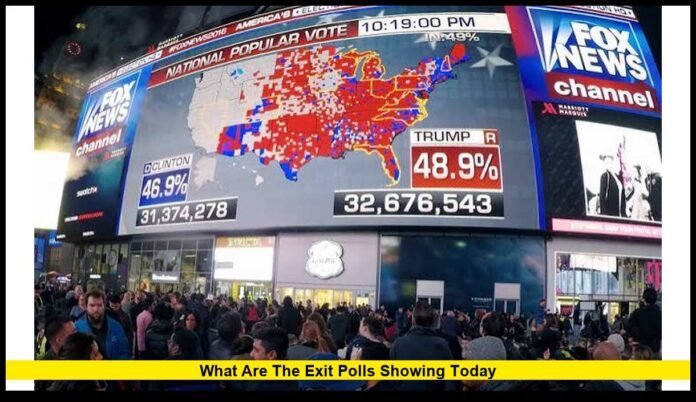

As Americans head to the polls on November 3, 2026, one of the biggest questions surrounding the midterm elections is what are the exit polls showing today. Voters are deciding contests that could reshape Congress, influence President Donald Trump’s legislative agenda, and determine political leadership in several states. However, the first exit-poll findings are not expected until after 5 p.m. Eastern Time, meaning there are no released Election Day exit-poll results to report at this stage.
The 2026 midterms feature elections for all 435 seats in the House of Representatives, 35 Senate seats, and governorships in 36 states. With control of Congress at stake, political analysts are watching voter turnout, economic concerns, presidential approval, and competitive statewide races for clues about the national mood.
When Will the First Exit Poll Results Be Available?
The first findings from the 2026 Voter Poll are expected after 5 p.m. Eastern Time on Election Day. The survey combines traditional interviews with voters at polling places and a large pre-election survey designed to include people who voted early or by mail.
Results will become available in stages. Findings that could indicate the outcome of a particular contest will not be released until the relevant polling locations have closed.
Poll closing times vary across the country. The first polling locations close at 6 p.m. Eastern Time in parts of Indiana and Kentucky. Other states follow throughout the evening, with California and Washington among the last states to close their polls.
This schedule means voters should be cautious about interpreting early election coverage. The absence of published exit-poll findings before the scheduled release does not indicate that a candidate is winning or losing.
What Is the 2026 Voter Poll?
The traditional exit poll has been a familiar part of American election coverage for decades. In 2026, major news organizations are using a combined survey system called the Voter Poll, conducted by SSRS.
The system is designed to provide a broader understanding of the electorate by combining pre-election interviews with Election Day polling.
Researchers gather information about candidate preferences, voter demographics, political attitudes, and the issues influencing decisions. They also use methods intended to reach people who cast ballots before Election Day.
This approach matters because millions of Americans vote through early voting and mail ballots. Interviewing only people leaving polling places on November 3 would leave out a substantial portion of the electorate.
The survey can help journalists explain how Americans voted and why they made those choices. Nevertheless, its estimates remain different from official election results.
Which Issues Could Shape the Exit-Poll Findings?
Several issues are likely to feature prominently in election-night analysis. The published survey findings will help establish which concerns mattered most to voters rather than relying on assumptions about the electorate.
The economy and household expenses
Economic conditions are often central to midterm elections. Inflation, grocery prices, housing costs, wages, health care expenses, and borrowing costs can influence how voters assess elected officials.
The survey may reveal whether economic concerns ranked among voters’ leading priorities and how people who identified the economy as their top issue voted.
However, economic dissatisfaction does not automatically benefit one political party. Voters may disagree about which officials are responsible for current conditions or which policies would provide relief.
Presidential approval
Midterm elections often serve as a public assessment of the president’s performance.
Survey findings can help explain whether voters who approve of the administration are more likely to support its party’s congressional candidates. They can also show whether dissatisfaction is associated with stronger opposition-party support.
These relationships may vary by state and district. National trends do not always predict the outcome of an individual race.
Immigration and border security
Immigration policy remains an important subject in national political debate. Voters may consider border enforcement, legal immigration, asylum policy, national security, and the economic effects of immigration when evaluating candidates.
The survey can help determine how frequently immigration appears among voters’ leading concerns and whether attitudes differ across political groups.
Health care and reproductive rights
Health care affordability and access to medical services may influence decisions in competitive congressional and statewide contests.
Reproductive rights may also affect voter preferences, particularly in states where abortion laws and proposed policy changes remain significant political issues.
The importance of these subjects will depend on the actual survey findings and the circumstances of individual races.
What Do Exit Polls Mean for Control of Congress?
The most consequential question of the 2026 midterms is whether Republicans or Democrats will control the House and Senate.
All 435 House seats are being contested. Because House elections take place in individual congressional districts, national polling averages cannot determine which party will win a majority.
A party may perform well nationally but lose several competitive districts. Alternatively, relatively small gains in strategically important districts may be enough to change control of the chamber.
The Senate presents a different challenge because only a portion of its seats are contested during each election cycle. The outcome depends on the results in the specific states holding Senate elections.
Competitive contests in states including Georgia, Michigan, North Carolina, Ohio, Maine, Iowa, and Texas are receiving particular attention.
Exit-poll findings may help explain how voters in these states approached the election. Actual vote totals, however, will provide the evidence needed to assess which candidates are winning.
How to Interpret Early Election Polling
When the first survey findings become available, readers should consider what each statistic actually measures.
A report showing that a certain percentage of voters identified the economy as their leading concern is not the same as a report showing a candidate’s share of the vote.
Similarly, a finding about how younger voters or independent voters behaved describes a particular group. It does not necessarily establish the preferences of the entire electorate.
Sample size also matters. National findings may be based on many respondents, while estimates for individual states or demographic groups can have greater uncertainty.
Survey estimates can change throughout election night as additional interviews are collected and researchers adjust the data.
Readers should also distinguish exit polls from election projections. A survey estimates voter behavior, while a projection reflects an assessment that a candidate is likely to win. Neither is the same as a final, certified result.
How Exit Polls Can Differ From Final Results
Exit polls can provide valuable information, but several factors may affect their accuracy.
Some voters are more willing than others to participate in surveys. People who vote early or by mail may also have different characteristics from those who vote in person on Election Day.
Researchers attempt to account for these differences, but statistical adjustments cannot eliminate every source of uncertainty.
Late-counted ballots can further complicate election-night coverage. Some states report large portions of their votes quickly, while others require more time to process outstanding ballots.
Consequently, an early survey estimate should not be treated as a definitive prediction of the final outcome.
The most reliable assessment combines voter surveys, official vote counts, turnout information, and race-specific analysis.
What to Watch as Election Night Continues
As the first results emerge, three developments will be especially important.
First, analysts will examine whether economic concerns and views of the administration appear to influence voting patterns across different states.
Second, attention will turn to competitive Senate and House contests, where relatively small changes in voter preferences could determine control of Congress.
Third, turnout patterns will help explain whether the final electorate differs from expectations based on pre-election surveys.
These developments will become clearer as more information is released. Until then, claims about specific exit-poll percentages or supposed winners should be treated with caution.
Final Outlook: What Are the Exit Polls Showing Today?
The 2026 midterm elections are an important test of the American political climate, but the first reliable conclusions about voter behavior will depend on the release of the Voter Poll findings after 5 p.m. Eastern Time.
At this stage, the key questions concern the economy, presidential approval, turnout, and the races that could determine control of Congress. The survey will help explain voters’ motivations, while official election returns will establish how the candidates are performing.
Readers should avoid treating predictions or unverified percentages as confirmed results. As the evening develops, the combination of survey findings and actual vote counts will provide a clearer picture of the electorate and the likely political consequences.
Follow the latest election developments and share your thoughts in the comments as the 2026 midterm results begin to emerge.