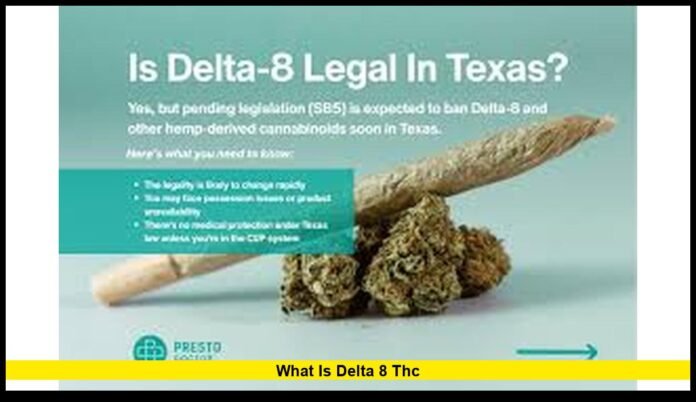

The term what is delta 8 THC refers to a hemp-derived psychoactive cannabinoid that has gained substantial attention in the United States — and it is now facing major legal shifts as of November 2025. Federal legislation passed by the United States Senate this week redefines “hemp” to exclude many intoxication-capable products, including most forms of delta-8, by late 2026. At the same time, regulators at the Food and Drug Administration (FDA) and state-level authorities are explicitly warning about health risks and unregulated manufacturing of delta-8 THC.
What Is Delta 8 THC?
Definition and Chemistry
Delta-8 tetrahydrocannabinol (commonly called “delta 8 THC”) is a cannabinoid found naturally in the Cannabis sativa plant, though only in very small amounts. It is structurally similar to the more familiar psychoactive compound, delta-9-tetrahydrocannabinol (delta-9 THC), with one key difference: the double bond in the molecule sits on the 8th carbon rather than the 9th.
Because delta 8 occurs in minimal quantities naturally, the commercially available form is often created by converting hemp-derived cannabidiol (CBD) into delta 8 via a chemical process.
Effects and How It Works
Delta 8 THC binds to the body’s endocannabinoid system (CB1 and CB2 receptors) similarly to delta-9 THC. Users describe its effects as a “fuzzy, euphoric high” that is somewhat milder than delta-9 THC. However, because of the limited research and variable product quality, its effect profile can be unpredictable.
Key Product Forms
Delta 8 THC is marketed in many forms for U.S. consumers:
- Gummies and candies.
- Vape cartridges and disposable pens.
- Edible chocolates and infused drinks.
These forms make delta 8 THC easily accessible in retail stores, vape shops, and online vendors—often without the age restrictions or labeling standards found in regulated cannabis markets.
Legal Status in the United States
Federal Level
At the federal level, the legal status of delta 8 THC is in flux. The 2018 Farm Bill legalized hemp (defined as cannabis with not more than 0.3% delta-9 THC by dry weight), but it did not explicitly address cannabinoids such as delta 8 derived from hemp. This left a “loophole” that manufacturers used to market delta 8 THC products.
In November 2025, the Senate approved language in a spending bill that would ban most hemp-derived intoxicating cannabinoids, including delta 8, by redefining hemp to exclude them. Under the new definition, a finished hemp-derived product must contain no more than 0.3% total THC and no more than 0.4 mg THC per container.
State-by-State Variation
Because federal regulation remains ambiguous and rapidly changing, each U.S. state has taken its own approach. For example:
- Some states have outright banned delta 8 THC or other hemp-derived intoxicating cannabinoids.
- Some states allow it with restrictions or require licensure.
- Some states have minimal regulation, making delta 8 easily available.
The lack of uniform oversight has led to significant differences in product availability and safety standards across the country.
Why This Matters
The impending federal changes could render the vast majority of delta 8 THC products on the market illegal by late 2026. This shift is already causing industry investment, regulation, and legal risk to increase. Consumers and retailers should stay alert to upcoming changes.
Health, Safety, and Public-Health Concerns
FDA and Public Health Warnings
The FDA has issued a consumer alert stating that delta 8 THC products have not been evaluated or approved for safe use. Some key concerns include:
- Chemical conversion processes: Some manufacturers use potentially unsafe chemicals to create delta 8 from CBD, introducing unknown by-products.
- Labeling and packaging: Many products are marketed as “hemp” or resemble snack foods, which may mislead consumers or appeal to children.
- Adverse events: Reported effects include hallucinations, vomiting, tremors, anxiety, confusion, and loss of consciousness.
Youth Usage and Public-Health Data
A national study found that over 11% of U.S. 12th-graders reported using delta 8 THC in the past year. The rate was higher in states with fewer regulations on delta 8 and where recreational marijuana remains illegal. Experts warn that adolescent exposure to psychoactive cannabinoids can pose risks to brain development, addiction potential, and mental health.
Research Gaps
Despite its widespread use, scientific understanding of delta 8’s long-term effects remains limited. Medical experts emphasize the need for more research into its pharmacology, dosing, and possible contaminants. Without standardized regulation or testing, consumers face uncertainty regarding purity and potency.
Why Consumers Are Using Delta 8 THC
- Perception of a “legal high”: Because delta 8 is derived from hemp, many users believe it skirts marijuana laws and is therefore legal and easier to access.
- Milder high: Some users describe delta 8’s effects as a smoother or lighter version of delta-9 THC, appealing to those seeking less intense psychoactive experiences.
- Accessibility: Products are sold in convenience stores, smoke shops, and online retailers in many states without traditional cannabis restrictions.
However, these same factors also contribute to safety concerns, as the lack of oversight and lab testing means products may contain harmful contaminants or inaccurate THC levels.
The Future of Delta 8 THC Regulation
The U.S. hemp and cannabis industries are preparing for a major regulatory overhaul. The new federal bill, if finalized, will close the 2018 Farm Bill loophole and require all intoxicating hemp products—including delta 8—to meet the same THC limits as regulated cannabis.
Industry experts predict that:
- Hemp-derived delta 8 THC products will largely disappear from the legal market by 2026 unless reformulated to meet new standards.
- States may strengthen testing and labeling requirements to ensure safety.
- Manufacturers could pivot toward non-intoxicating cannabinoids such as CBD or minor compounds like CBG and CBN.
For consumers, the message is clear: laws are tightening, and awareness of safety and compliance is more important than ever.
Bottom Line & Consumer Takeaway
In summary, what is delta 8 THC? It is a hemp-derived psychoactive cannabinoid offering a high similar to traditional THC but less potent and less regulated. Its legal status is evolving rapidly. The U.S. government is moving to ban most intoxicating hemp products by redefining hemp under federal law. Health agencies warn that delta 8 products are unapproved, may contain contaminants, and can pose risks to children and adults alike.
For consumers:
- “Hemp-derived” does not necessarily mean “safe.”
- Check your local state laws before buying.
- Verify that any product you purchase has third-party lab testing.
- Stay cautious—scientific data on long-term effects is still limited.
Stay informed and tread cautiously if you’re considering delta 8 THC — and feel free to share your thoughts or ask questions below.