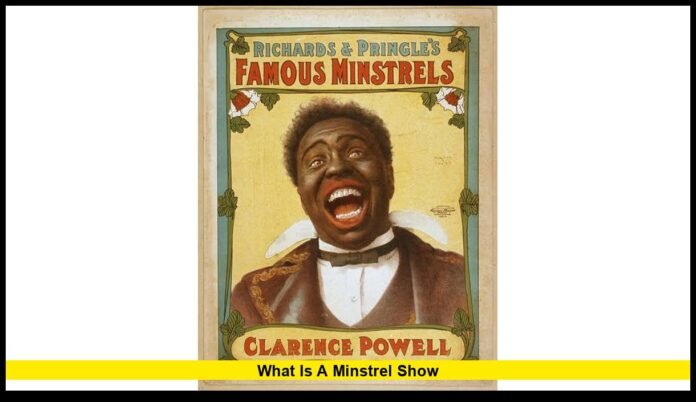

What is a Minstrel show? It was a popular form of American theatrical entertainment that combined music, comedy, dance and sketches with racist portrayals of Black Americans, especially through blackface performance. The form developed in the 19th century and became one of the most influential, and deeply troubling, traditions in American popular culture. Today, historians and museums treat minstrel shows as an important part of U.S. cultural history because they helped spread racial stereotypes that shaped American entertainment and public attitudes for generations.
The term refers primarily to the professional minstrel tradition that emerged during the 1830s and became formally organized into touring companies during the 1840s. Performers commonly used dark makeup, exaggerated costumes, music, comedy routines and stereotyped characters to create fictional representations of African Americans.
The subject remains relevant because many familiar elements of American entertainment, including certain songs, stage conventions, comedy styles and visual caricatures, developed alongside or were influenced by minstrelsy. Understanding the history also helps explain why blackface carries such strong racial meaning in the United States today.
What Is a Minstrel Show?
A minstrel show was a theatrical variety performance that typically featured white performers portraying Black people through exaggerated costumes, makeup, speech, movement and behavior. Blackface makeup often involved burnt cork or other dark substances, while performers frequently exaggerated facial features and adopted stereotyped characters.
The performances included songs, dances, comic dialogue, short sketches and other entertainment. The Library of Congress describes minstrel posters as representing programs that commonly included African-American music, broad comedy and African-American impersonations.
Although individual shows differed, many followed recognizable conventions. Performers presented caricatures rather than realistic portrayals of African Americans. Those caricatures often depicted Black people as lazy, ignorant, dishonest, foolish or excessively emotional.
The racial stereotypes were not incidental to the tradition. They formed a central part of the entertainment.
That distinction is important when explaining the history of minstrelsy. A minstrel show was not simply an old-fashioned musical comedy. It was an entertainment form built around racial impersonation and stereotypes.
When Did Minstrel Shows Begin?
The roots of blackface entertainment appeared before the minstrel show became a formal theatrical institution. During the early 19th century, white performers in the United States increasingly used blackface makeup and exaggerated portrayals of Black people in theatrical performances.
Thomas Dartmouth Rice became one of the most famous early blackface performers. Around 1830, he popularized the character Jim Crow, a stereotyped Black character associated with a song and dance routine. The Smithsonian identifies Rice as the developer of the first popularly known blackface character, “Jim Crow.”
The popularity of such performances expanded rapidly.
By the 1840s, blackface entertainment had developed into a recognizable commercial industry. Companies produced touring shows, songs, sheet music, costumes and other material connected with the performances.
The Library of Congress notes that minstrel shows became popular beginning in the 1840s, with many surviving posters dating from the late 19th and early 20th centuries.
Why Was Blackface Used in Minstrel Shows?
Blackface was used to create a theatrical imitation of Black identity. White performers darkened their faces and then presented exaggerated versions of African American speech, music, appearance and behavior.
The Smithsonian’s National Museum of African American History and Culture explains that minstrelsy cannot be separated from the racial derision and stereotyping at its core. Performances distorted African American features, language, dance, deportment and character.
This created a powerful visual shorthand.
Audiences could immediately recognize the intended character because performers relied on repeated stereotypes. The result was a theatrical language that portrayed Black Americans as fundamentally different from white Americans.
The practice also reflected the racial hierarchy of 19th-century America. Minstrelsy developed during a period when slavery, racial segregation and political struggles over citizenship shaped American life.
The entertainment industry helped make racial caricatures familiar to millions of people.
What Did a Minstrel Show Look Like?
Minstrel shows developed recognizable formats as the tradition matured. A typical performance could contain multiple sections featuring music, comedy, dancing, dialogue and short dramatic scenes.
One important development was the structured minstrel show of the mid-19th century. Performers often appeared in groups rather than simply as individual entertainers.
Music played a major role.
Banjo playing, songs and dances became closely associated with the minstrel stage. Performances also incorporated elements of African American musical culture, although white performers frequently presented those traditions through distorted and stereotypical interpretations.
The shows could also feature comic characters and exaggerated depictions of plantation life.
The Smithsonian notes that early minstrel performances portrayed enslaved Africans and plantation life through highly stereotypical representations. Characters were commonly depicted as lazy, ignorant, superstitious, hypersexual, cowardly or prone to theft.
These portrayals were fictional caricatures rather than accurate representations of Black American life.
Who Was Jim Crow?
Jim Crow became one of the most recognizable characters associated with early blackface minstrelsy.
Thomas Dartmouth Rice performed a routine connected with the character around 1830. The character became widely known through Rice’s performances and the song and dance associated with him.
The name later became associated with the system of racial segregation known as Jim Crow.
The theatrical character and the later legal and social system were not identical things, but the connection is historically significant. The minstrel character helped make “Jim Crow” a widely recognized racial expression in American culture.
This history shows how entertainment could influence language beyond the theater.
A stage character created for popular amusement eventually became connected with a much broader vocabulary of racial discrimination.
How Popular Were Minstrel Shows?
Minstrel shows became a major form of American entertainment during the 19th century.
Their popularity extended beyond major theaters. Touring companies performed in cities and towns across the country, bringing the format to different audiences.
The shows also became part of other entertainment settings.
The Smithsonian describes minstrel performances on showboats traveling American waterways. One Smithsonian collection item, a puppet named Mr. Tambo, is associated with a minstrel show reportedly staged on a Mississippi River showboat between New Orleans and St. Louis sometime between 1850 and 1875.
Large touring companies also emerged.
In the late 19th century, theater entrepreneur Jack Haverly consolidated minstrel companies into large touring organizations. His United Mastodon Minstrels eventually included more than 100 members at one point and used elaborate stage productions, costumes and effects.
This demonstrates the commercial scale minstrelsy reached.
It was not a small theatrical curiosity. It became an organized entertainment business with performers, managers, musicians, touring companies, theaters, publishers and merchandise.
Did Black Performers Appear in Minstrel Shows?
Yes. African American performers eventually entered the minstrel industry, although they faced serious racial discrimination and often had to work within a system built around stereotypes.
By the 1870s, African American actors began performing as minstrels, sometimes while still appearing in blackface. The Smithsonian explains that some Black performers brought greater humanity to caricatured roles, but Black minstrel companies could still present racist material because of the expectations of the entertainment industry and its audiences.
This creates an important distinction in the history of minstrelsy.
Black performers did not necessarily endorse the stereotypes they were required to portray. Some used performance strategically to earn money and establish careers in an industry that severely restricted opportunities for African American entertainers.
Others worked to transform the material.
The Smithsonian notes that African American performers could distinguish themselves from white performers by bringing greater humanity to stereotyped characters.
African American entertainers also developed their own theatrical traditions that eventually moved beyond the limitations of blackface minstrelsy.
What Music Was Used in Minstrel Shows?
Music was central to the minstrel tradition.
Songs, banjo performances, dances and musical comedy helped make the shows accessible to large audiences. Minstrel songs also circulated outside theaters through sheet music.
The Smithsonian’s archival collection of minstrel and blackface material includes illustrated sheet music dating from roughly 1828 through 1978, with much of the material concentrated in the 1840s and 1850s.
The commercial publication of songs helped extend minstrelsy’s cultural reach.
People who never attended a performance could encounter minstrel imagery and songs through printed music, advertisements and other forms of popular culture.
The cakewalk provides one example of how African American cultural practices became entangled with minstrelsy.
The Smithsonian’s National Museum of American History explains that the cakewalk became a regular routine in minstrel shows by the end of the Civil War. White performers transformed the dance into a caricature while presenting it for predominantly white audiences.
How Did Minstrel Shows Portray Black Americans?
The central problem with minstrel shows was their repeated presentation of Black Americans through racist stereotypes.
Performers exaggerated physical characteristics, speech patterns, clothing and behavior. The characters frequently appeared as foolish, dishonest, lazy or incapable.
These images reduced complex human beings to a limited set of comic stereotypes.
The Smithsonian’s National Museum of African American History and Culture emphasizes that these representations helped codify ideas about Blackness. The institution notes that repeated stereotypes portrayed Black people as irresponsible, laughable and difficult to understand.
Such portrayals had consequences beyond entertainment.
When audiences repeatedly encountered the same stereotypes, those images could influence perceptions of African Americans in everyday life. Minstrelsy therefore played a role in the broader cultural history of American racism.
How Did Minstrel Shows Affect American Culture?
Minstrelsy influenced American popular entertainment for decades.
Its conventions appeared in theater, vaudeville, music, film and later mass media. The Smithsonian notes that blackface performances moved beyond the stage into radio, television and film.
Some major entertainers of the 20th century also appeared in blackface.
The Smithsonian identifies performers including Shirley Temple, Judy Garland and Mickey Rooney among popular actors who participated in blackface performances.
The influence extended into other forms of entertainment as well.
The Smithsonian Libraries and Archives describes scholarship examining connections between blackface minstrelsy and early American animation. Such research explores how visual and performance conventions associated with minstrelsy influenced early cartoon characters and animation culture.
Minstrelsy’s influence therefore did not disappear when traditional minstrel companies declined.
Elements of its visual language and stereotypes survived in later entertainment.
When Did Minstrel Shows Decline?
Minstrel shows gradually lost their position as America’s dominant popular entertainment as new forms of entertainment developed.
Vaudeville became increasingly important during the late 19th and early 20th centuries. Minstrel-style acts continued to appear within vaudeville, but the broader entertainment industry was changing.
The Smithsonian describes vaudeville as a major form of American family entertainment and notes that many minstrel companies and performers helped shape its development after the Civil War.
Movies, radio and other mass-media formats later created additional alternatives.
Even as formal minstrel companies declined, blackface itself remained present in American entertainment into the 20th century.
That persistence explains why the historical impact of minstrelsy continued long after the original theatrical format faded.
Why Are Minstrel Shows Considered Racist?
Minstrel shows are considered racist because their entertainment depended heavily on the caricature and degradation of Black Americans.
The issue is not simply that performers used makeup to change their appearance. Blackface was part of a larger performance system that presented racial stereotypes as comedy.
The Smithsonian states directly that blackface minstrelsy was founded on the comic enactment of racial stereotypes.
The performances occurred within a society marked by slavery and racial inequality. As a result, portraying Black Americans as inferior, foolish or subhuman reinforced existing racial hierarchies.
The historical context matters.
A modern audience may encounter an old image, song or performance without understanding its original meaning. Studying minstrelsy helps explain why these images are not merely outdated jokes.
They were products of a racial system and contributed to the circulation of racial ideas.
Are Minstrel Shows Still Performed Today?
Traditional minstrel shows are no longer a mainstream form of American entertainment.
However, the legacy of blackface and minstrel imagery remains a subject of historical and cultural discussion. The Smithsonian notes that blackface and racial caricature continue to appear in public controversies, including incidents involving schools, universities and other organizations.
Modern discussions generally treat blackface as offensive because of its historical connection to racial stereotyping and discrimination.
Museums and historians continue to preserve minstrel-related objects, posters, sheet music, photographs and other materials because they provide evidence about American cultural history.
The purpose of studying these materials is not to celebrate the stereotypes.
Instead, historical collections allow researchers and the public to understand how racial ideas developed, circulated and became embedded in popular culture.
Minstrel Shows vs. Other 19th-Century Theater
Minstrel shows were one part of a much larger American entertainment industry.
They shared characteristics with other variety performances, including music, comedy, dancing and short sketches. What distinguished blackface minstrelsy was its central use of racial impersonation and caricature.
The Library of Congress describes minstrel companies as presenting programs that combined African-American music, broad comedy and African-American impersonations.
That combination helped make the format commercially successful.
At the same time, it made minstrelsy particularly significant in the history of American racial representation.
The tradition connected entertainment with racial identity at a time when the United States was undergoing enormous political and social change.
A Quick Timeline of Minstrel Show History
| Period | Important development |
|---|---|
| Early 1800s | Blackface performances begin appearing in American popular entertainment |
| Around 1830 | Thomas Dartmouth Rice popularizes the Jim Crow character |
| 1830s | Early minstrel performances emerge in New York |
| 1840s | Minstrel shows develop into organized commercial entertainment |
| 1850s–1860s | Touring companies and minstrel performances expand widely |
| After the Civil War | Minstrelsy remains highly popular while Black performers increasingly enter the industry |
| Late 1800s | Large touring companies and elaborate minstrel productions become prominent |
| Early 1900s | Minstrel traditions influence vaudeville and other entertainment |
| 20th century | Blackface appears in film, radio, television and other mass media |
| Today | Minstrelsy is studied primarily as an important and troubling part of American cultural history |
Why Understanding Minstrel Shows Matters Today
Knowing the answer to what is a minstrel show requires more than memorizing a definition.
The history illustrates how entertainment can influence cultural attitudes. A performance that millions of people considered comedy could also normalize harmful ideas about an entire racial group.
Minstrelsy also demonstrates how cultural traditions can survive after the original institutions disappear.
Some musical and theatrical conventions associated with the minstrel stage entered later entertainment forms. At the same time, the racist imagery associated with blackface continued to affect how Black Americans were represented.
Museums such as the Smithsonian continue to preserve minstrel-related artifacts because they document these developments.
The Library of Congress also maintains collections and research resources related to minstrelsy, African American music and early American popular entertainment.
Studying these materials provides a more complete understanding of American entertainment history.
It also helps distinguish African American cultural contributions from the distorted representations created by white performers.
What Is the Main Historical Lesson of Minstrel Shows?
The history of minstrelsy shows that popular entertainment can have a powerful role in shaping public ideas about race.
Minstrel performers borrowed elements of African American music, dance and culture while frequently presenting them through racist caricatures. African American performers later entered the same industry and, in some cases, worked to reshape those traditions from within.
The legacy is therefore complicated, but one fact is clear: blackface minstrelsy played a major role in creating and spreading racial stereotypes in the United States.
Today, minstrel shows are primarily studied through museums, archives, scholarship and historical collections rather than treated as ordinary entertainment.
Understanding the tradition provides important context for American theater, music, comedy, popular culture and the history of race.
The most accurate answer to what is a Minstrel show is therefore straightforward: it was a historically significant American entertainment form built around music, comedy and theatrical performance, but its most recognizable tradition relied on blackface and racist portrayals of African Americans.
What part of minstrel show history do you think deserves more attention? Share your thoughts in the comments and stay updated on important American cultural history.