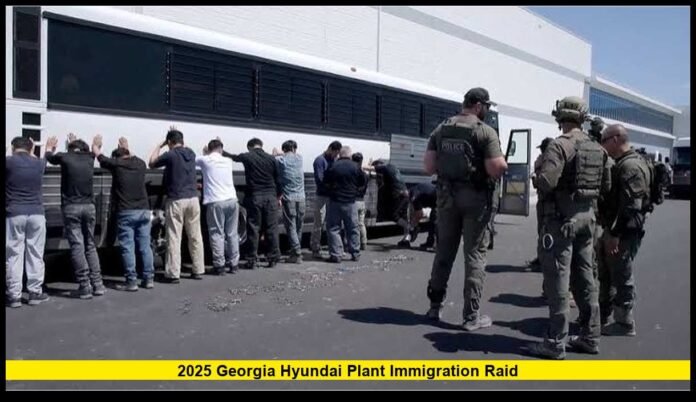

The 2025 georgia hyundai plant immigration raid has entered a new legal phase, with more than 300 South Korean workers beginning administrative claims against the U.S. government nearly one year after their detention in Georgia. The workers were among 475 people detained during the September 4, 2025, federal operation at a Hyundai Motor Group and LG Energy Solution battery facility in Ellabell.
The latest claims challenge the workers’ detention, the conditions they experienced in custody and the personal and financial harm they say followed the operation. The filings target nine federal agencies, including the Department of Homeland Security, Immigration and Customs Enforcement, Customs and Border Protection, the FBI, the Department of Justice and the Department of Labor.
The legal action marks a major development in a case that initially centered on alleged unlawful employment. Federal authorities conducted the operation under a judicial search warrant and said the investigation involved suspected violations of federal employment and immigration laws.
One year later, the Justice Department has confirmed that no criminal charges have been filed in connection with the investigation involving the companies. Federal court records show the case as closed.
That combination of developments has placed the treatment of the detained workers at the center of the story.
What Happened at the Georgia Hyundai Facility
Federal agents carried out the operation on September 4, 2025, at the HL-GA Battery Company facility located on the Hyundai Motor Group Metaplant America campus in Ellabell, Georgia.
The battery facility was being constructed as part of Hyundai Motor Group’s major manufacturing investment in the Savannah area. Hyundai and LG Energy Solution established the joint venture to produce batteries for electric vehicles manufactured in the United States.
The federal operation involved hundreds of law enforcement personnel.
Authorities identified more than 475 workers during the operation. Most of the South Korean workers were employed through contractors or subcontractors involved in construction and battery-facility work rather than directly by Hyundai.
Federal officials said investigators had spent months examining suspected unlawful employment practices before obtaining and executing the search warrant.
The Justice Department described the operation as a criminal investigation involving alleged unlawful employment of foreign nationals.
The government also said some workers attempted to flee when agents arrived. Several people reportedly entered a sewage pond on the property before authorities detained them.
The operation quickly became an international story because of the number of South Korean nationals involved.
475 Workers Were Detained
The number 475 became central to coverage of the operation.
Federal authorities identified more than 475 people who they said were unlawfully working at the site. The group included workers from several countries.
More than 300 were South Korean nationals.
Other detained workers included people from Latin American countries and other parts of the world. Their immigration circumstances varied, and the federal government did not characterize every worker’s situation in exactly the same way.
The workers were taken into federal custody following the operation.
Images released during the raid showed workers being restrained. Some were placed in handcuffs and shackles before transportation to detention facilities.
Those images produced an immediate backlash in South Korea.
The visual evidence became especially significant because South Korea is a major U.S. economic and security partner. The detained workers were also connected to a high-profile industrial project backed by billions of dollars in investment.
Why South Korean Workers Became the Focus
The large number of South Korean workers made the raid particularly sensitive.
Many had traveled to Georgia for specialized work associated with the construction and installation of equipment at the battery facility.
Large industrial projects often require specialized personnel during construction and equipment installation. Foreign engineers, technicians and other specialists may travel temporarily to the United States for these assignments.
The dispute surrounding the Georgia operation included questions about whether particular workers had appropriate authorization for the specific activities they performed.
A worker can legally enter the United States but still lack authorization to perform particular types of employment.
That distinction became especially important in the Georgia case.
Federal authorities argued that workers were violating U.S. immigration or employment rules. Workers and their representatives have disputed aspects of the government’s handling of the detentions.
The latest legal claims now give those workers an opportunity to present their allegations through a formal federal process.
The Search Warrant Is Now a Major Legal Issue
One of the most closely watched issues involves the federal search warrant used during the operation.
The government has maintained that agents acted under a judicially authorized warrant as part of an investigation into suspected unlawful employment and other federal crimes.
However, current reporting on the workers’ claims has highlighted that the warrant identified four specific individuals as targets. None of those four people were among the South Korean workers detained during the operation.
That distinction is likely to remain important as the claims move forward.
The workers’ legal representatives argue that the government improperly detained people beyond the individuals specifically identified in the warrant.
Federal officials have defended the overall operation as lawful.
The competing arguments have not been finally resolved in court.
The Treatment of Workers During Detention
The conditions surrounding the detentions have become a central part of the new claims.
Workers say they experienced serious emotional distress during the operation and subsequent detention.
Their claims seek compensation for several categories of alleged harm, including lost employment, confiscated belongings and psychological injuries.
Some workers also say they were unable to communicate with family members after their phones were taken.
For families in South Korea, the sudden loss of contact created considerable uncertainty.
The images of workers restrained at their wrists, waists and ankles also intensified public criticism.
The workers’ attorneys now argue that the manner of detention caused unnecessary humiliation and lasting emotional harm.
Those allegations remain claims rather than findings by a court.
The federal government continues to maintain that the enforcement operation was lawful.
More Than 300 Workers Begin Administrative Claims
The newest development came in September 2026.
More than 300 South Korean workers have begun filing administrative claims with federal agencies over their treatment during the 2025 operation.
The process is important because an administrative claim generally must precede certain lawsuits seeking damages from the federal government.
The workers’ attorney has indicated that claims will be filed on behalf of the affected workers with nine federal agencies.
Those agencies include:
- Department of Homeland Security
- Immigration and Customs Enforcement
- Customs and Border Protection
- Federal Bureau of Investigation
- Department of Justice
- Department of Labor
- Other federal agencies involved in the operation
The filings seek damages for alleged losses and injuries connected to the detention.
The claims also challenge the circumstances in which the workers were held.
The legal representatives have said they intend to continue filing claims for the remaining workers during 2026.
This means the dispute could continue developing well beyond the anniversary of the original raid.
No Criminal Charges Filed Against the Companies
Another important development emerged on the first anniversary of the operation.
The Department of Justice confirmed that no criminal charges had been filed in connection with the case involving the Hyundai megasite.
Federal court records also show the case as closed.
That does not mean authorities declared that every worker involved in the operation had complied with immigration law.
It does mean that the major criminal investigation announced after the raid did not result in criminal charges against the companies involved, based on the latest confirmed information.
The distinction is important because the initial operation was described as an investigation into alleged unlawful employment.
The absence of charges also adds context to the workers’ decision to pursue administrative claims against federal agencies.
The Case Involves Contractors and Subcontractors
Another detail frequently misunderstood involves who actually employed the detained workers.
The operation took place at a Hyundai Motor Group campus, but the workers detained at the battery construction site were not all Hyundai employees.
Many worked for contractors or subcontractors.
The battery facility itself was being developed through HL-GA Battery Company, a joint venture involving Hyundai Motor Group and LG Energy Solution.
Hyundai stated after the raid that the detained foreign nationals were not directly employed by Hyundai.
That distinction matters when describing the case.
The location was a major Hyundai manufacturing campus, but the federal investigation focused on the battery construction operation and companies working on the project.
What Happened to the Detained South Korean Workers
The detention created an immediate diplomatic challenge between Washington and Seoul.
South Korean officials traveled to the United States to work on the release and return of their citizens.
More than 300 South Korean workers ultimately returned to South Korea after being detained.
Their return became one of the most visible consequences of the operation.
The episode also prompted broader discussions about the immigration process for foreign specialists working on major U.S. industrial projects.
The controversy did not permanently end the involvement of Korean workers in the Georgia project.
Some workers later returned to the United States for work connected to battery facilities, including some who had been detained during the original operation.
That development underscored the importance of the battery project to the companies involved and the continuing need for specialized personnel.
Some Workers Later Returned to the United States
The return of some affected workers became another notable part of the aftermath.
After the initial detention and repatriation, certain Korean workers returned to the United States under immigration arrangements that allowed them to participate in qualifying work.
Some reportedly returned using B-1 visas.
Their return does not resolve the legal dispute surrounding the original operation.
Instead, it demonstrates how complicated immigration rules can become when foreign specialists participate in highly technical industrial projects.
The workers’ legal claims now focus on what happened during the raid and detention rather than simply on their later immigration status.
A Separate $2 Million Claim Adds to the Legal Pressure
The South Korean workers are not the only people pursuing legal action.
Alfredo Fajardo Melgarejo, a Colombian worker detained during the operation, has filed a $2 million administrative claim against ICE.
His claim describes the September 2025 detention as a traumatic experience.
Fajardo alleges that officers used excessive force during his arrest. He also says authorities failed to provide him with an opportunity to communicate with his family for an extended period.
His attorneys say his family feared that something serious had happened to him because they could not reach him.
The claim also alleges that Fajardo lost employment and suffered financial and emotional consequences following the detention.
These allegations have not been established as facts by a court.
The claim is moving through the administrative process established for seeking damages from the federal government.
The First Anniversary Changed the Focus of the Case
When the raid happened in September 2025, the central question was why hundreds of workers were detained.
A year later, the focus has shifted.
The investigation itself did not result in criminal charges against the companies, according to the latest Justice Department confirmation.
Meanwhile, the people detained during the operation are challenging the government’s conduct.
That creates two separate issues.
The first involves the government’s original allegations about unauthorized employment and immigration violations.
The second involves whether federal officers violated the rights of workers during their detention.
Those questions can exist independently.
A worker could face an immigration violation while still having legal protections governing how federal authorities may detain and treat that person.
The new administrative claims are designed to address the second issue.
Why the Legal Claims Matter
The claims could become one of the most important developments arising from the Georgia operation.
If the federal agencies deny the claims, or if the administrative process otherwise reaches a point where the workers can pursue further litigation, federal courts could eventually be asked to examine the circumstances surrounding the operation.
That could place evidence from the raid under greater scrutiny.
The workers’ attorneys may seek records involving the search warrant, detention decisions, transportation, custody conditions and communications between federal agencies.
The government would have an opportunity to defend its actions and challenge the allegations.
No final judicial determination has been made about the workers’ claims.
For now, the legal process is still developing.
Current Status of the Georgia Hyundai Raid
As of September 16, 2026, the major confirmed developments are clear.
Federal agents detained more than 475 workers at the Georgia battery construction site on September 4, 2025.
More than 300 South Korean nationals were among those detained.
The operation was conducted under a federal search warrant during an investigation into alleged unlawful employment.
Most of the detained Korean workers eventually returned to South Korea.
Some later returned to the United States for work connected to battery manufacturing.
The Justice Department has confirmed that no criminal charges have been filed in connection with the investigation involving the companies.
Now, more than 300 South Korean workers are pursuing administrative claims against federal agencies.
A separate Colombian worker has also filed a $2 million claim against ICE.
The government continues to defend the legality of the original operation.
The workers’ legal representatives are challenging the circumstances of their detention and seeking compensation for alleged harm.
The next stage will depend on how federal agencies respond to the administrative claims and whether the disputes eventually reach federal court.
The case therefore remains active from a legal perspective even though the original enforcement operation occurred a year ago.
What Comes Next
The workers’ claims could take months to process.
Additional claims are expected to be filed as the legal team works to represent the larger group of South Korean detainees.
The process could eventually produce negotiations, administrative decisions or federal litigation.
For the workers, the claims represent an opportunity to challenge what they say happened during one of the largest worksite immigration operations in U.S. history.
For the federal government, the proceedings provide an opportunity to defend the actions taken during the investigation.
The central dispute is no longer limited to immigration status.
It now includes questions about detention, treatment, damages and the scope of federal authority during a major workplace enforcement operation.
The answers will likely shape how the September 2025 Georgia operation is viewed in the years ahead.
The legal fight surrounding the Georgia Hyundai raid is still unfolding, so share your thoughts below and stay informed as new developments emerge.