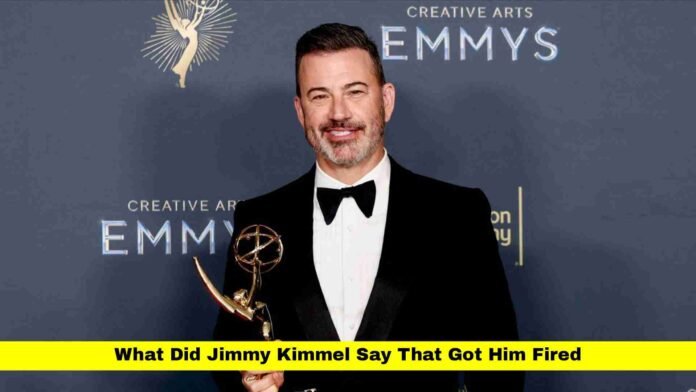

The phrase what did Jimmy Kimmel say that got him fired has dominated headlines since mid-September 2025. While the word “fired” is technically inaccurate, it reflects the widespread perception that ABC had permanently removed him from late-night television. In reality, Kimmel’s show was suspended for six days following controversial comments he made about the murder of conservative activist Charlie Kirk. The suspension created a political firestorm, drew regulatory threats, and raised major questions about free speech in entertainment.
This article breaks down everything you need to know—from the exact remarks that caused outrage to the timeline of events, the political fallout, and what this moment means for the future of late-night comedy.
Jimmy Kimmel’s Controversial Monologue
On September 15, 2025, during his opening monologue on Jimmy Kimmel Live!, Kimmel addressed the assassination of Charlie Kirk, who was killed in Utah just days earlier. His comments struck a nerve because they targeted the way political groups responded to the tragedy.
Kimmel said:
“We hit some new lows over the weekend with the MAGA gang trying to characterize this kid who murdered Charlie Kirk as anything other than one of them, and doing everything they can to score political points from it.”
The late-night host’s tone was sharp, and his choice of words angered many on the right. Critics argued that Kimmel’s remarks came too soon after Kirk’s death and risked disrespecting the family. Supporters countered that he was simply highlighting how politicians were exploiting the killing for partisan gain.
Kimmel later clarified that his intent was not to blame conservatives as a group, but rather to criticize opportunistic rhetoric.
Why ABC Pulled Jimmy Kimmel Off the Air
Two days later, on September 17, ABC announced that Jimmy Kimmel Live! would be suspended “indefinitely.” The network justified its decision by describing the monologue as “ill-timed and insensitive.”
Behind the scenes, however, multiple factors influenced the suspension:
- Regulatory Pressure: FCC Chair Brendan Carr publicly criticized Kimmel’s remarks and hinted that affiliate licenses could come under review if ABC failed to act.
- Affiliate Boycotts: Major station groups such as Nexstar and Sinclair refused to air the show, regardless of ABC’s decision.
- Political Blowback: Several conservative figures accused Kimmel of fueling division during a national tragedy.
- Corporate Risk Management: Disney, ABC’s parent company, faced mounting pressure to avoid being drawn into political disputes.
These overlapping forces left ABC with little choice but to take action, even if temporarily.
Kimmel’s Reaction to the Suspension
Jimmy Kimmel expressed frustration with the network’s decision but avoided direct attacks against ABC. He later explained that while he disagreed with the suspension, he understood the network’s fear of escalating political fallout.
Kimmel clarified that:
- He did not intend to disrespect Charlie Kirk’s family.
- He believed the murderer acted alone and did not represent any broader group.
- His remarks were directed at political opportunism, not ideology itself.
By September 22, ABC and Kimmel had reached an agreement to bring the show back.
The Return of Jimmy Kimmel Live!
On September 23, Kimmel returned to late-night television with a lengthy 15-minute monologue addressing the suspension.
During his remarks, Kimmel:
- Reaffirmed that violence should never be politicized.
- Thanked supporters across the political spectrum who defended his right to speak.
- Criticized FCC officials who threatened ABC affiliates, calling it censorship.
- Praised Erika Kirk, Charlie Kirk’s widow, for her dignity at the memorial service.
His return episode drew heightened viewership, showing that the controversy only amplified public interest.
Why People Believe Kimmel Was “Fired”
Although Kimmel was reinstated quickly, the perception of a firing spread online. There are several reasons for this:
- Immediate Show Removal – The abrupt disappearance of Jimmy Kimmel Live! created the impression of termination.
- Affiliate Rebellion – Local station groups preempted the show, making it appear permanently canceled in many regions.
- Political Rhetoric – Figures like Donald Trump described the suspension as a firing, reinforcing the narrative.
- No Clear Timeline – ABC initially labeled the suspension as “indefinite,” leaving audiences confused about whether Kimmel would return.
For many viewers, suspension felt indistinguishable from being fired.
The Political Firestorm
The suspension quickly evolved into a national debate over comedy, politics, and free expression.
- Donald Trump called Kimmel’s remarks “horrible” and celebrated his suspension, describing it as proof that “the ratings-challenged clown” had been exposed.
- Brendan Carr, FCC Chair, pushed for stronger scrutiny of ABC affiliates, claiming Kimmel’s remarks violated broadcast standards.
- Stephen Colbert and Seth Meyers, fellow late-night hosts, defended Kimmel and condemned ABC’s decision as bowing to political intimidation.
- Unexpected Allies: Some conservative lawmakers, while critical of Kimmel’s words, nonetheless defended his right to free speech.
The cross-ideological reactions highlighted how the controversy touched on deeper issues of censorship and media independence.
Timeline of Events
| Date | Event |
|---|---|
| Sept 15, 2025 | Kimmel delivers controversial Charlie Kirk monologue |
| Sept 17, 2025 | ABC suspends Jimmy Kimmel Live! indefinitely |
| Sept 18, 2025 | Nexstar and Sinclair preempt the show on their ABC affiliates |
| Sept 22, 2025 | ABC announces Kimmel’s return following internal discussions |
| Sept 23, 2025 | Kimmel returns to air, addressing controversy in opening monologue |
Impact on Late-Night Comedy
Kimmel’s suspension raised broader concerns within the entertainment industry. Late-night shows thrive on political commentary and satire. If a host can be pulled off the air under political pressure, it sets a precedent that could affect others.
The situation highlighted:
- Fragility of Satire: Comedy that targets politics is increasingly vulnerable to backlash.
- Corporate Hesitancy: Networks may prioritize advertiser and affiliate concerns over creative freedom.
- Polarization of Audiences: Viewers interpret satire through ideological filters, amplifying controversy.
Kimmel himself suggested that if comedians must “self-censor to avoid upsetting politicians,” late-night comedy risks losing its purpose.
Public Opinion and Audience Reaction
Reactions from the public were divided along partisan lines.
- Supporters of Kimmel argued that suspension was censorship and that he was being punished for speaking truth to power.
- Critics accused him of being disrespectful and claimed he crossed a moral line by addressing a tragedy too soon.
- General Viewers expressed confusion, many believing he had been outright fired.
Interestingly, ratings for Kimmel’s return episode spiked significantly, showing that controversy often fuels renewed interest.
What This Means for ABC and Disney
For ABC and its parent company Disney, the suspension reflected the balancing act of maintaining both corporate responsibility and creative freedom.
- Affiliates and advertisers wanted to avoid controversy.
- Political threats risked regulatory complications.
- At the same time, pulling Kimmel risked alienating viewers and employees who value artistic freedom.
The incident reinforced the difficulty media corporations face in navigating America’s polarized environment.
Final Thoughts
So, what did Jimmy Kimmel say that got him fired? His blunt critique of how Charlie Kirk’s death was politicized triggered a cascade of political pressure, affiliate boycotts, and ultimately, a six-day suspension. While not technically fired, the suspension blurred the lines, leading many to believe he had been permanently removed.
Kimmel’s return to late-night television reignited debates about free speech, censorship, and the future of political comedy in America. His case serves as a reminder of how fragile creative freedom can be when media, politics, and public opinion collide.
Do you think ABC made the right call, or was Kimmel unfairly targeted? Share your thoughts in the comments below.