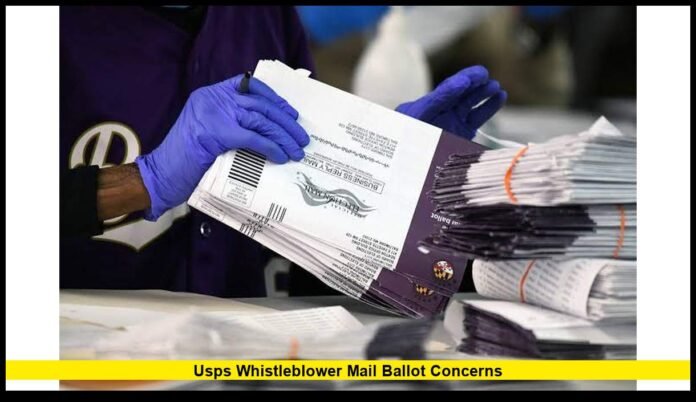

USPS whistleblower mail ballot concerns are drawing national attention as an anonymous federal official warns that a rushed Postal Service system could delay or prevent large batches of mail ballots from reaching voters before the 2026 midterm elections.
The whistleblower disclosure became public on September 1 after Sen. Richard Blumenthal of Connecticut released the allegations and sent them to Postmaster General David Steiner. The disclosure focuses on the Postal Service’s new Federal Ballot Mail Portal and related technology designed to enforce new federal requirements for election mail.
The allegations are significant because the system could affect how states submit and mail absentee ballots. The whistleblower claims the technology was developed under severe time pressure, received inadequate testing and could create a process with virtually no tolerance for scanning or data errors.
At the same time, the legal framework surrounding the USPS plan remains unsettled. A federal judge in Massachusetts issued a 14-day temporary restraining order on August 27 that blocks key parts of the Postal Service’s final ballot-mail rule for elections occurring through November 3, 2026.
The Trump administration is seeking to overturn that restriction. A hearing on whether a longer-lasting injunction should remain in place is scheduled for September 3.
Why the USPS Whistleblower Warning Matters
The controversy centers on a major proposed change to the Postal Service’s role in handling federal election mail.
Under the final rule issued by USPS in August, states and local election officials would have to follow new requirements involving ballot envelopes, return envelopes, unique Intelligent Mail Barcodes and information submitted through the Federal Ballot Mail Portal.
The whistleblower says the technology supporting those requirements was developed too quickly for a system that could affect millions of voters.
The disclosure describes the development process as rushed and insufficiently tested. It alleges that requirements changed repeatedly and that software developers did not receive enough time to document and test the system properly.
One especially serious allegation concerns the verification process for large ballot mailings.
The whistleblower claims USPS designed the system around a zero-percent failure standard. Under that process, a barcode mismatch in a sampled batch could cause the entire mailing to be rejected and returned to election officials for correction.
That distinction is important. The allegation does not mean USPS has already rejected thousands or millions of legal ballots. Rather, the whistleblower is warning that the proposed process could create delays or prevent ballots from entering the mail if the new requirements take effect.
What the Federal Ballot Mail Portal Is Designed to Do
The Federal Ballot Mail Portal sits at the center of the dispute.
The Postal Service created the portal to support the new federal ballot-mail requirements. Under the final rule, election officials would submit information connected with voters receiving federal election ballots and the barcodes appearing on ballot envelopes.
The Federal Register rule states that portal users must provide information such as the voter’s name and address, the issuing state and the Intelligent Mail Barcodes on outbound and return ballot envelopes.
The Postal Service has also said the portal is not intended to determine whether a voter is legally eligible to vote.
That point creates an important distinction between the official rule and the whistleblower’s concerns.
USPS has stated that it will not independently determine whether a voter’s name is accurate. It also says the system will not check whether an address is valid or investigate issues such as a name change.
The whistleblower, however, focuses on the practical consequences of matching ballot information and scanning barcodes. The concern is that technical failures could stop an entire batch from moving forward even when most or all voters in that batch are eligible.
This creates the possibility of a problem at the intersection of technology and election administration.
The Zero-Failure Concern
The most striking allegation in the disclosure involves what the whistleblower describes as a zero-percent failure policy.
Under the reported procedure, postal employees would scan a sample of ballots from a larger mailing. The scanned information would then be compared with data submitted through the new portal.
The whistleblower claims that if even one sampled barcode fails to match, the entire batch could be rejected.
For example, a state could prepare a mailing containing 10,000 ballots. If one barcode in the sample failed the verification process, the entire batch could potentially be returned to election officials instead of being accepted for mailing.
The remaining 9,999 ballots would not necessarily be considered invalid. The problem would be that the batch could remain stalled until the discrepancy was identified and corrected.
That distinction is central to understanding the concern.
The whistleblower is warning about delivery delays and batch-level rejection, rather than claiming that every ballot in such a batch would ultimately be declared invalid.
Large election offices routinely process ballots in substantial quantities. A system that requires an entire batch to be corrected after one verification problem could therefore create logistical pressure as states approach statutory mailing deadlines.
The whistleblower argues that repeated verification cycles could delay thousands of ballots.
Concerns About Testing and Development
The disclosure also raises questions about how quickly USPS developed the new technology.
The whistleblower says the system was built under constantly changing requirements and received only limited opportunities for user testing.
One allegation states that users could have as little as four working days to test the system before the planned September 1 implementation.
For ordinary software, rushed testing can create operational problems. For election technology, the consequences could be considerably more serious because election offices operate under fixed statutory deadlines.
Election officials cannot simply postpone an election if a computer system encounters problems.
They must prepare ballots, meet mailing schedules, respond to voter requests and accommodate changes to voter information.
The whistleblower therefore argues that the development schedule creates a serious operational risk.
The disclosure also claims that USPS personnel continued development work while legal challenges over the new rules were unfolding.
That allegation has become particularly important because Judge Indira Talwani issued a new temporary restraining order on August 27.
What the August 27 Court Order Says
The current legal dispute is essential to understanding the whistleblower allegations.
On August 27, Judge Indira Talwani of the U.S. District Court for the District of Massachusetts issued a 14-day temporary restraining order involving key portions of USPS’s final rule.
The order applies to elections occurring on or before November 3, 2026.
It blocks USPS from implementing or enforcing several provisions involving mandatory ballot-envelope standards, mandatory registration with the Federal Ballot Mail Portal, mandatory voter enrollment and related verification requirements.
The court order specifically prevents USPS from taking further preparatory steps or implementing the covered provisions for elections occurring before or on November 3 while the temporary restriction remains active.
Judge Talwani’s order followed litigation brought by states and voting-rights organizations challenging the federal effort to change mail-ballot procedures.
The legal fight is not finished.
The administration has asked an appeals court to lift the restriction. A hearing is scheduled for September 3 as the court considers whether stronger and longer-lasting relief should remain in place.
That means the rules affecting mail ballots could still change as the 2026 election approaches.
How the Dispute Started
The current controversy traces back to an executive order signed by President Donald Trump on March 31, 2026.
The order sought major changes to federal election procedures, including requirements related to citizenship verification and mail voting.
It directed federal agencies to develop information that could be used to determine eligibility for federal elections and instructed USPS to restrict delivery of certain mail ballots based on information provided through the new system.
The order quickly faced legal challenges.
Opponents argued that the federal government was attempting to interfere with election administration traditionally handled by states and local jurisdictions.
The Postal Service later issued a final rule in August establishing detailed procedures for federal ballot mail.
That rule included requirements involving envelope design, unique barcodes and voter information submitted through the Federal Ballot Mail Portal.
The final rule intensified the legal dispute because election officials were approaching the period when states would begin sending absentee ballots for the November election.
Why Timing Is a Major Issue
Timing is one of the strongest themes in the whistleblower disclosure.
The 2026 midterm election is approaching quickly. States have different rules governing when election officials must begin sending absentee ballots, and some jurisdictions begin the process weeks before Election Day.
North Carolina is among the states preparing to begin mailing ballots at the start of September.
That leaves election offices with little room for extended technical testing.
If a new federal system experiences problems after ballot production begins, officials may have to correct data, modify mailing batches and repeat verification steps while simultaneously handling normal election responsibilities.
The whistleblower argues that the system’s timing could therefore magnify relatively small technical problems.
A single scanning error might be manageable under normal circumstances. A scanning error that stops an entire batch could become much more consequential when thousands of ballots are being prepared under tight deadlines.
USPS Position and What Is Not Yet Confirmed
It is important to separate confirmed facts from the whistleblower’s allegations.
The Postal Service has publicly described the Federal Ballot Mail Portal as a tool for collecting and verifying required mailing information. USPS has said the system will not independently determine whether names or addresses are accurate.
The final federal rule also states that portal information can be updated and that election officials can supplement submitted information as permitted under state law.
Those provisions appear designed to allow states to make updates as voter information changes.
However, the whistleblower alleges that the operational verification process creates a much stricter environment than the public descriptions suggest.
The Postal Service had not publicly provided a detailed response to the whistleblower allegations as of September 1.
Therefore, claims about internal testing, employee reactions, exact failure rates and the operation of the alleged zero-failure process should be treated as allegations rather than established facts.
The same caution applies to predictions about how many voters could ultimately be affected.
No verified figure currently establishes that millions of ballots will be rejected.
The whistleblower’s warning is that the system could create that level of disruption if implemented with the alleged flaws.
What the Whistleblower Says Could Happen to Mail Ballots
The concerns can be grouped into several major areas:
- Batch rejection: A barcode problem in a sampled group could potentially stop an entire mailing.
- Repeated verification: Election officials could have to correct problems and resubmit ballot information.
- Limited testing: The whistleblower says the system did not receive adequate testing before its planned launch.
- Changing requirements: Development teams allegedly worked while requirements continued to change.
- Election deadlines: States have fixed schedules for preparing and mailing absentee ballots.
- Legal uncertainty: Courts are still deciding whether USPS can enforce the new requirements.
- Operational risk: Problems with the portal or scanning process could affect the movement of otherwise valid ballots.
None of these points means that every mail ballot will face a problem.
The concern is that a system with multiple technical checkpoints could introduce new opportunities for delays at a time when election offices have limited time to respond.
Why State Election Officials Are Watching the Case
State and local election officials are particularly important to this dispute because they would have to work with the new federal system.
Under the rule, officials would be responsible for submitting the required voter and barcode information.
That creates a new administrative step between preparing a ballot and placing it into the mail.
Election offices already maintain voter registration databases and election-management systems. Adding another federal portal could require additional procedures and staff training.
The whistleblower’s allegations raise the question of whether those systems can communicate reliably during the busiest part of the election cycle.
The answer will depend partly on whether the courts allow the new requirements to take effect.
If the court restrictions remain, key portions of the USPS rule will remain blocked for the November election.
If the restrictions are lifted, election officials could face a compressed timeline for complying with the new requirements.
What Happens Next
The next major development is the September 3 court hearing.
The court is considering whether to extend the temporary restrictions against the USPS rule while the broader legal challenge continues.
The Trump administration is also pursuing an appeal.
That means the legal status of the ballot-mail requirements could change before the November election.
Meanwhile, Sen. Blumenthal is seeking answers from Postmaster General David Steiner about the whistleblower’s allegations.
The senator has called for information about the technology, testing, implementation plans and legal basis for the Postal Service’s actions.
Congressional oversight could add another layer to the dispute if USPS provides documents or testimony addressing the allegations.
For voters, the immediate issue is not whether the whistleblower’s worst-case scenario has already occurred. It has not been established that millions of ballots have been rejected.
The immediate issue is whether the disputed system will be allowed to operate and, if so, whether it can function reliably under election conditions.
What Voters Should Understand Right Now
The USPS whistleblower mail ballot concerns involve a developing legal and operational dispute.
As of September 1, key parts of the new USPS requirements remain blocked by a temporary court order.
The whistleblower’s claims about rushed development and potential batch rejection have not been independently established as proven failures affecting voters.
At the same time, the concerns have become part of an active federal court battle over how mail ballots should be handled in the 2026 midterm elections.
Voters who plan to use mail ballots should continue following instructions from their state or local election officials. Those officials remain the appropriate source for information about ballot-request deadlines, mailing schedules and the status of individual ballots.
The Postal Service also maintains election-mail guidance for voters and election officials.
The situation could change quickly because the courts are still considering the legality and enforcement of the new requirements.
For now, the most important confirmed development is that the whistleblower has raised serious technical concerns, Congress is seeking answers, and the courts have temporarily restricted key portions of the USPS rule.
The September 3 hearing could provide an important indication of whether those restrictions will remain in place as states move deeper into the 2026 election cycle.
The USPS ballot dispute is still unfolding, so stay informed and share your thoughts as new verified developments emerge.