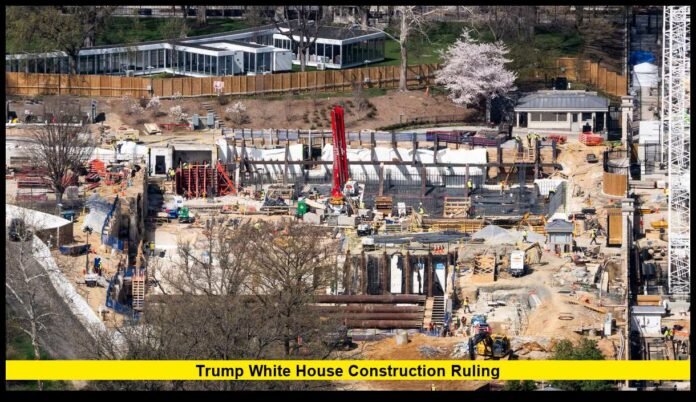

The latest trump white house construction ruling has given President Donald Trump a significant victory, allowing construction of his planned White House ballroom and associated security complex to continue while the broader legal dispute remains unresolved. In a 5-4 decision issued August 31, the U.S. Supreme Court stayed a lower-court order that would have halted most above-ground construction.
The decision is notable because the justices did not ultimately determine whether the ballroom project itself is legal. Instead, the majority focused on whether the National Trust for Historic Preservation had the constitutional standing required to challenge the project in federal court. The Court concluded that the government was likely to prevail on that question and that other factors favored allowing construction to proceed.
The ruling comes after months of litigation involving presidential authority, congressional control over federal property, historic preservation and national-security concerns.
Supreme Court Gives Trump Immediate Construction Victory
The administration had asked the justices to intervene after the U.S. Court of Appeals for the District of Columbia Circuit upheld a preliminary injunction restricting above-ground construction. The appeals court had determined that the Trump administration could not proceed with the ballroom without congressional authorization.
Rather than leave that injunction in place, the Supreme Court granted the administration’s request for a stay.
The majority emphasized that its decision was not a final ruling on whether the East Wing project complies with federal law. That distinction is central to understanding the case.
Construction can proceed, but the underlying legal questions have not all been resolved.
The Court’s decision instead centered on Article III standing. The majority determined that the National Trust’s claimed injury was probably not sufficiently concrete and particularized to allow the organization to maintain its federal lawsuit.
For the Trump administration, however, the practical effect is substantial. Workers can continue building the above-ground structure instead of waiting for the litigation to conclude.
What Is the White House Ballroom Project?
Trump’s project calls for a roughly 90,000-square-foot complex on the site where the White House East Wing previously stood.
The ballroom itself is planned as a major event facility capable of hosting large gatherings. The broader development also includes extensive security and military infrastructure beneath and around the new structure.
The administration has placed the estimated cost at approximately $400 million and has said the project is being financed through private contributions rather than conventional taxpayer funding for the ballroom itself.
The White House has also increasingly emphasized the security dimensions of the project.
Government lawyers have argued that the ballroom cannot be separated from the underground security infrastructure being developed underneath it. They have cited concerns involving presidential protection, potential attacks, drones, missiles and other threats.
According to the administration’s court filings, stopping above-ground construction could interfere with the integrated design and security requirements of the underground complex.
That argument became increasingly important as the litigation progressed.
Why Did the East Wing Have to Be Demolished?
The project could not proceed in its current form without removing the existing East Wing.
Demolition began in October 2025 after Trump announced plans for a major ballroom on the eastern side of the White House complex.
The East Wing had been an important part of the White House campus for generations. It housed offices associated with the first lady and included other facilities used by the presidential administration.
The structure was originally constructed in 1902 and later significantly expanded.
Its demolition immediately generated criticism from preservation advocates, who argued that the administration was making an extraordinary alteration to a historic national landmark.
The National Trust for Historic Preservation ultimately filed a federal lawsuit challenging the project.
What Did the National Trust Argue?
The National Trust argued that the administration could not simply demolish the East Wing and construct a major replacement structure without completing required legal and administrative processes.
The organization maintained that Congress has an important role in authorizing construction and controlling federal property.
It also challenged the administration’s handling of environmental review and federal planning procedures.
At the heart of the lawsuit was a broader question: Can a president independently make a major permanent structural change to the White House complex, or does Congress have to authorize such a project?
The National Trust argued that Congress must approve the construction.
The Trump administration disagreed and maintained that existing federal laws give the president broad authority to renovate, improve and protect the White House and its grounds.
That disagreement produced conflicting rulings in the lower courts.
How the Lower Courts Ruled Against Trump
The legal battle took a significant turn in March 2026 when U.S. District Judge Richard Leon issued an order restricting above-ground construction.
The judge permitted certain underground work and construction necessary for security to continue, but he rejected the administration’s broader argument that the president could proceed without congressional approval.
The case then went before the D.C. Circuit.
On August 7, a two-judge majority of the appeals court upheld the lower court’s decision. The court concluded that the administration lacked the unilateral authority to undertake the major project without congressional authorization.
The appeals court also stressed that its decision was not based on whether a ballroom was desirable.
Instead, the dispute concerned which branch of government has authority to approve such a major alteration to federal property.
The court gave the administration time to seek emergency relief from the Supreme Court.
That appeal ultimately produced the August 31 decision allowing construction to continue.
Why Standing Became So Important
The Supreme Court’s ruling turned heavily on a procedural question that could determine the future of the lawsuit.
Federal courts generally require plaintiffs to demonstrate a concrete injury before they can challenge government action.
The National Trust relied in part on a member who said she regularly visits the White House area and has professional expertise in historic architecture. She argued that the scale, height and design of the project harmed her aesthetic, cultural and historical interests.
The Supreme Court majority was not persuaded that those interests amounted to the type of concrete injury required under Article III.
The justices therefore concluded that the government was likely to succeed in arguing that the National Trust lacked standing.
That finding allowed the Court to grant the administration’s requested relief without deciding the entire dispute over presidential authority.
Chief Justice Roberts Issues Strong Dissent
Chief Justice John Roberts joined the dissent, along with Justices Sonia Sotomayor, Elena Kagan and Ketanji Brown Jackson.
Roberts took issue with the majority’s treatment of the preservation group’s alleged injury.
He argued that a person with a genuine relationship to a historic site can experience a concrete aesthetic injury when the site is fundamentally changed.
More significantly, Roberts also addressed the underlying legality of the construction.
He argued that the project was likely unlawful because Congress had not expressly authorized the construction.
Roberts’ dissent emphasized the separation of powers and Congress’s authority over federal property.
His position underscored the central constitutional concern surrounding the case: A president may control the executive branch, but that does not necessarily give the president unrestricted authority to permanently alter federally controlled property.
The disagreement between Roberts and the majority therefore extends beyond the ballroom itself.
It raises questions about the limits of presidential power.
Trump’s National Security Argument
National security has become one of the administration’s strongest arguments for continuing construction.
Trump’s lawyers have described the development as an integrated military and security complex rather than simply an event space.
The government has argued that the project is designed to provide enhanced protection for the president, first family, White House employees and visitors.
The administration has cited various security threats and assassination attempts involving Trump in arguing that construction should not be delayed.
Government lawyers have also maintained that the underground facilities and above-ground ballroom are interconnected.
Under that argument, stopping the visible portion of the project could undermine the security functions below it.
The lower courts allowed some security-related work to continue, but the administration argued that this distinction did not adequately address the overall design of the facility.
The Supreme Court majority gave significant weight to the government’s claims of potential irreparable harm.
How Far Along Is Construction?
The project has moved rapidly during the legal battle.
The Trump administration told the Supreme Court that the overall East Wing development was approximately 65% complete.
Government filings described a substantial concrete-and-steel structure that extends several stories below ground and rises significantly above the surrounding site.
The administration has pushed ahead with construction while repeatedly warning that delays could make the project difficult or impossible to modify later.
That speed has been a major point of contention with preservation advocates.
The National Trust argued that rapidly advancing construction while litigation was pending could effectively make any eventual court victory meaningless.
If a large permanent structure were completed before a final judicial decision, removing or redesigning it could be extremely difficult and expensive.
When Could the Ballroom Be Finished?
The administration has indicated that construction is expected to continue toward completion in 2028.
Trump has publicly promoted the ballroom as a major addition to the White House and has expressed confidence that it will become an important venue for presidential events.
The project’s schedule is now considerably less constrained by the immediate injunction because of the Supreme Court’s August 31 decision.
However, additional legal proceedings could still affect the ultimate status of the project.
The Supreme Court’s ruling does not mean every remaining legal question has disappeared.
Does the Supreme Court Ruling Mean Trump Won the Entire Case?
No.
That is perhaps the most important distinction in the latest development.
The Supreme Court allowed construction to continue, but the majority expressly avoided deciding the ultimate legality of the East Wing project.
The ruling instead found that the National Trust likely lacked standing and that the factors governing emergency relief favored the government.
In practical terms, Trump won the immediate battle over construction.
But the decision did not establish a broad legal rule stating that the president can make any desired change to the White House without congressional involvement.
That question remains at the center of the disagreement highlighted by Roberts’ dissent.
What Happens Next?
The administration is expected to continue pursuing Supreme Court review of the broader dispute.
The Supreme Court’s stay allows construction to proceed while the litigation develops.
Meanwhile, the National Trust has criticized the decision but has continued to challenge the administration’s position.
The future of the case could depend on whether another party can establish standing or whether Congress itself becomes directly involved.
Congressional action could also change the legal landscape.
If lawmakers formally authorize the project, one of the principal objections raised by the lower courts could be substantially altered. So far, however, the administration has continued to defend its position that congressional authorization was not required.
Why This Case Could Have a Lasting Impact
The significance of the trump white house construction ruling goes beyond the construction of one ballroom.
The case presents a clash between executive power and congressional authority over federal property.
It also raises questions about how historic buildings should be protected when a sitting president seeks substantial renovations.
The White House is not an ordinary federal building. It serves simultaneously as the president’s workplace, the symbolic home of the presidency and one of the most recognizable historic structures in the United States.
That makes the dispute especially consequential.
If presidents have broad unilateral authority to substantially modify the complex, future administrations could potentially inherit greater freedom to reshape it.
If Congress must approve major structural changes, lawmakers would have a more direct role in determining the future appearance and use of the presidential residence.
The Supreme Court’s latest order does not settle that debate.
Bottom Line
The Supreme Court has cleared the way for Donald Trump’s White House ballroom project to continue after a 5-4 decision blocked a lower-court construction halt. The immediate result is a major victory for the administration, which can now keep advancing the approximately $400 million project.
However, the ruling should not be interpreted as a final declaration that Trump has unlimited authority to build the complex. The justices focused primarily on whether the National Trust for Historic Preservation had standing to sue and did not definitively decide whether the project violated federal law.
Chief Justice Roberts and the three liberal justices strongly disagreed, arguing that the preservation group had suffered a legally recognizable injury and that the construction was likely unlawful without congressional authorization.
With construction moving ahead and the broader legal questions still unresolved, the White House ballroom fight remains an important test of presidential power, congressional authority and the future of one of America’s most historic buildings.
What do you think about the Supreme Court’s decision and the future of the White House project? Share your thoughts and stay tuned for the next major development.