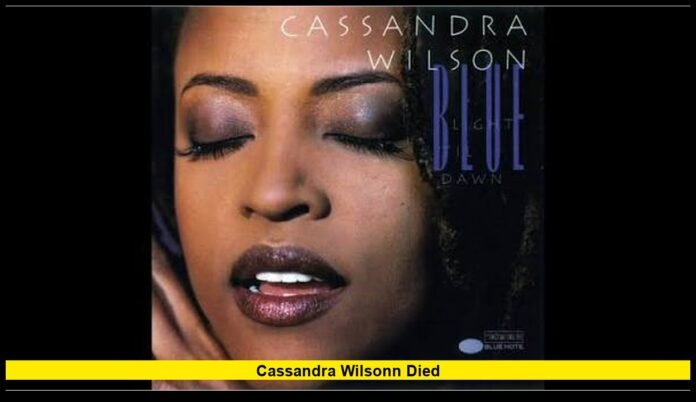

The news that cassandra wilson Died at age 70 has brought a profound sense of loss to the jazz community and to listeners around the world. The acclaimed singer, songwriter and producer died in Jackson, Mississippi, her hometown, on September 2, 2026. Her longtime manager, Robert Torre, confirmed that she passed away peacefully at home surrounded by family and close friends. No cause of death was included in the initial announcement.
Wilson leaves behind a career that stretched across several decades and helped redefine what a contemporary jazz vocalist could accomplish. With her unmistakable contralto, sophisticated phrasing and willingness to draw from blues, folk, country, gospel and other American traditions, she became one of the most influential jazz singers of her generation.
Cassandra Wilson’s Death Confirmed at Age 70
Cassandra Wilson was 70 when she died in Jackson. The announcement was made by her longtime manager, who had represented the artist for approximately two decades.
According to the statement released following her death, Wilson was surrounded by family and close friends during her final moments. Her representatives also asked the public to respect the privacy of those closest to her while they mourn.
The circumstances surrounding her death remain limited in the publicly available information. A cause of death has not been announced, making it important to distinguish confirmed details from speculation circulating online.
Memorial and funeral arrangements are also expected to be communicated separately.
Wilson’s death comes after a career in which she established herself not only as a celebrated vocalist but also as an important interpreter of American musical traditions.
A Mississippi Childhood Shaped Her Sound
Born December 4, 1955, in Jackson, Mississippi, Wilson grew up surrounded by music. Her father was a musician, while her mother worked as an educator. The cultural environment of Mississippi gave Wilson early exposure to musical traditions that would later become central to her artistic identity.
She began playing piano when she was six years old and later learned guitar. By her teenage years, music had become an increasingly important part of her life.
Although Wilson ultimately became internationally recognized as a jazz vocalist, her musical interests were never confined to a single category. The sounds she encountered growing up in Mississippi—including blues, gospel and folk traditions—became important ingredients in the artistic language she developed.
Her hometown remained a significant part of her identity throughout her career. Jackson officials have since remembered Wilson as a native daughter whose music carried the character and history of Mississippi to audiences around the world.
Education and the Beginning of Her Professional Journey
Wilson attended Millsaps College before completing her studies at Jackson State University, where she earned a degree in mass communications.
Her route into professional music was not simply a traditional conservatory-to-stage journey. After leaving Mississippi, she spent time in New Orleans and worked in television while continuing to pursue music.
That period exposed her to different cultural and musical environments and eventually helped lead her toward New York City.
In the early 1980s, Wilson moved to New York, where the city’s thriving jazz scene gave her the opportunity to work alongside some of the most adventurous musicians of the period.
The move became a crucial turning point in her development.
Her Role in the M-Base Collective
After arriving in New York, Wilson became connected with saxophonist Steve Coleman and the group of musicians associated with the M-Base Collective.
M-Base represented an ambitious approach to contemporary jazz. Its musicians were interested in rhythm, composition, improvisation and new ways of organizing musical ideas.
Wilson’s involvement in that environment helped establish her as an artist who was comfortable with experimentation.
Her early work was considerably different from the polished jazz-vocal career for which she would eventually become famous. Rather than simply performing established standards, she became part of a musical community searching for new possibilities.
That experience helped prepare Wilson for the artistic independence that would characterize her later recordings.
The Blue Note Era Changed Everything
A major transformation came when Wilson signed with Blue Note Records in the early 1990s.
Her 1993 album Blue Light ‘Til Dawn became one of the defining recordings of her career. The album moved beyond the conventional jazz songbook and placed greater emphasis on blues, folk and roots-oriented material.
Wilson’s approach was striking because she did not treat those musical traditions as separate from jazz. Instead, she brought them together naturally.
Her voice provided the connecting element.
The success and influence of Blue Light ‘Til Dawn helped establish a new model for jazz vocalists. Wilson showed that a singer could honor jazz tradition while incorporating songs and sounds associated with the wider American musical landscape.
That artistic decision became one of the most important features of her career.
New Moon Daughter Delivered a Grammy Victory
Wilson continued developing her sound through the 1990s, eventually releasing New Moon Daughter in 1995.
The album became another landmark project and earned Wilson the Grammy Award for Best Jazz Vocal Performance in 1997.
Her performance style was by then unmistakable. Wilson did not rely on vocal excess. Instead, she used tone, restraint, timing and emotional weight to transform songs.
The success of New Moon Daughter reinforced her position among the leading jazz vocalists of her generation.
It also demonstrated that her approach to repertoire was not a passing experiment. She had created an artistic identity capable of sustaining an extensive recording career.
Exploring the Legacy of Miles Davis
Wilson’s musical curiosity also led her toward the work of Miles Davis.
Her 1999 album Traveling Miles was inspired by Davis and his musical legacy. Rather than simply reproducing his compositions, Wilson approached his work through her own perspective.
The project reflected an important characteristic of her career: she was interested in dialogue with musical history rather than straightforward imitation.
Wilson repeatedly demonstrated that familiar music could be revisited from a different emotional and cultural perspective.
Her interpretation of Davis-related material became another example of how she could connect the past with contemporary jazz.
Her Collaboration With Wynton Marsalis
Wilson’s career also included significant collaborations with major figures in jazz.
Among them was trumpeter and composer Wynton Marsalis. Wilson performed in Blood on the Fields, Marsalis’ large-scale jazz composition that became the first jazz work to receive the Pulitzer Prize for Music.
Her involvement in such ambitious projects demonstrated the breadth of her abilities beyond the traditional role of a recording vocalist.
She worked with numerous respected musicians during her career, including Dave Holland, Bill Frisell, Charlie Haden, Pat Metheny, Jason Moran and Terri Lyne Carrington.
Those collaborations placed her within a broad network of musicians representing different generations and musical approaches.
Loverly Brought Another Grammy
Wilson’s Grammy success continued many years after her first major win.
Her 2008 album Loverly earned the Grammy Award for Best Jazz Vocal Album in 2009.
The recognition was significant because it confirmed that Wilson’s influence had continued well beyond the period in which she first became famous.
Instead of remaining tied to one particular era or style, she continued developing her interpretations and finding new ways to approach jazz standards and other material.
By then, her reputation had been firmly established internationally.
Billie Holiday Inspired Coming Forth by Day
Another notable project came in 2015 with Coming Forth by Day, Wilson’s tribute to Billie Holiday.
The album arrived around the centennial of Holiday’s birth and gave Wilson an opportunity to engage with the legacy of another defining jazz vocalist.
Wilson’s approach again avoided simple imitation. She interpreted Holiday’s repertoire through her own distinctive musical perspective.
The project reflected the broader pattern of her career: Wilson could pay tribute to influential artists while still maintaining a highly individual identity.
A Career Built on Musical Boundaries
One reason Wilson became so influential was her refusal to treat musical genres as rigid categories.
Her work could move from jazz standards to blues, folk songs, country material and contemporary compositions without losing its underlying character.
Her voice gave those different styles a common center.
She also demonstrated that a jazz singer did not necessarily have to choose between tradition and experimentation. Wilson could respect the history of jazz while simultaneously challenging expectations about what belonged within the genre.
This helped make her recordings accessible to listeners with interests beyond traditional jazz.
For younger musicians, her career provided an example of how artistic identity could be built through curiosity rather than strict adherence to convention.
Recognition as an NEA Jazz Master
In 2022, Wilson received one of the highest honors available to an American jazz musician when she was named an NEA Jazz Master.
The honor recognized her contribution to the development and preservation of jazz and placed her alongside other highly respected figures in the genre.
Her selection reflected the depth of a career that had already included Grammy Awards, major collaborations, international performances and decades of recording.
It also recognized the cultural importance of her work.
Wilson had spent much of her career connecting jazz with the broader history of American music, particularly the blues, folk and roots traditions associated with the South.
Cassandra Wilson’s Connection to Jackson, Mississippi
Although Wilson became a global artist, Jackson remained central to her story.
The city shaped her early musical education and later honored her accomplishments. A marker recognizing Wilson has also been included on the Mississippi Blues Trail.
Her relationship with Mississippi helped distinguish her from many contemporary jazz singers. Her sound frequently carried traces of the region’s musical history without becoming limited by it.
That connection was also reflected in the response to her death from Jackson leaders.
The city has remembered Wilson as an artist who brought international attention to the musical heritage of her hometown and state.
Her Influence on Jazz Singers
Wilson’s impact can be seen in the generations of vocalists who followed her.
She demonstrated the possibilities of singing with restraint, atmosphere and emotional intelligence rather than depending solely on vocal power.
Her recordings also encouraged musicians to reconsider the boundaries of jazz repertoire.
Songs associated with country, folk, blues and popular music could be transformed into sophisticated jazz performances when approached with imagination.
This philosophy became a defining part of her artistic legacy.
Wilson’s influence therefore extends beyond the recordings for which she received awards. It also exists in the broader evolution of jazz singing and in the willingness of later artists to move freely between genres.
What Cassandra Wilson Leaves Behind
The death of Cassandra Wilson marks the end of a remarkable chapter in American jazz.
She leaves behind a substantial discography, Grammy-winning performances, celebrated collaborations and a body of work that consistently challenged expectations.
She also leaves an important example of artistic independence.
Wilson never needed to abandon her roots in order to become an international jazz figure. Instead, she brought Mississippi, the blues, folk traditions and other elements of American musical history into her work and made them part of a distinctive contemporary sound.
For listeners discovering her music for the first time, albums such as Blue Light ‘Til Dawn, New Moon Daughter, Traveling Miles and Loverly provide an entry point into an extraordinary career.
For longtime admirers, her passing is a reminder of how much she contributed to the musical culture of the United States.
Cassandra Wilson Died, but Her Music Endures
The confirmation that cassandra wilson Died at 70 has prompted renewed attention to the career of an artist whose work crossed generations and genres.
Her passing was announced from Jackson, the Mississippi city where her story began, bringing her life and career full circle in a particularly meaningful way.
While details surrounding memorial arrangements are expected to emerge later, the artistic record Wilson leaves behind is already clear.
She was a Grammy-winning vocalist, an NEA Jazz Master, a songwriter, producer and collaborator whose work helped redefine contemporary jazz singing.
Her voice gave new character to familiar songs, while her willingness to explore blues, folk and country traditions helped make jazz feel larger rather than narrower.
Cassandra Wilson’s career ultimately demonstrated that respecting musical tradition does not require standing still. Her recordings remain evidence of an artist who listened deeply, experimented fearlessly and developed a sound that belonged unmistakably to her.
Which Cassandra Wilson song or album made the biggest impression on you? Share your favorite memory in the comments and stay connected for further updates about her life, music and legacy.