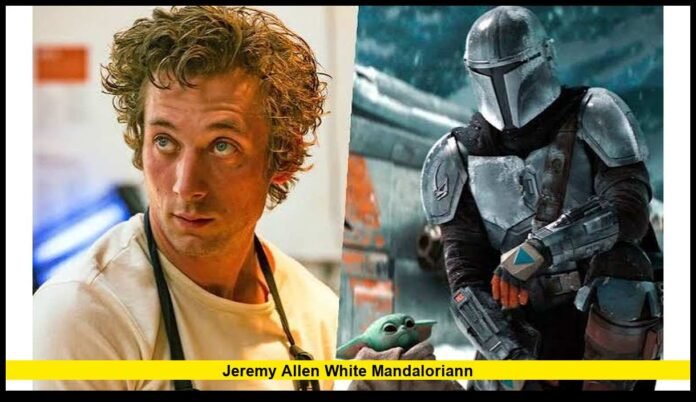

The jeremy allen white mandalorian connection has become one of the most talked-about casting stories surrounding Star Wars: The Mandalorian and Grogu. Rather than stepping into the armor of the galaxy’s most famous bounty hunter, White takes on a very different role: he provides the voice of Rotta the Hutt, Jabba the Hutt’s son. With the movie now streaming on Disney+ and available through digital and physical home releases, fans have a chance to see exactly how White’s performance fits into the latest chapter of the Star Wars universe.
Jeremy Allen White Is Not Playing the Mandalorian
One of the biggest sources of confusion surrounding White’s involvement is his connection to the title The Mandalorian. White is not playing Din Djarin, the armored warrior at the center of the franchise.
Pedro Pascal remains the performer associated with Din Djarin, while White voices Rotta the Hutt. The distinction is important because White’s role is almost entirely different from what his casting might initially suggest.
Din Djarin is a Mandalorian bounty hunter whose relationship with Grogu has driven the story since the original Disney+ series premiered. Rotta, meanwhile, comes from the Hutt crime family and has a direct connection to one of the most notorious figures in Star Wars history.
That unusual casting choice is part of what made White’s involvement such a surprise.
Who Is Rotta the Hutt?
Rotta the Hutt is the son of Jabba the Hutt. Longtime Star Wars viewers may recognize him from the 2008 animated movie Star Wars: The Clone Wars, where he appeared as a baby Hutt.
At that stage of his life, Rotta was known by the nickname “Stinky” and was far from the intimidating character seen in the new film. His original storyline involved his kidnapping and a rescue mission that brought Anakin Skywalker and Ahsoka Tano into the conflict.
Nearly two decades later, Rotta has grown into a dramatically different character.
In The Mandalorian and Grogu, he is presented as a powerful, physically imposing Hutt who has developed into a fighter. His appearance represents a major visual departure from the familiar image of Hutts as enormous, largely sedentary crime lords.
The character’s return also gives the new movie a direct connection to The Clone Wars and the wider Star Wars mythology.
A Very Different Hutt
Rotta’s physical appearance is one of the movie’s most noticeable surprises.
Instead of looking like the traditional Hutt crime lord, the adult Rotta is muscular and athletic. He has a powerful build and fights with a physical intensity that is unusual for his species.
That required the visual-effects team to rethink how a Hutt could move.
The filmmakers wanted Rotta to feel heavy and dangerous while still moving quickly enough to participate in action sequences. His movement was developed with inspiration from elephant seals, whose unusual body mechanics helped the animators imagine how a massive slug-like creature could move rapidly.
The result is a Rotta who can charge, attack, roll and fight in ways that audiences have rarely seen from a Hutt.
His combat style even includes a distinctive rolling attack that became one of the character’s signature movements.
Jeremy Allen White’s Voice Brings Rotta to Life
White’s most important contribution to the character is his voice.
The actor is widely known for emotionally intense performances, particularly as Carmy Berzatto in The Bear. Rotta gave him an opportunity to work in a completely different performance environment.
Voice acting requires an actor to communicate personality, emotion and attitude without relying on the conventional facial expressions audiences normally associate with screen acting.
White also had to work with the unusual vocal characteristics of a Hutt.
The character speaks Galactic Basic in the film while also using some Huttese. White has discussed the experience of learning and performing the Hutt language as part of his work on the movie.
His voice was subsequently integrated into the broader sound and visual-effects process, allowing Rotta to feel like a fully realized Star Wars character rather than simply an animated creature with an actor’s voice attached.
Why White Was an Unexpected Choice
White’s casting initially surprised many fans because nothing about his recent career obviously suggested that he would become the voice of Jabba’s son.
His work has largely centered on dramatic and character-driven performances. His portrayal of Carmy made him one of television’s most recognizable actors, while his performance as Bruce Springsteen in Deliver Me From Nowhere further demonstrated his ability to take on demanding real-world characters.
Rotta is an entirely different challenge.
There is no recognizable human face for audiences to associate with White. Instead, his performance becomes part of a digital creature constructed by an extensive team of artists, animators, stunt performers and visual-effects specialists.
That makes the role an interesting departure for the actor.
How Rotta Was Created
Rotta’s final appearance was the product of extensive collaboration.
Industrial Light & Magic developed the digital character while the production team refined his design throughout the filmmaking process. The goal was to make him recognizable as Jabba’s son without simply turning him into a younger copy of his father.
The designers incorporated elements of the Hutt family’s established visual language while giving Rotta a much younger and more athletic silhouette.
His face also went through significant development.
At one stage, the character was considered too friendly and too human-looking. The filmmakers ultimately adjusted his appearance so that he looked more convincingly like a member of the Hutt species and more clearly connected to Jabba.
The changes helped establish the balance the filmmakers wanted: Rotta needed to be intimidating enough to function as a formidable fighter while remaining sympathetic enough for audiences to care about him.
The Physical Performance Behind Rotta
Although White supplies Rotta’s voice, another performer was used on set to help establish the character’s physical presence.
Richard Cetrone served as Rotta’s on-set performer, giving the actors something tangible to react to during filming. His presence helped establish eyelines and the physical positioning of Rotta in scenes involving Din Djarin and other characters.
This was especially important because Rotta is a large digital character.
Without a physical reference, performers would have had to imagine exactly where the character was standing, how high his head was positioned and how his movements affected the scene.
Cetrone’s work provided that practical reference.
The visual-effects team could then replace the stand-in with the finished digital Rotta during post-production.
Rotta Has an Important Emotional Role
Rotta is not simply included in the movie as a large creature for action sequences.
The character also plays an emotional role in the story.
One of the central ideas surrounding Rotta is his relationship with his father’s legacy. Being Jabba’s son comes with an enormous reputation, and the movie explores what it means for Rotta to establish an identity of his own.
That creates an interesting contrast with Grogu.
Grogu is also a young character whose life is shaped by powerful figures around him. Din Djarin has become his protector and mentor, while Rotta comes from an entirely different family environment connected to the Hutt underworld.
The interaction between the two characters provides a softer dimension to the movie.
Rotta may be capable of fighting, but the filmmakers also wanted audiences to see his more vulnerable side.
The Story of The Mandalorian and Grogu
The movie takes place after the fall of the Galactic Empire.
Imperial forces have not disappeared completely, and the emerging New Republic is attempting to establish order across the galaxy. Din Djarin and Grogu are drawn into another dangerous mission that takes them into unfamiliar territory.
Their relationship remains the emotional foundation of the story.
The Disney+ series established Din as a bounty hunter who initially encountered Grogu as part of a job. Over time, their relationship developed into something much deeper, transforming Din into a protector and father figure.
The feature film carries that relationship into a larger cinematic setting.
Rotta becomes an important part of their latest adventure, linking the Mandalorian duo to the Hutt family and the wider criminal world of the Star Wars galaxy.
When The Mandalorian and Grogu Was Released
Star Wars: The Mandalorian and Grogu opened in theaters on May 22, 2026.
The film marked a major step for the franchise because it moved the story of Din Djarin and Grogu from Disney+ television into a theatrical feature.
The movie was directed by Jon Favreau, who helped establish The Mandalorian as one of the defining modern Star Wars properties. Favreau also worked on the screenplay alongside Dave Filoni and Noah Kloor.
Pedro Pascal leads the cast as Din Djarin, with Sigourney Weaver playing Colonel Ward. White joins the cast through his voice performance as Rotta.
The movie has a reported runtime of approximately two hours and 12 minutes and carries a PG-13 rating.
The Latest Streaming Update
The biggest current development is that the film is now available to watch at home.
As of September 2, 2026, The Mandalorian and Grogu is streaming on Disney+. It is also available through digital purchase and home-video formats, giving fans several ways to experience the movie outside theaters.
The home release includes additional behind-the-scenes material that explores the production process.
For fans particularly interested in White’s role, the behind-the-scenes content provides a closer look at how Rotta was designed and animated.
The timing is significant because audiences who have been curious about White’s involvement no longer have to rely on trailers or promotional material. They can now watch the complete performance and see how Rotta fits into Din and Grogu’s story.
What Makes White’s Performance Stand Out
White’s involvement works largely because the role does not resemble his best-known characters.
Carmy from The Bear is defined by anxiety, ambition, grief and emotional intensity. White’s performance as Bruce Springsteen required him to inhabit a real person with an established public identity.
Rotta requires something else entirely.
The actor has to create a personality for a fictional alien who does not have a human face and whose physical characteristics are produced digitally.
That means his voice becomes one of the most important tools for establishing Rotta’s identity.
The character needs to sound young enough to reflect his place in the Hutt family but powerful enough to match his physical appearance. He also needs moments of humor, vulnerability and aggression.
That combination gives White an unusually broad performance challenge.
Is Rotta a Major Character in the Movie?
Yes. Rotta is much more than a brief cameo.
The character is central to the movie’s story and receives substantial screen time. His involvement gives Din and Grogu a mission that connects directly to the Hutt family while introducing a new side of the Star Wars underworld.
Rotta also receives action scenes as well as quieter character moments.
This balance was important to the filmmakers because they did not want the character to function only as a monster or antagonist.
Instead, Rotta is presented as a character audiences can understand and, at times, sympathize with.
What the Role Means for White’s Career
For White, joining Star Wars represents another significant step in an increasingly varied career.
The actor has already moved between television, film and music-related dramatic roles. Taking on a voice role in one of the world’s biggest entertainment franchises adds another category to his résumé.
It also demonstrates that White is willing to move beyond the type of grounded dramatic character that initially made him famous.
Rotta may not look like White, but the actor’s personality and vocal choices are essential to the character.
That makes the performance particularly interesting for viewers who recognize White’s voice but may not immediately associate it with the giant Hutt appearing on screen.
The Jeremy Allen White Mandalorian Connection Explained
For anyone searching for the jeremy allen white mandalorian connection, the answer is straightforward: White is part of the cast of The Mandalorian and Grogu, but he is not the actor playing Din Djarin.
His role is Rotta the Hutt, the adult son of Jabba the Hutt.
The character first appeared as a baby in The Clone Wars and has now returned as a much older, physically powerful Hutt. White provides the voice while a combination of live-action performance, animation, creature development and visual effects creates Rotta’s physical presence.
The role gives White a unique entry into the Star Wars universe and makes him part of the franchise’s first major theatrical continuation of the Mandalorian storyline.
What Fans Should Know Now
The movie’s arrival on Disney+ changes the conversation around White’s casting because viewers can now experience the complete performance.
Rotta is one of the film’s most distinctive new additions, combining a familiar Star Wars lineage with a completely redesigned personality and physical appearance.
The character’s relationship with Jabba provides a connection to the original trilogy, while his history in The Clone Wars connects the film to the animated side of the franchise.
At the same time, his interactions with Din and Grogu help make the character relevant to the current generation of Star Wars storytelling.
White’s casting therefore makes more sense when viewed as part of a larger creative strategy. Instead of simply bringing back an old character, the filmmakers have used Rotta to introduce a new interpretation of the Hutt family.
Final Thoughts
Jeremy Allen White’s arrival in the Star Wars universe is unusual, unexpected and deliberately different from his previous major roles. He does not wear the Mandalorian armor, and he does not replace Pedro Pascal as Din Djarin. Instead, he gives his voice to Rotta the Hutt, a character with roots stretching back to The Clone Wars and Jabba’s criminal empire.
With The Mandalorian and Grogu now available on Disney+, viewers can finally see how the actor’s performance contributes to Rotta’s personality. The combination of White’s voice, physical reference work and ILM’s animation creates a Hutt who is stronger, faster and more emotionally expressive than audiences have previously seen.
The result is a Star Wars character who carries a famous family name while attempting to become something more than simply Jabba’s son.
Have you watched The Mandalorian and Grogu yet? Share your thoughts on Jeremy Allen White’s Rotta the Hutt performance and stay tuned for more Star Wars updates.