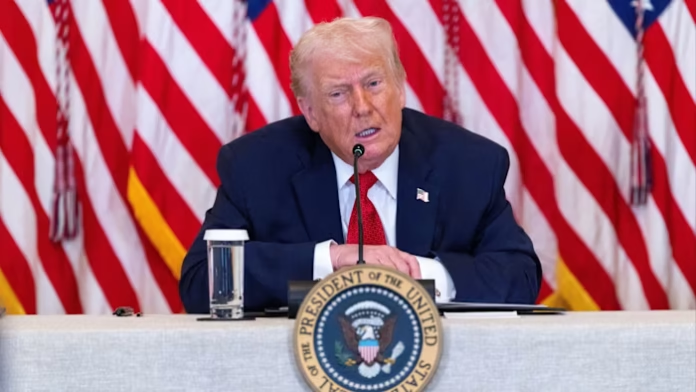

President Donald Trump dramatically Trump threatens tariffs as part of his escalating effort to push for U.S. control over the strategically vital Arctic territory of Greenland, signaling a new phase in international tensions that span trade, security, and alliance politics. His comments have stirred diplomatic strain with key European partners and ignited vigorous debate within Washington as lawmakers and allied leaders seek to manage the fallout from a policy dispute with broad global implications.
The president’s remarks, made during a public address at the White House, outlined his willingness to impose economic penalties on nations that resist supporting Washington’s push for influence over Greenland. This unprecedented linkage of trade tools to geopolitical objectives underscores the growing complexity of U.S. foreign policy but has raised serious questions among allies and legislators alike about the future of transatlantic relations and Arctic security.
A Bold Strategic Pivot in Arctic Policy
Greenland, an autonomous territory of the Kingdom of Denmark, sits at the northern edge of the North Atlantic and adjacent to key Arctic sea routes. Its geographic position has long made it an object of strategic interest for global powers. Melting ice has opened new shipping lanes and intensified competition for resources such as rare earths and critical minerals. The United States already maintains a military presence on the island through long-standing agreements, but under this latest push, Trump has indicated that more direct control or influence is essential to counter perceived threats from Russia and China.
Trump’s assertion that economic coercion may be necessary marks an abrupt escalation in how the United States is approaching Arctic geopolitics. By suggesting that friendly nations could face tariffs if they oppose U.S. ambitions regarding Greenland, the administration has blurred the lines between trade policy and national security in a way rarely seen in recent U.S. diplomatic history.
Allies Push Back Firmly Against Coercion
Denmark and Greenland have responded with firm statements rejecting the notion that Greenland’s future could be dictated by external pressure. Danish officials have reiterated that Greenland is not for sale and that discussions about its status must respect its people’s will and international law. Greenland’s leaders have made clear they intend to remain within the Danish realm and affirmed their commitment to long-standing alliance frameworks.
The prime minister of Greenland has underscored that the territory’s choice is tied to Denmark, NATO, and broader international partnerships, reinforcing that autonomy and self-determination remain central to Greenland’s approach. Indigenous leaders have also voiced strong opposition to any proposal that could be seen as undermining the island’s sovereignty or traditional governance structures.
NATO’s Role and Alliance Tensions
The latest round of statements from the United States has reverberated across the NATO alliance, where Greenland’s position within the Danish realm is protected by collective defense commitments. Several NATO members have increased their military presence in the Arctic region, participating in joint exercises and signaling solidarity in regional security concerns.
These deployments are framed as part of broader Arctic defense planning rather than a direct response to U.S. policy. However, the underlying tension remains palpable, as alliance unity is tested by divergent perspectives on how best to address shifting geopolitical realities.
Some European defense officials caution that destabilizing rhetoric or punitive measures against partners could erode trust within the alliance. They emphasize that cooperative frameworks and shared security strategies are essential to confronting common challenges posed by other global powers in the region.
Bipartisan U.S. Reaction and Congressional Diplomacy
Within the United States, the president’s stance on Greenland has been met with a mix of support for strengthening U.S. strategic positions and concern over diplomatic fallout. A delegation of bipartisan lawmakers traveled to Denmark in recent days in an effort to reduce tensions and reaffirm their commitment to allied cooperation.
Many of these lawmakers have stressed that economic leverage should not be wielded against long-standing partners. They argue that diplomatic dialogue, not threats, must guide discussions about Arctic security and sovereignty issues. There is growing interest in legislative proposals aimed at clarifying the executive branch’s authority on international acquisitions and trade actions tied to foreign policy goals.
This internal debate reflects broader questions about the role of Congress in shaping foreign policy and how to balance national security objectives with alliance management.
Economic Stakes: Trade Tools as Foreign Policy Instruments
Trump’s suggestion of tariffs as a means to influence international behavior brings to the fore fundamental questions about the use of trade policy. Traditionally, sanctions and economic penalties have been directed at adversarial states in response to aggression or human rights violations. But applying tariffs to allied nations over strategic disagreements represents a departure from conventional practice.
Trade experts warn that such a move could provoke retaliation, disrupt integrated supply chains, and create long-term distrust among trading partners. European economies, heavily interconnected with U.S. markets, may find their policymakers under domestic pressure to respond if punitive tariffs were ever enacted.
The uncertainty surrounding this strategy underscores the complexity of using economic pressure in geopolitical disputes, particularly when the target is an alliance partner rather than a rival state.
Global Reactions Reflect Widespread Concern
European responses to the situation have varied, but many leaders have expressed deep unease about linking economic penalties to foreign policy demands. France, in particular, has underscored the importance of trade and security cooperation with the United States, while cautioning that unilateral actions that appear to undermine sovereignty or economic ties could have far-reaching consequences.
European defense and diplomatic circles are also watching how the situation may influence broader debates about strategic autonomy and defense cooperation. As nations grapple with how to balance reliance on traditional alliances with the need for independent security frameworks, the Greenland dispute has emerged as a catalyst for deeper reflection.
Some officials suggest that strengthened multilateral engagement on Arctic security could serve as a more constructive path forward, rather than allowing bilateral tensions to dominate the narrative.
The Strategic Importance of Greenland Reinforced
The ongoing debate over Greenland has underscored the island’s significance in global geopolitics. Beyond the immediate political clash, experts on Arctic affairs emphasize that Greenland will continue to play a central role in shaping regional security, environmental monitoring, and economic opportunity.
Climate change is rapidly transforming the Arctic, making the region more accessible and heightening competition for its natural resources. The waters around Greenland are increasingly important for commercial shipping, and advanced sensor systems on the island contribute to global monitoring networks.
These factors explain not only why the United States views Greenland through the lens of national security but also why European partners are equally determined to collaborate within existing multilateral frameworks to ensure stability.
Long-Term Implications for Transatlantic Relations
The current standoff has sparked intense discussion about the future of U.S.-European relations. How this episode ultimately resolves could have implications for alliance cohesion, economic ties, and diplomatic norms. Both sides of the Atlantic appear committed to finding pathways to cooperation, but disagreements over Greenland’s status and the methods used to pursue strategic objectives have cast a spotlight on underlying tensions.
As diplomacy continues, leaders on all sides are confronting the challenge of reconciling national priorities with collective security interests. The debates unfolding now may shape policy directions on defense, Arctic strategy, and trade for years to come.
Whether through continued negotiation, alliance-driven security initiatives, or recalibrated policy approaches, the Greenland question remains a defining issue at the intersection of geography, economics, and international relations.
The Road Ahead
Efforts to navigate this complex dispute will extend beyond immediate political cycles. Greenland’s role in Arctic geopolitics is likely to remain a central focus for policymakers in Washington, Copenhagen, Nuuk, and across Europe. The evolving dynamics of trade, defense, and diplomacy in the Arctic will continue to influence broader strategic calculations as world powers reassess their roles in a rapidly changing global landscape.
The interplay between economic policy and security objectives, highlighted by the administration’s rhetoric on tariffs, points to new frontiers in how nations pursue their interests. As these discussions evolve, the international community will be watching closely to see how alliances adapt and what lessons emerge for managing shared challenges.
President Trump’s latest declarations have thrust Greenland into the spotlight once again, raising questions about power, partnership, and the principles guiding modern diplomacy.