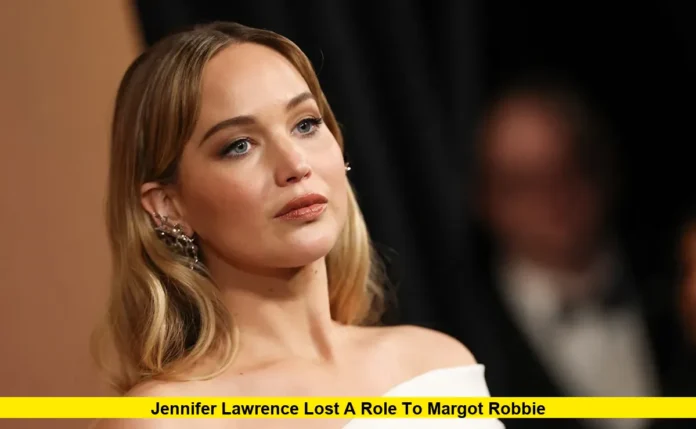

Jennifer Lawrence lost a role to Margot Robbie, according to her own recent account, after online critics claimed she was “not pretty enough” for the part, a revelation that has reignited debate about beauty standards, casting politics, and the power of public opinion in modern Hollywood.
The Academy Award–winning actress shared the story during a recent podcast appearance, speaking openly about how early discussions with a major director once placed her in the mix for a high-profile role that ultimately went to Robbie. Her comments quickly gained attention across entertainment platforms because they offer a rare look at how online narratives and appearance-based judgment can shape opportunities even at the highest level of the film industry.
The Role at the Center of the Conversation
The role Lawrence referenced was Sharon Tate in Quentin Tarantino’s 2019 film Once Upon a Time in Hollywood. The movie, set in late-1960s Los Angeles, followed a fictional storyline intertwined with real historical figures and became one of the most discussed films of its era.
Margot Robbie ultimately portrayed Tate, delivering a performance praised for its quiet emotion and classic screen presence. The character carried significant cultural weight, as Tate remains an enduring symbol of Hollywood’s golden age and a tragic figure whose life was cut short.
According to Lawrence, she had been told that the director was interested in working with her and had considered her for the project. However, she recalled that online discussion soon began questioning whether she fit the traditional image associated with Tate. She said the prevailing narrative suggested she was not visually “right” for the role, and that this perception may have influenced the final casting decision.
What Jennifer Lawrence Revealed
In her remarks, Lawrence did not accuse any individual or studio of deliberate exclusion. Instead, she described how online commentary can create a powerful atmosphere around a project. Once a certain story takes hold — especially one centered on appearance — it can be difficult for decision-makers to ignore.
She acknowledged that memory can evolve over time, but she maintained that the essence of the situation remained clear: she was interested in the role, the director had shown interest, and the conversation changed after negative discussion about her looks gained traction.
Her tone was candid and reflective, showing both vulnerability and perspective. She emphasized that losing a role is part of an actor’s reality, even for those at the top of the industry.
Why Margot Robbie Was Cast
Robbie’s casting was widely welcomed when the film premiered. Many felt her resemblance, screen presence, and subtle performance style aligned well with the character and the film’s nostalgic tone.
At the time, Robbie was already known for moving seamlessly between major studio productions and character-driven films. Her portrayal of Tate relied more on expression and mood than on dialogue, allowing her to embody the spirit of the era in a way that resonated with audiences.
From an industry perspective, casting decisions of this scale rarely hinge on a single factor. Creative vision, chemistry, scheduling, and audience perception all play roles. While Lawrence’s comments highlight the impact of public opinion, they exist alongside these broader considerations.
Beauty Standards and Online Judgment
Lawrence’s story touches on a long-standing issue in Hollywood: the narrow standards of beauty often imposed on women. Despite her accolades and box-office success, she revealed that she, too, has been subject to harsh and public evaluation based on appearance.
Social media amplifies these judgments, turning personal opinions into widespread narratives. When those narratives gain momentum, they can shape how performers are perceived, sometimes influencing opportunities before an audience ever sees a finished film.
Career Paths That Continue to Rise
Jennifer Lawrence has built a career defined by versatility, moving from intense dramas to global franchises with ease. She has previously spoken about roles she narrowly missed, often reflecting on how those moments ultimately guided her toward projects that better suited her at different stages of her life.
Margot Robbie, meanwhile, has continued to expand her range, taking on complex characters while remaining a major box-office draw. The Sharon Tate role became one of many highlights in her growing body of work.
The moment where Jennifer Lawrence lost a role to Margot Robbie now stands as an example of how two successful careers can briefly intersect before continuing on their own distinct, accomplished paths.
How Public Opinion Shapes Hollywood Today
In today’s film industry, casting choices are discussed and debated instantly. Social platforms allow fans to voice approval or criticism in real time, creating a feedback loop that can influence perception long before a project is released.
Lawrence’s experience illustrates how powerful that collective voice can become. Even when it is not the sole factor in a decision, it can shape the narrative around who is considered “right” for a role and why.
Social Media Snippets
X (Twitter):
Jennifer Lawrence says online critics calling her “not pretty enough” may have cost her a major role that later went to Margot Robbie. Hollywood casting under the microscope again.
Facebook:
In a candid podcast moment, Jennifer Lawrence opened up about losing a high-profile role to Margot Robbie after online trolls questioned her looks. Her story is sparking new debate about beauty standards and public pressure in Hollywood.
Instagram:
Jennifer Lawrence reveals how online judgment about her appearance may have changed the course of a major film role later played by Margot Robbie. A powerful reminder of how perception can shape opportunity.
Threads:
From early interest to final casting, Jennifer Lawrence reflects on the role she believes slipped away after public criticism about her looks, with Margot Robbie ultimately stepping into the part.
What’s your take on how public opinion can influence casting decisions in Hollywood? Join the conversation and stay tuned for more behind-the-scenes stories.