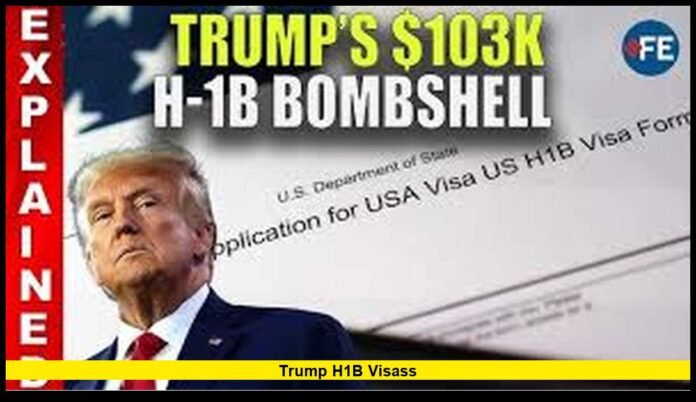

The latest trump h1b visas development has put employers, technology companies, international graduates and skilled foreign workers on alert after the Department of Homeland Security proposed a new $103,265 fee for H-1B petitions subject to the annual cap. The proposal, announced on August 24, 2026, represents another major attempt by the Trump administration to change how the United States handles high-skilled employment immigration.
The proposed fee would be in addition to other applicable immigration charges and would affect a significant portion of employers seeking to hire foreign professionals through the annual H-1B program. At the same time, the proposal is not yet a final rule, meaning employers and prospective workers should distinguish between what has been proposed and what is currently required.
Key Points Summary
╔════════════════════════════════════════════════════════════════════╗
║ – DHS has proposed a $103,265 additional fee for H-1B petitions subject to the annual cap. ║
║ – The proposed charge would apply to cap-subject cases, including petitions eligible for the U.S. advanced-degree exemption. ║
║ – Certain cap-exempt employers, including qualifying universities and research organizations, would not face the proposed additional fee. ║
║ – The H-1B annual allocation remains 65,000 regular positions plus 20,000 for qualifying U.S. advanced-degree graduates. ║
║ – The proposed fee would be added to other applicable H-1B filing costs rather than replacing existing government charges. ║
║ – DHS estimates the new fee could generate about $8.8 billion annually based on projected cap-subject petition volume. ║
║ – H-1B applicants are also facing increased visa screening and online-presence review under separate administration policies. ║
║ – The proposal will go through a public-comment and rulemaking process before it can become a final requirement. ║
╚════════════════════════════════════════════════════════════════════╝
What Is Happening With H-1B Visas Under Trump?
The Trump administration is pursuing a broader restructuring of the H-1B system, and the proposed $103,265 fee is one of the most significant developments so far.
The H-1B program allows U.S. employers to hire foreign workers for specialty occupations requiring specialized knowledge and typically a qualifying degree or equivalent credentials. The program is heavily used by businesses in technology, engineering, finance, healthcare, research and other professional industries.
For years, employers have used H-1B sponsorship to recruit and retain workers whose skills are difficult to find in the domestic labor market.
The new proposal could substantially increase the financial commitment required for employers seeking workers through the cap-subject portion of the program.
However, the proposed fee should not be confused with an immediate universal charge for every person holding H-1B status.
Proposed H-1B Fee Would Be $103,265
The Department of Homeland Security is proposing an additional $103,265 fee for H-1B petitions that are subject to the annual numerical cap.
The fee would be paid when the qualifying petition is filed and would come on top of other applicable fees and payments.
DHS estimates the proposal could generate approximately $8.8 billion annually, based on an estimated 85,000 cap-subject H-1B petitions.
The government says the revenue would help recover costs associated with administering the broader lawful immigration system.
Those costs include immigration-benefit adjudication, fraud detection, national-security vetting, technology modernization, records management, immigration court operations, consular processing, labor standards enforcement and coordination between federal agencies.
The size of the proposed fee makes the measure especially significant because traditional H-1B government charges have been far lower than six figures.
Is the $103,265 Fee Already Required?
No.
The $103,265 charge is currently a proposed fee, not a finalized rule that automatically applies to every H-1B petition.
The proposal is moving through the federal regulatory process. A public-comment period will provide an opportunity for employers, workers, industry groups and other interested parties to respond before the government determines whether to finalize the regulation.
That means the final policy could potentially change before implementation.
The distinction is particularly important for H-1B workers and employers making decisions about future hiring or immigration filings. A proposed rule should not automatically be treated as an enforceable requirement.
Which H-1B Petitions Would Be Covered?
The proposal specifically targets H-1B petitions subject to the annual cap.
The annual H-1B allocation includes:
- 65,000 positions under the regular H-1B cap.
- 20,000 additional positions reserved for qualifying foreign nationals with a master’s degree or higher from a U.S. institution of higher education.
The proposed $103,265 charge would also cover petitions eligible for the advanced-degree exemption because those cases remain part of the annual cap system.
This makes the proposed measure potentially important for employers recruiting international graduates from American universities.
Who Would Be Exempt?
Not every H-1B petition is subject to the annual numerical cap.
Certain organizations and employment arrangements qualify for cap-exempt treatment.
Under the proposed rule, the additional fee would not apply to certain cap-exempt petitions filed by organizations such as qualifying institutions of higher education, nonprofit research organizations and governmental research organizations.
This means an employer’s status and the nature of the H-1B petition could determine whether the proposed six-figure fee applies.
The distinction between cap-subject and cap-exempt employment could therefore become increasingly important if the proposal becomes final.
Why the Proposed Fee Is So Important
A six-figure fee could fundamentally alter the financial calculation behind H-1B sponsorship.
Employers already deal with government filing charges, attorney expenses, compliance costs and other expenses associated with hiring foreign workers.
Adding $103,265 to a cap-subject petition could make sponsorship considerably more expensive.
For a company hiring one foreign professional, the additional amount could represent a major expense. For companies sponsoring dozens or hundreds of workers, the potential financial impact could reach millions of dollars.
That could influence decisions about recruitment, salary levels, staffing locations and whether an employer chooses to sponsor a particular candidate.
Impact on Technology Companies
Technology companies are among the largest users of the H-1B program, making the proposed fee especially significant for the sector.
Software engineers, data specialists, cybersecurity professionals, artificial-intelligence experts and other highly skilled employees can be hired through the H-1B system when they meet the program’s requirements.
A six-figure filing cost could cause companies to reconsider sponsorship strategies.
Some employers could decide that only the most difficult-to-replace candidates justify the expense. Others could accelerate recruitment of U.S.-based workers or consider expanding teams outside the United States.
The ultimate effect will depend heavily on whether the proposal is finalized and how courts and federal agencies interpret the resulting rule.
What About International Students?
International students could also feel the effects indirectly.
Many foreign students attend U.S. universities with the expectation that they may eventually work for a U.S. employer. After completing their studies, eligible graduates can use employment authorization pathways before seeking longer-term employer sponsorship.
H-1B sponsorship is an important part of that employment pipeline.
If employers face significantly higher costs for cap-subject H-1B petitions, some may become more selective about which international graduates they sponsor.
This could make the transition from U.S. higher education to long-term employment more difficult for some students.
It could also affect companies that traditionally recruit heavily from American universities.
The Administration’s Broader H-1B Strategy
The proposed fee is not an isolated policy.
The Trump administration has been pursuing multiple changes designed to reshape the H-1B system around higher-skilled and higher-paid employment while increasing government scrutiny of applicants.
One major change involves the H-1B selection process.
The administration has moved toward a system that gives greater weight to higher-paid positions rather than treating all eligible registrations in the same way.
That means employers offering higher wage levels may have an advantage in the selection process compared with employers offering lower wage levels.
The policy is intended to shift the program toward workers the administration considers more highly skilled and economically valuable.
Higher Wages Could Become More Important
The wage component of the H-1B system has become increasingly important.
Employers must comply with applicable wage requirements when sponsoring H-1B workers. Under the newer selection approach, wage levels can also influence the likelihood that a registration is selected.
This creates a system in which compensation could affect both the economics of sponsorship and the selection process.
For workers, that could mean job offers at higher salary levels become increasingly attractive from an immigration perspective.
For employers, it could encourage changes in how positions are classified, compensated and structured.
H-1B Visa Screening Has Also Tightened
Another important development is the expansion of visa screening.
The State Department has required online-presence review for H-1B applicants and H-4 dependents as part of increased visa vetting.
Applicants are instructed to make their social media profiles public or open to facilitate government review.
The government says the screening is intended to identify applicants who may be inadmissible or pose national-security or public-safety concerns.
For H-1B workers applying for visas at U.S. consulates, this means the immigration process increasingly involves detailed scrutiny beyond the employer’s petition.
What Does This Mean for Indian H-1B Workers?
The proposed fee is especially relevant to Indian professionals because Indian nationals have historically represented a substantial share of H-1B beneficiaries.
The technology sector, in particular, has relied heavily on skilled professionals from India.
A major increase in employer sponsorship costs could therefore have consequences for Indian technology workers, international graduates and professionals seeking U.S. employment.
However, workers should not assume that the proposed fee means they personally must pay $103,265.
The proposal is structured as an additional charge associated with qualifying employer-filed H-1B petitions.
Employers and immigration attorneys will need to examine the specific petition category to determine whether the proposed fee would apply.
Could Existing H-1B Workers Be Affected?
Existing H-1B workers should not automatically interpret the proposal as a new $103,265 charge on their current status.
The proposal is directed at petitions subject to the annual H-1B cap.
That is different from saying every H-1B extension, amendment or renewal would carry the same fee.
The exact treatment of individual cases will depend on the final regulation and the circumstances of each filing.
Workers who already have H-1B status should therefore avoid relying on social-media headlines or generalized claims about the new fee.
The Legal Battle Could Continue
The proposed fee also arrives after the administration experienced a major legal challenge involving a previous $100,000 H-1B fee.
That earlier measure was challenged in federal court, creating questions about the executive branch’s authority to impose such a large immigration-related payment.
The new proposal uses a different regulatory approach, with DHS pursuing a formal rulemaking process.
That does not guarantee that the new policy will avoid litigation.
Business organizations, immigration advocates and other groups could challenge the final rule if they believe the government exceeded its authority or failed to follow applicable legal requirements.
The legal process could therefore become an important part of the story.
What Employers Should Watch
Companies that rely on H-1B sponsorship should monitor several developments closely.
Public Comment Period
The proposed rule will go through a public-comment process. Industry groups and employers can submit their views before the government considers a final regulation.
Final Rule
The proposal could change before becoming final. Employers should wait for the final text before assuming the exact fee, scope or implementation requirements.
Court Challenges
Litigation could affect whether the fee takes effect and whether portions of the policy survive legal challenges.
H-1B Selection Rules
Companies should also follow changes to the selection process, particularly rules involving wage levels and registration procedures.
Visa Screening
Employees applying for visas abroad should be aware of increased screening and online-presence review requirements.
What Workers Should Know Right Now
Foreign professionals should not assume that the proposed fee means the end of H-1B sponsorship.
The H-1B program continues to exist, and the annual cap remains in place.
The major question is how expensive and selective the system becomes if the administration’s proposals are finalized.
Workers should also remember that an H-1B petition and an H-1B visa are related but distinct parts of the immigration process. An employer generally files a petition with U.S. immigration authorities, while a worker outside the United States may separately need to obtain a visa through the State Department before traveling for employment.
That distinction becomes particularly important as visa screening and immigration policies evolve.
What Could Happen to U.S. Hiring?
The proposed fee could produce competing effects.
Supporters may argue that the higher cost encourages companies to prioritize American workers and limits misuse of the H-1B system.
Critics may argue that the measure could make it harder for U.S. companies to recruit specialized talent when qualified domestic candidates are unavailable.
The actual economic impact could vary by industry.
Large corporations may be able to absorb the cost more easily than startups or smaller businesses. Universities and research institutions that qualify for cap exemptions could be affected differently from ordinary private-sector employers.
Companies could also respond by increasing salaries, changing recruiting strategies, moving certain positions abroad or reducing sponsorship.
Trump H-1B Visas: What Happens Next?
The immediate focus is the federal rulemaking process.
The proposed $103,265 fee is one of the most consequential H-1B immigration developments of 2026, but it is not yet the final word.
The government must consider public comments before deciding whether to issue a final rule. Any final regulation could also become the subject of legal challenges.
Meanwhile, employers and foreign professionals must navigate a changing immigration environment that includes stricter screening, greater emphasis on wage levels and increased government scrutiny.
For companies, the central concern is cost. For workers, the central concern is whether employers remain willing to sponsor them under a substantially more expensive system.
Final Takeaway
The proposed $103,265 H-1B fee represents a dramatic potential shift in the cost of employing foreign professionals in the United States.
If finalized in its current form, the measure could make cap-subject sponsorship far more expensive while leaving qualifying cap-exempt organizations outside the additional charge.
The proposal is also part of a much larger transformation of the H-1B system under the Trump administration. Changes involving selection, wages, screening and immigration enforcement are all contributing to a more restrictive and closely monitored environment for foreign professionals.
For now, the most important point is that the $103,265 charge remains proposed rather than universally enforceable. The public-comment process, final regulation and possible court challenges will determine what employers and workers ultimately have to follow.
The H-1B program remains one of the most important pathways for U.S. employers seeking specialized international talent, so any major change to its cost or selection process could have consequences far beyond individual visa applicants.
What do you think about the proposed H-1B changes? Share your thoughts in the comments and keep checking back for the latest U.S. immigration updates.