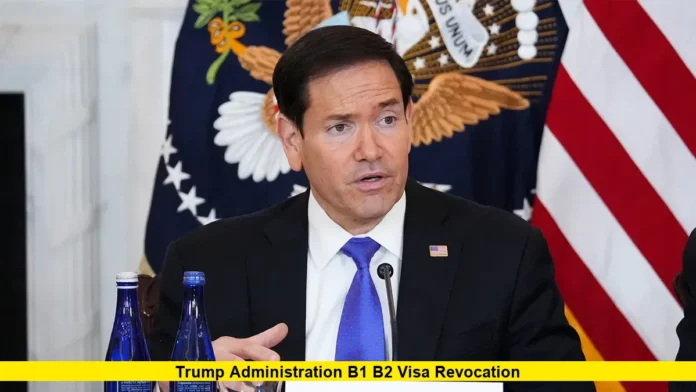

The trump administration b1 b2 visa revocation policy is now at the center of a major U.S. immigration development, with the State Department preparing to revoke the business and tourism visas of as many as 200,000 foreign nationals who have applied for or are seeking asylum in the United States. The planned action could become the largest single mass visa revocation in U.S. history.
The latest development was reported on August 24, 2026, based on State Department documents obtained by The Associated Press and information from two U.S. officials. The affected visas would involve B-1 and B-2 visas issued between 2016 and 2026 to people who later sought asylum or are currently pursuing asylum in the United States.
The proposal has not yet become a completed mass revocation. Officials expect the State Department to announce the action in the coming weeks, unless the policy is changed or challenged before implementation.
What the Latest B-1 and B-2 Visa Revocation Plan Means
B-1 visas generally cover temporary business travel, while B-2 visas cover tourism and other qualifying temporary visits. Many foreign visitors receive a combined B-1/B-2 visa for both purposes.
Under the latest plan, the administration is focusing on people who originally entered the United States as temporary visitors and later applied for asylum.
The State Department’s position is that B-1 and B-2 visas are issued for temporary travel. Officials have argued that the visas were granted based on an expectation that travelers intended to return to their home countries rather than use visitor status as a pathway toward remaining permanently in the United States.
The administration is coordinating the proposed action with the Department of Homeland Security. That coordination reflects the broader effort to connect visa enforcement with immigration enforcement inside the United States.
The potential scale is significant. As many as 200,000 people could be affected if the government proceeds with the full scope currently under consideration. However, the final number could change as officials review individual cases and implement the policy.
Who Could Be Affected
The reported plan focuses on foreign nationals who meet several conditions connected to their previous travel to the United States.
The group under consideration includes people who:
- Entered the United States using B-1 business or B-2 tourism visas.
- Received those visas between 2016 and 2026.
- Later applied for asylum in the United States.
- Are currently seeking asylum, based on the administration’s review.
- Remain connected to the visitor-visa category targeted by the State Department.
The proposal is not described as a blanket cancellation of every B-1 or B-2 visa issued during the period. Instead, the government is identifying people whose later asylum activity falls within the planned enforcement action.
That distinction matters for U.S. travelers, businesses and foreign visitors. A person holding a valid B-1/B-2 visa is not automatically affected simply because the visa was issued during the 2016-2026 period.
The Revocations Are Not Yet Final
One of the most important points in the latest update is that the reported mass revocations are still being prepared.
The State Department is expected to make an announcement in the coming weeks. The plan could also face legal challenges, which could affect its timing, scope or implementation.
For that reason, the reported figure of up to 200,000 should be treated as the potential size of the operation, not a confirmed final count of people whose visas have already been revoked.
The distinction is especially important because the State Department has already carried out a much broader visa-revocation campaign under President Donald Trump.
State Department Has Already Revoked More Than 175,000 Visas
On August 10, the State Department announced that it had revoked more than 175,000 visas under the Trump administration.
The department said the revocations involved foreign nationals who violated visa terms, committed crimes, called for violence against Americans, defrauded Americans, abused the immigration system or endangered national security.
According to the department, criminal activity represented the largest category of revocations. Officials identified assault, driving under the influence, theft and drug-related crimes among the leading reasons. Other cited cases involved serious offenses, including sexual assault, child abuse, fraud and embezzlement.
The 175,000 figure covers visa revocations across the administration’s enforcement efforts and is not limited to B-1 or B-2 visas.
That makes the proposed asylum-related action different from the existing total. The potential 200,000 B-1/B-2 cases represent a separate group that could be subjected to a coordinated review.
Why Asylum Applications Are Central to the New Policy
The latest proposal centers on the administration’s view that some visitors used temporary visas and then sought a different immigration outcome after arriving in the United States.
The State Department has argued that B-1 and B-2 visas are issued to people expected to make temporary visits. The administration is now examining cases in which visitors entered under those categories and subsequently pursued asylum.
Asylum is a separate U.S. immigration process. Foreign nationals physically present in the United States can seek asylum if they meet the legal requirements for protection based on persecution or a well-founded fear of persecution.
The administration’s planned visa action does not change the fact that asylum is governed by its own legal framework. Instead, the proposal concerns whether the person’s existing visitor visa should remain valid.
This is why the planned action could have consequences even for people whose asylum cases involve separate proceedings.
Visa Revocation Does Not Automatically Mean Immediate Deportation
Another key distinction is between visa revocation and deportation.
A visa allows a foreign national to seek admission to the United States at a port of entry. It does not itself provide an unconditional right to remain in the country.
The latest reports indicate that revoking the B-1 or B-2 visa would strip the affected individual of that visitor-visa status, but the revocation itself would not necessarily mean immediate deportation.
The immigration consequences for an individual can depend on the person’s circumstances and any other immigration status or proceedings involved.
This means the planned policy should not be described simply as a mass deportation order. The immediate action being prepared is a mass visa-revocation initiative.
The Administration’s Broader Visa Enforcement Campaign
The proposed B-1/B-2 action follows a series of increasingly aggressive visa policies during Trump’s second administration.
The State Department has expanded scrutiny of visa holders and applicants while increasing enforcement against people accused of criminal activity, immigration violations, fraud and other conduct viewed by officials as inconsistent with U.S. immigration rules.
Officials have also targeted alleged birth-tourism schemes. In June, the State Department announced that U.S. diplomatic missions had uncovered hundreds of suspected cases involving networks that allegedly helped foreign nationals obtain visitor visas for the purpose of giving birth in the United States.
The department has said that a visitor visa cannot be used when the primary purpose of the trip is to obtain U.S. citizenship for a child through childbirth.
These actions illustrate the administration’s broader effort to scrutinize how B-1 and B-2 visas are obtained and used.
Visa Bonds Add Another Layer of B-1/B-2 Restrictions
The administration has also changed the financial requirements surrounding some B-1/B-2 visa applications.
On August 3, 2026, the Department of State made its Visa Bond Program permanent. Under the final rule, covered B-1/B-2 applicants can be required to post a bond of up to $20,000 as a condition of visa issuance.
The bond program is designed to encourage covered visitors to comply with the terms of their temporary admission and depart when required.
During the earlier pilot program, approximately 20,000 visa applications were determined to require a bond, and nearly half resulted in a bond payment. The State Department also reported an 83% reduction in B-1/B-2 visa issuance for countries covered by the pilot during its first 10 months.
The permanent program is separate from the proposed mass revocation of visas involving asylum seekers.
Visa Suspensions Are Also Affecting B-1/B-2 Travel
Separate from individual visa revocations, the Trump administration has imposed country-specific restrictions affecting B-1 and B-2 travel.
The State Department’s current guidance lists multiple countries whose nationals face partial or full suspension of visa issuance or entry under presidential proclamations. The restrictions include B-1/B-2 categories in several cases, with specified exceptions and potential waivers.
These country-based restrictions should not be confused with the planned asylum-related revocation program.
A visa suspension generally concerns nationality and eligibility for issuance or entry. A revocation concerns an individual visa that has already been issued.
What Happens Next
The immediate next step is a formal announcement from the State Department.
The administration is expected to provide more details about how it intends to identify affected B-1 and B-2 visa holders and how the revocations will be carried out. The current reporting indicates that the announcement could come within the next several weeks.
Legal challenges are also likely if the administration proceeds with the full proposal. The potential scale of the action makes the legal process particularly significant because the reported target could reach 200,000 people.
Until the State Department issues final instructions, the exact scope and implementation details remain subject to change.
Trump Administration B1 B2 Visa Revocation: What Is Confirmed Right Now
As of August 25, 2026, the key confirmed points are:
| Issue | Latest confirmed status |
|---|---|
| Potential affected population | Up to 200,000 foreign nationals |
| Visa categories | B-1 business and B-2 tourism |
| Relevant visa period | Visas issued between 2016 and 2026 |
| Main focus | Holders who applied for or are seeking asylum |
| Government agencies involved | State Department and Department of Homeland Security |
| Current status | Planned/preparatory action, not a completed mass revocation |
| Expected announcement | Coming weeks |
| Potential historical significance | Could become the largest single mass visa revocation in U.S. history |
| Existing Trump-era visa revocations | More than 175,000 across visa categories |
The most important takeaway is that the administration has not yet completed the reported 200,000-case revocation operation. The figure represents the potential scope of a policy now being prepared.
At the same time, the State Department’s separate announcement that more than 175,000 visas have already been revoked demonstrates that visa enforcement has become a major part of the administration’s immigration strategy.
For B-1 and B-2 visa holders, the coming weeks will be important as the government provides additional details about eligibility, case reviews and implementation.
Stay tuned for the latest verified updates as the Trump administration’s B-1 and B-2 visa policy develops.