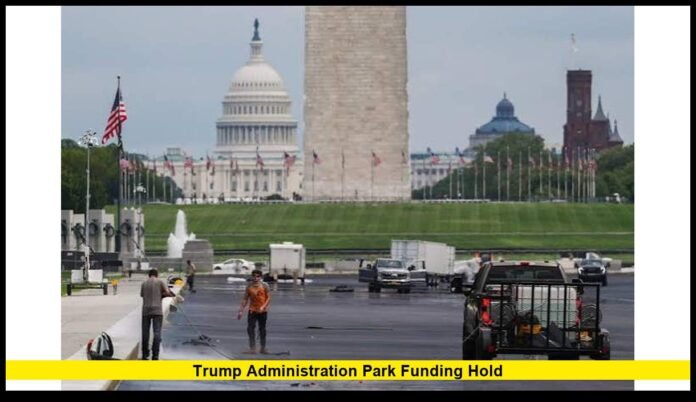

The latest Trump administration park funding hold is affecting national park projects across the United States, with more than 130 planned partnership projects worth at least $25 million recently blocked from moving forward. The developments come on top of a much larger group of more than 1,500 maintenance projects that had already been moved to a low-priority list as federal officials focused resources on White House-backed priorities tied to the nation’s 250th anniversary.
The newest developments have expanded concerns about how federal money is being directed across the National Park Service. Projects involving fire preparedness, historic site protection, equipment, visitor services and other park needs had already secured funding before the Interior Department rejected the agreements needed to release some of that money.
The affected work involves parks across the country, including major destinations such as Yellowstone, Yosemite, Zion and Joshua Tree.
The situation has become particularly significant because the National Park Service already faces a maintenance backlog exceeding $24 billion. At the same time, the agency is dealing with staffing reductions, changes to its organizational structure and a proposed reduction in regular discretionary funding for the next fiscal year.
More National Park Projects Face a Funding Block
The newest development involves more than 130 partnership agreements that the Interior Department did not approve.
The projects were designed to allow national parks to work with outside organizations on specific activities. These arrangements can provide services that parks cannot easily perform with their existing federal workforce.
The projects covered a wide range of needs.
Some involved wildfire preparedness in California. Others involved protecting prehistoric earthworks in Iowa or supporting sled dog operations in Alaska.
Several of the projects involved some of the country’s most visited and recognizable national parks.
The agreements had already secured funding through sources that included congressional appropriations, existing federal programs and internal funding processes.
The Interior Department’s decision therefore did not simply affect projects that were waiting for money to become available. In many cases, funding had already been identified.
The agreements still required final departmental approval before the money could be released and the work could begin.
That approval did not come for the affected projects.
The Interior Department has said it rejected the agreements because officials determined that some activities did not align with current administration priorities.
The agency has not publicly provided a complete project-by-project explanation for every rejection.
The New $25 Million Issue Adds to Earlier Delays
The newly blocked agreements are separate from the larger list of maintenance projects that were moved to low priority earlier in 2026.
That earlier list contained roughly 1,500 projects across more than 200 National Park Service sites.
The combined estimated value of those projects exceeded $400 million.
The work ranged from major infrastructure needs to basic operational purchases.
Examples included roof repairs at Golden Gate National Recreation Area, computer upgrades at Katmai National Park and routine supply purchases at Yellowstone.
The low-priority designation created uncertainty about when those projects could proceed.
With the federal fiscal year ending September 30, many were not expected to be completed during the current fiscal year.
The newer development involving more than 130 partnership agreements adds another layer.
In this case, the projects were not simply waiting at the bottom of a maintenance list. The Interior Department rejected the agreements required to allow the work to proceed.
That distinction matters because it affects projects that had already moved through earlier funding steps.
Why the National Park Service Uses Outside Partnerships
Partnership agreements are an important tool for the National Park Service.
Parks frequently work with nonprofit organizations, universities, local groups and other partners to carry out specialized projects.
These arrangements can provide expertise and additional workers without requiring the Park Service to permanently expand its federal workforce.
That approach has become more important as the agency has faced staffing reductions.
When a partnership agreement is blocked, the park may not have enough employees or resources to perform the same work internally.
That can create delays even when the underlying project remains necessary.
For projects involving wildfire preparation, historic preservation or specialized services, timing can also matter.
A postponed project may have consequences beyond a simple change in schedule.
The administration has not indicated that every rejected project has been permanently canceled. Some projects could potentially be reconsidered under different conditions or through another funding mechanism.
However, the immediate effect is that the agreements cannot proceed as originally planned.
More Than 1,500 Projects Were Already on a Low-Priority List
The broader funding controversy began attracting national attention after National Park Service documents showed that more than 1,500 projects had been classified as low priority.
The projects covered more than 200 park sites.
The list included routine maintenance as well as infrastructure improvements.
Officials indicated that many of the projects were unlikely to receive contracts before the end of the fiscal year.
The estimated value of the work was more than $400 million.
That amount represents a substantial collection of individual projects rather than one single construction program.
Some projects involved relatively basic needs.
Others involved repairs that could affect park facilities and infrastructure over the long term.
The Park Service must make decisions about which projects receive funding when resources are limited.
The dispute in 2026 centers on the role of White House priorities in that process.
Projects connected to the nation’s 250th anniversary received heightened attention, particularly in Washington, D.C.
Washington Projects Have Received Major Attention
The nation’s 250th anniversary has been a major focus of the administration’s park-related spending during 2026.
Several high-profile projects in Washington have received funding and operational attention.
The Lincoln Memorial Reflecting Pool became one of the best-known examples.
The administration pushed for improvements to the reflecting pool ahead of the July Fourth anniversary celebrations.
The project encountered problems after repairs were completed, including issues involving the surface treatment and algae.
The situation drew additional attention to the broader question of how National Park Service resources were being allocated.
Washington has also received funding for fountain rehabilitation and other beautification work.
Public records reviewed earlier this year showed that roughly $140 million had been obligated or spent by the Park Service in Washington during 2026.
The spending includes the reflecting pool and fountain-related projects.
The concentration of resources in the nation’s capital has drawn criticism from lawmakers who argue that parks outside Washington continue to face serious infrastructure needs.
The administration has defended its approach and maintained that the Park Service continues to work on maintenance projects around the country.
Park Entrance Fees Have Become Part of the Debate
National park entrance fees have also become an important part of the funding dispute.
The Park Service collects fees at many sites across the country.
These funds help support park operations and maintenance.
Earlier in 2026, internal agency documents showed that at least $90 million in park entrance fee revenue was being directed toward projects in Washington.
That included money for fountain repairs and a $1.6 million fireworks display connected to the July Fourth celebration.
The allocation generated questions from lawmakers about whether park-generated revenue should instead be used for maintenance needs across the national park system.
The issue is especially significant because parks depend on fee revenue to address local needs.
Many parks have aging facilities, roads, trails, visitor centers and utility systems.
Redirecting available resources can therefore affect how quickly individual parks address their own maintenance requirements.
The administration has indicated that it is examining multiple funding sources for maintenance.
Those sources include park pass revenue and other available funds.
The Maintenance Backlog Remains a Major Problem
The funding dispute is taking place against a longstanding infrastructure challenge.
The National Park Service manages more than 70,000 assets.
Those assets include historic structures, visitor centers, roads, bridges, trails and utility systems.
The agency’s maintenance backlog has grown to more than $24 billion.
That backlog includes repairs that have been delayed over time because of limited resources and the sheer scale of the national park system.
More than 323 million visitors use national parks each year.
Heavy visitation can increase wear on infrastructure.
Roads experience vehicle traffic. Trails require repairs. Restrooms need regular maintenance. Historic buildings require specialized preservation work.
A delayed project does not necessarily create an immediate visible problem.
However, postponing repairs can increase the eventual cost of addressing them.
This is why the current funding decisions have drawn attention from lawmakers and park organizations.
They are taking place at a time when the Park Service already has billions of dollars in identified maintenance needs.
The Great American Outdoors Act Still Matters
Congress has previously taken major steps to address the national park maintenance backlog.
The Great American Outdoors Act became law in 2020.
The legislation created a major federal funding source for deferred maintenance on public lands.
The program provided billions of dollars for repairs and improvements across national parks and other federal lands.
The funding supported more than 1,500 projects across the country during its five-year period.
That program helped address some of the accumulated maintenance needs within the federal public lands system.
However, the dedicated funding period reached its scheduled end after fiscal year 2025.
The expiration increased the importance of annual congressional appropriations and other funding sources.
That makes the current project delays especially important.
The Park Service is trying to address an enormous backlog while also managing annual funding decisions.
Staffing Cuts Are Adding Pressure
Money is not the only challenge facing the agency.
The National Park Service has also experienced significant workforce reductions during the Trump administration.
The agency lost at least one-quarter of its permanent workforce and contracting personnel.
Those losses affect the Park Service’s ability to manage projects.
Federal contracting requires trained personnel who can prepare agreements, evaluate proposals, oversee contractors and ensure that work follows government requirements.
The contracting workforce has also been consolidated within the Interior Department.
Public records indicate that the department’s contracting workforce declined by more than 20%.
That creates another potential bottleneck.
Even when money is available, projects cannot necessarily move forward immediately.
Someone must manage the contracts and oversee the work.
When fewer employees are available, the process can take longer.
The Park Service Is Also Facing Reorganization
The funding issue comes as the Interior Department considers significant changes to the structure of the National Park Service.
Draft planning documents released in September show that the administration is considering a major reorganization of the Park Service and other Interior Department agencies.
The proposed changes would alter how some national parks and regional offices operate.
The administration has presented reorganizational efforts as part of a broader attempt to change how public lands agencies operate.
The plans remain separate from the individual funding decisions affecting projects.
However, the timing has attracted attention because the agency is already dealing with staffing losses and delayed projects.
Changes to regional structures could also affect how parks manage future maintenance and partnership work.
The Fiscal 2027 Budget Could Change the Funding Picture
The administration’s fiscal 2027 budget proposal would provide $2.206 billion in discretionary funding for the National Park Service.
That represents a significant reduction from the $3.267 billion enacted for fiscal 2026.
The proposed amount is roughly 32% below the current fiscal year’s enacted discretionary funding.
However, the administration’s proposal is not the final funding decision.
Congress controls federal appropriations.
The House Appropriations Committee has already advanced a fiscal 2027 proposal that would provide $3.225 billion in discretionary funding for the National Park Service.
That amount is substantially higher than the administration’s request.
If Congress does not enact a full-year appropriations bill by the beginning of fiscal 2027, the Park Service can continue operating under temporary funding arrangements.
The final outcome will determine how much discretionary money becomes available for the agency.
The Current Situation Is Not a Nationwide Cancellation
It is important to distinguish between a funding hold, a low-priority designation and a permanent cancellation.
The federal government has not announced that all national park maintenance projects are being canceled.
Many projects continue.
The Park Service also maintains a separate high-priority list containing more than 2,000 projects.
Some of those projects already have contracts or are moving through the contracting process.
The administration has also stated that some projects initially classified as low priority were incorrectly categorized and later corrected.
However, the combination of the low-priority list and the newly rejected partnership agreements has created substantial uncertainty for many projects.
Some work has been delayed.
Some projects may need to find alternative funding.
Others could return to the federal pipeline later.
The precise outcome will vary by project.
What Happens After September 30
The September 30 end of fiscal year 2026 is an important deadline.
Projects that have not been contracted by then could face another round of prioritization.
Some may receive funding in a future fiscal year.
Others may require new approvals.
Projects connected to partnership agreements could also be reconsidered if the Interior Department changes its position or if agencies identify alternative ways to perform the work.
Congressional appropriations will play a major role in the next stage.
The fiscal 2027 budget process remains active, and the final funding level could differ substantially from the administration’s original request.
The Park Service must therefore navigate both immediate project delays and longer-term budget uncertainty.
What the Funding Hold Means for National Parks
The current developments show how federal funding priorities can directly affect projects far from Washington.
A delayed roof repair in California, a computer upgrade in Alaska or wildfire preparation work can be affected by decisions made at the department level.
The same applies to partnership projects.
Outside organizations often provide specialized services that national parks need but cannot easily perform with existing employees.
When agreements are blocked, parks may have fewer options for completing that work.
The consequences may not always be visible to visitors immediately.
A visitor may see a functioning trail or historic building without realizing that a maintenance project has been postponed.
Over time, however, repeated delays can increase pressure on infrastructure.
That makes the current funding decisions important not only for fiscal year 2026 but also for future park conditions.
The Latest Status of the Park Funding Dispute
As of September 13, 2026, the National Park Service faces multiple layers of funding pressure.
More than 1,500 projects worth over $400 million have been placed on a low-priority list.
More than 130 additional partnership projects worth at least $25 million have recently been rejected at the Interior Department level.
The affected projects include work at some of the country’s most visited parks.
At the same time, Washington has received substantial funding and attention for projects connected to the 250th anniversary.
The Park Service continues to manage a maintenance backlog exceeding $24 billion.
The agency is also operating with a significantly smaller workforce than before the Trump administration’s second term.
The next major developments will come from the end of the current fiscal year and the ongoing congressional budget process.
The final fiscal 2027 appropriations level will determine how much regular funding the agency receives next year.
For now, the central issue remains how the available federal resources are being distributed between immediate administration priorities and the broader maintenance needs of America’s national parks.
The coming weeks could bring important changes to these delayed projects, so share your thoughts and stay informed as the National Park Service funding situation develops.