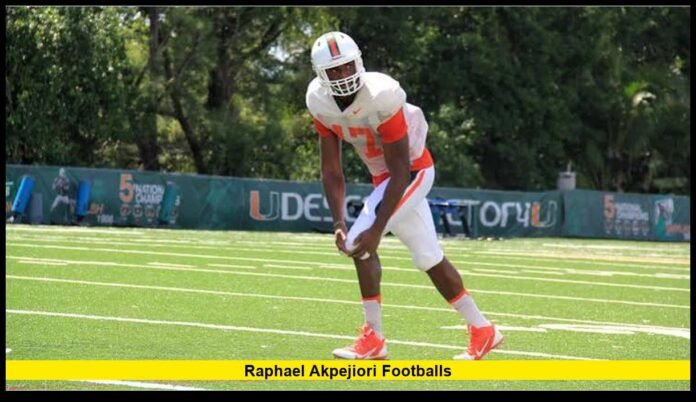

Raphael Akpejiori football history began with one of the more unusual transitions in college sports. The Nigerian-born athlete arrived at the University of Miami as a basketball player, completed four seasons with the Hurricanes, and then decided to try American football despite having never played the sport before. His size and athletic background made him an intriguing tight-end prospect, but his football experiment was only one stage of a much broader sporting journey that eventually took him into professional heavyweight boxing.
Akpejiori’s career stands out because of the number of major changes he made as an athlete. He went from Nigerian youth basketball to American college basketball, then from basketball to football, and eventually from football to boxing. Each transition required him to learn a new sport while relying on the physical strength, competitiveness and discipline developed in the previous one.
As of the latest update, boxing is the sport that defines his professional career. However, his brief time with Miami’s football program remains an important part of his story.
Who Is Raphael Akpejiori?
Ethasor Raphael Akpejiori was born in Lagos, Nigeria, on October 10, 1990. He later moved to the United States and established himself as a basketball player.
Akpejiori attended Sunrise Christian Academy in Kansas, where his basketball ability helped put him on the college recruiting radar. He was recognized as a promising power forward and also played AAU basketball with Baltimore Elite.
The move to the United States eventually led him to the University of Miami, where he became part of the Hurricanes men’s basketball program.
At Miami, Akpejiori played from 2010 through 2014. He appeared in 85 games and was primarily used as a reserve. Although his offensive statistics were modest, his size and physical presence made him useful around the basket.
He was also part of Miami’s 2013 ACC championship team, giving him an opportunity to experience success at the highest level of college basketball.
But basketball was not the end of his athletic ambitions.
The Move From Basketball to Football
After completing his basketball career, Akpejiori made a decision that immediately attracted attention around Miami.
He joined the Hurricanes football program during the summer of 2014.
The unusual aspect of the move was that Akpejiori had never played American football. He was not a former high school football star changing positions or a college football player returning from injury. He was learning the sport almost entirely from the beginning.
Miami listed him as a tight end and gave him jersey No. 47. He was listed at 6-foot-9 and 248 pounds, giving coaches an unusually large athlete to work with.
The move was particularly interesting because of another Miami athlete who had successfully made the same general transition.
The Jimmy Graham Connection
Akpejiori’s decision to try football immediately brought comparisons with Jimmy Graham.
Graham had also played basketball at Miami before becoming a football player. He transitioned to tight end and eventually became an NFL star with the New Orleans Saints and other teams.
That example helped demonstrate why basketball players can sometimes attract attention from football coaches. Height, wingspan, coordination, body control and the ability to compete for a ball in the air can all be valuable qualities for a tight end.
Akpejiori had several of those physical characteristics.
However, the comparison had an important limitation. Graham had already developed football skills before reaching the NFL level, while Akpejiori was attempting to learn the fundamentals of American football after completing his basketball career.
That meant his development had to be accelerated.
Learning American Football From Scratch
For Akpejiori, becoming a football player meant learning much more than simply catching a ball.
A tight end must understand route running, blocking assignments, releases, defensive coverage, positioning and timing. The player must also become comfortable with the physical contact that takes place on almost every play.
Akpejiori’s basketball experience gave him some transferable abilities, but football required a completely different understanding of space and movement.
His height was an obvious advantage, particularly when considering his potential as a receiving target. A 6-foot-9 athlete can present a large target for a quarterback, especially near the goal line.
The challenge was turning that physical advantage into football production.
He trained alongside experienced football players and worked on the technical side of the game. His transition also received attention because of his work with people connected to Miami’s football and professional football communities.
Did Akpejiori Play in the NFL?
Akpejiori did not go on to establish a long-term NFL career.
His football opportunity nevertheless progressed far enough for him to receive professional evaluation. He participated in Miami’s 2015 pro day, giving NFL personnel an opportunity to examine his athletic abilities.
His physical measurements and workout numbers demonstrated why he had been considered an interesting experiment.
But physical potential alone is rarely enough to produce an NFL career, particularly for a player who started learning football at the college level.
The amount of technical development required to become an NFL tight end is considerable. Players competing for professional roster spots generally have years of experience with route concepts, blocking schemes, defensive reads and game situations.
Akpejiori’s football career therefore remained relatively short.
His next sporting challenge would be even more dramatic.
Why Did Raphael Akpejiori Turn to Boxing?
After leaving college athletics, Akpejiori earned a master’s degree in mechanical engineering from Miami and began working at the university as an energy engineer.
On paper, he had established a promising professional path outside sports.
Yet competitive athletics continued to appeal to him.
The desire to compete eventually led him to boxing. What began as another athletic experiment developed into a serious professional career.
His transition into boxing was particularly demanding because heavyweight boxing requires conditioning, technical skill, timing, defensive awareness and the ability to absorb and deliver powerful punches.
Akpejiori’s size immediately made him an interesting heavyweight prospect.
His previous experience in basketball and football also gave him familiarity with physical competition, although boxing required an entirely different skill set.
Building a Professional Boxing Career
Akpejiori turned professional in 2018.
He quickly became known for his punching power and ability to finish opponents. His record was built largely through stoppage victories, making him an appealing opponent for heavyweight events.
His career also demonstrated that moving between sports does not eliminate the challenges of professional competition.
In July 2023, Akpejiori suffered the first defeat of his professional boxing career against Arslanbek Makhmudov. The fight ended in the second round.
He later returned to the win column and continued competing as a heavyweight.
His career subsequently included victories as well as difficult losses against increasingly experienced opposition.
In 2025, he suffered a first-round defeat against Stephan Shaw. He responded with a win over Frank Mola in February 2026 before facing Mourad Aliev in May.
The Aliev bout ended in another setback, putting Akpejiori in a difficult position heading into his next major opportunity.
The Latest Fight Against Da’Mazion Vanhouter
The latest chapter of Akpejiori’s career came on September 12, 2026, in Las Vegas.
He faced unbeaten American heavyweight Da’Mazion “Mazi” Vanhouter on the undercard of the Ryan Garcia-Conor Benn event at T-Mobile Arena.
The matchup was scheduled for eight rounds and represented a significant opportunity for Vanhouter, who entered the contest as one of the younger heavyweight prospects attracting attention.
Akpejiori brought substantially more professional experience into the fight.
The difference in momentum, however, became apparent almost immediately.
Vanhouter pressed forward from the opening bell and put Akpejiori under pressure. After a brief sequence in which Vanhouter appeared to experience discomfort, the fight resumed.
The young American then connected with a powerful right hand that sent Akpejiori to the canvas.
The referee stopped the contest at 1:58 of the opening round.
The result gave Vanhouter another major knockout victory while adding another defeat to Akpejiori’s professional record.
Raphael Akpejiori Football Remains Part of His Story
Although boxing has become the main focus of Akpejiori’s professional athletic career, his football experience continues to attract interest because of how unusual it was.
Most athletes who reach the college level specialize in one sport for many years. Akpejiori did the opposite.
He became a college basketball player, helped Miami win an ACC championship, completed his basketball eligibility and then voluntarily entered a football program without previous American football experience.
That decision required considerable confidence.
It also demonstrated his willingness to accept a steep learning curve rather than remain within the boundaries of the sport he already knew.
His football experiment did not produce an NFL career, but it became an important bridge between his basketball background and his later life as a professional boxer.
How Basketball Helped His Athletic Development
Basketball may have been the foundation for much of Akpejiori’s athletic development.
The sport required him to use his height, reach and body positioning constantly. Rebounding demanded timing and physical contact, while defending larger players required strength and anticipation.
Those qualities could translate to other sports.
Football gave him experience with another form of contact and helped introduce him to the physical demands of the gridiron.
Boxing later required him to develop completely different techniques, including footwork, punching mechanics, defensive movement and ring strategy.
The common thread throughout all three sports was competition.
Akpejiori has repeatedly pursued environments where physical preparation and performance are tested directly.
Akpejiori’s Physical Profile
Size has been one of the defining features of Akpejiori’s athletic career.
Miami listed him at 6-foot-9 and 248 pounds during his football season. His unusual combination of height and strength helped make him a natural candidate for a tight-end experiment.
That physical profile also translated naturally to heavyweight boxing.
A tall heavyweight can use reach and distance to control an opponent, although height alone does not guarantee success. Boxing requires the athlete to convert physical dimensions into effective movement, punching and defense.
Akpejiori’s professional record showed that he possessed considerable power, with the overwhelming majority of his victories coming by knockout or technical knockout.
What Happened to His Football Career?
Akpejiori’s football career ended without a sustained professional contract, but that does not mean the experiment was unsuccessful from a personal or developmental standpoint.
He challenged himself in a sport he had never played before, trained with a major college football program and reached the stage of professional evaluation.
More importantly, football became another chapter in an athletic life that continued long after college.
His story demonstrates that athletes do not always follow a conventional route. A player can finish one sport and discover an entirely different competitive opportunity elsewhere.
For Akpejiori, that opportunity eventually became boxing.
Where Is Raphael Akpejiori Now?
Following the September 2026 defeat to Vanhouter, Akpejiori remains a professional heavyweight boxer.
The latest result leaves his record at 19 wins and four losses, with 18 victories coming by knockout or technical knockout.
At 35 years old, his career is entering a different stage from the one he occupied as a college basketball player or football experimenter.
His next move in boxing will determine whether he continues pursuing high-level heavyweight opportunities or takes his career in another direction.
Whatever comes next, his athletic history is already unusual.
He has competed in college basketball, attempted American football without prior experience and built a professional boxing career. Few athletes can claim such a varied path.
Frequently Asked Questions
What sport did Raphael Akpejiori play at Miami?
Akpejiori played men’s basketball at the University of Miami for four seasons from 2010 through 2014. He later joined the football program as a tight end.
Did Raphael Akpejiori have football experience before joining Miami?
No. Miami’s football profile stated that he had never played American football before joining the Hurricanes.
What position did he play in football?
He played tight end and was listed at 6-foot-9 and 248 pounds.
Why was he compared with Jimmy Graham?
Both athletes played basketball at the University of Miami before attempting to transition into football. Graham ultimately became a successful NFL tight end.
Did Akpejiori reach the NFL?
He did not establish an NFL career. He did participate in Miami’s 2015 pro day as he explored professional football opportunities.
When did Akpejiori begin professional boxing?
He turned professional in 2018 after moving from his previous career and pursuing competitive boxing.
What is his latest boxing record?
After losing to Da’Mazion Vanhouter by first-round knockout on September 12, 2026, Akpejiori’s record stands at 19-4 with 18 knockout victories.
Final Takeaway
Raphael Akpejiori’s career is a reminder that an athlete’s path does not always follow a straight line. His journey began in Nigeria, continued through American college basketball, moved unexpectedly to football and eventually developed into a professional heavyweight boxing career.
His time with Miami’s football team lasted only a short period, but it remains one of the most fascinating chapters of his sporting biography. At 6-foot-9, he had the physical profile to attract attention, while his willingness to learn American football from scratch separated his story from conventional college recruiting narratives.
Today, boxing is the central part of his professional identity. His September 2026 bout with Da’Mazion Vanhouter ended quickly, but it also added another chapter to a career that has already crossed three major sports.
The football experiment may not have produced an NFL breakthrough, yet it helped establish Akpejiori as an athlete willing to take significant risks and pursue competition wherever he could find it.