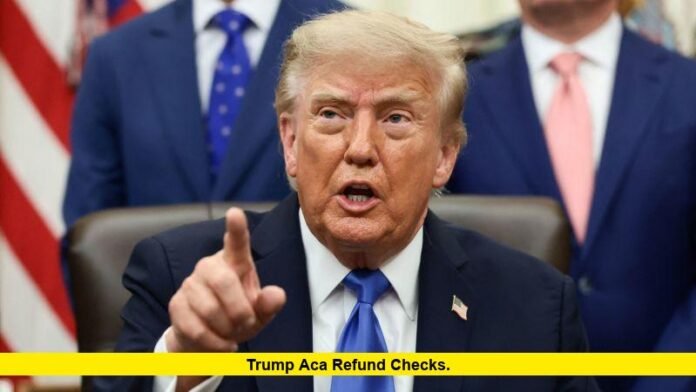

The newest October 1 development
The latest reporting says recipients are receiving the $500 payment together with a letter signed by President Trump. The letter says the Biden administration overcharged consumers through ACA exchange user fees and that the surplus is being returned. Business Insider
There is also an important caveat: the administration’s characterization of these payments as refunds for consumer overcharges is disputed by healthcare-policy experts and critics. The basic fact that payments are being distributed is separate from the debate over whether the underlying fees actually constituted consumer overcharges.
Trump ACA refund checks are beginning to go out to more than 950,000 Americans as the administration starts distributing $500 payments tied to Affordable Care Act marketplace coverage. The payments are being sent to eligible consumers in 30 states that use the federal HealthCare.gov marketplace, with Treasury checks and letters from President Donald Trump beginning to be mailed September 30, 2026.
The payments were announced by Trump on September 10 as the Working Families Obamacare Refunds. The White House said the program would return excess marketplace user fees to people who paid the full cost of their ACA coverage. The administration originally said checks would begin going out in October, but the latest update shows the mailing process is beginning at the end of September.
The program has generated significant interest because the $500 payment is different from the regular ACA medical loss ratio rebates that insurers send to some policyholders. It is also limited to a relatively small share of the more than 19 million people enrolled in ACA Marketplace coverage.
Read Also-Trump Sending $500 Checks: Who Is Eligible, When Payments Are Arriving and What to Know
What Are the $500 ACA Refund Checks?
The Trump administration describes the payments as refunds of excess fees associated with the federal ACA exchange. Insurers that sell plans through HealthCare.gov pay user fees to support the operation of the federal marketplace.
Those fees help fund services such as the HealthCare.gov website, its call center and enrollment assistance programs. Insurers generally build the cost of the fees into premiums rather than listing them as a separate charge to consumers.
The White House says the federal government collected more in user fees than was necessary to operate the exchange during the Biden administration. It says the resulting surplus should be returned to consumers who paid the full price of their coverage.
That explanation remains a key part of the administration’s description of the program. However, independent health policy experts have disputed the broader characterization that the existence of a surplus proves consumers were improperly overcharged.
KFF health policy expert Cynthia Cox has noted that user fees collected during earlier years also contributed to accumulated funds. Reuters reported that the Trump administration’s first term collected more user fees than it spent, producing an estimated $1 billion in unspent funds.
Who Qualifies for the $500 Payment?
The eligibility rules are narrower than the headline announcement may suggest.
The payment is intended for people who had 2026 ACA Marketplace coverage through HealthCare.gov and paid the full premium without receiving a federal premium subsidy. Most people with ACA Marketplace coverage will not receive the payment.
The White House has said the refunds primarily target people above 400% of the federal poverty level who do not qualify for premium assistance. They can also include people between 100% and 400% of the poverty level who did not receive a premium subsidy.
An important distinction is that simply having an ACA plan does not make someone eligible.
A person can live in one of the participating states and still receive no payment if that individual received premium assistance for 2026. The same applies to people enrolled through state-based marketplaces rather than HealthCare.gov.
The administration says it has already identified the eligible recipients. People do not need to submit a separate application to claim the $500 refund.
Which States Are Included?
The refund program covers the 30 states that used the federal HealthCare.gov marketplace for 2026 coverage.
Those states are:
- Alabama
- Alaska
- Arizona
- Arkansas
- Delaware
- Florida
- Hawaii
- Indiana
- Iowa
- Kansas
- Louisiana
- Michigan
- Mississippi
- Missouri
- Montana
- Nebraska
- New Hampshire
- North Carolina
- North Dakota
- Ohio
- Oklahoma
- Oregon
- South Carolina
- South Dakota
- Tennessee
- Texas
- Utah
- West Virginia
- Wisconsin
- Wyoming
CMS confirms that 30 states used HealthCare.gov during the 2026 Open Enrollment Period, while 21 states and the District of Columbia operated their own marketplace platforms.
Residents of states with their own marketplaces are therefore outside the federal refund program, even if they purchased ACA coverage.
How Much Is Each Refund?
The announced refund is $500 per eligible person.
It is not a $500 household payment. An eligible household with multiple people enrolled in qualifying Marketplace coverage could receive more than one $500 payment.
The White House estimates that nearly 1 million people will receive payments. The latest September 30 update puts the number of checks beginning to go out at more than 950,000 recipients across the 30 states.
The total value of the program is therefore roughly $500 million.
The exact relationship between an individual’s payment and the amount that person may have paid through marketplace user fees is not presented as an individualized calculation. The administration is using the $500 figure as the standardized refund amount for eligible recipients.
When Are the Checks Being Sent?
The latest update is especially important for people waiting for the payment.
On September 30, Treasury checks and letters signed by Trump began going out to more than 950,000 eligible Americans. The mailing process does not mean every recipient will receive the check in the mail on September 30.
The White House’s original September 10 announcement said payments would begin in October. The latest reporting shows that the federal government is starting the mailing process at the end of September, with recipients expected to receive the checks as they move through the mail.
People who qualify should therefore distinguish between the date checks begin mailing and the date an individual check arrives.
There is no single nationwide arrival date for every recipient.
Do You Need to Apply for the Refund?
No separate application is required for people the administration has identified as eligible.
The government has stated that eligible recipients have already been identified. That means consumers should not need to submit a new ACA application, pay a fee or complete a special refund form to receive the payment.
This point also matters for avoiding scams.
Consumers should be cautious of anyone requesting money, bank-account credentials or other sensitive information in exchange for helping them obtain the $500 refund. The federal program is based on an existing list of eligible Marketplace enrollees.
A request for payment in exchange for obtaining the refund would not be part of the announced process.
Is This the Same as an ACA Insurance Rebate?
No. The $500 federal refund should not be confused with the ACA’s Medical Loss Ratio, or MLR, rebates.
MLR rebates are issued by insurance companies when they fail to spend the required percentage of premium revenue on medical care and quality improvement. For individual and small-group coverage, insurers generally must spend at least 80% of premium revenue on those areas.
KFF estimates that insurers will issue about $759 million in MLR rebates across commercial markets in 2026. Those rebates are based on insurer financial performance and are separate from the Trump administration’s $500 federal refund program.
That distinction is important because an ACA enrollee could potentially encounter information about both programs during the same period.
The $500 federal payment is tied to the newly announced refund program. MLR rebates are tied to insurance companies’ spending and profitability calculations under the ACA.
Why Are Some ACA Enrollees Excluded?
The administration’s refund program does not cover everyone enrolled in an ACA Marketplace plan.
The central distinction is whether the consumer paid the full premium without federal premium assistance. Subsidized enrollees are excluded from the announced $500 payment.
One reason for that distinction is the way premium subsidies work. Reuters reported that people receiving subsidies generally have their premium contribution tied to income, meaning the government absorbs much of the effect when the underlying premium changes.
HealthCare.gov enrollment also matters.
Someone enrolled through a state-based marketplace is outside the federal refund program even if that person paid the full price of an ACA plan. The refund specifically targets qualifying enrollees in the 30 states using the federal exchange.
What Is the Dispute Over the Excess Fees?
The biggest factual dispute surrounding the refund concerns the characterization of the accumulated user-fee money.
The White House says consumers were effectively overcharged because marketplace user fees were collected above the amount needed to operate the federal exchange. It describes the payments as returning money that ultimately came from consumers.
Independent analysis provides additional context.
Cynthia Cox of KFF told Reuters that a surplus of user-fee revenue does not necessarily establish that consumers were overcharged. She noted that the fees were set ahead of time and that spending on programs supporting enrollment changed over time. Reuters also reported that the 2026 user-fee rate was set at 2.5% of premiums.
CMS has since finalized a lower 1.9% federal exchange user-fee rate for the 2027 benefit year.
As a result, the existence of the refund program is confirmed, while the administration’s broader characterization of the historical surplus remains contested.
How Many Americans Are Receiving the Money?
The number of recipients is small compared with total ACA Marketplace enrollment.
More than 19 million Americans had Marketplace coverage, while the announced refund program covers nearly 1 million people. That means the overwhelming majority of ACA Marketplace enrollees are not part of the $500 payment program.
The eligibility restrictions explain much of that difference.
Recipients must fall within the federal marketplace population and meet the requirements for full-price coverage. People receiving premium assistance and people using state-based exchanges are excluded from the announced program.
What Should Eligible Consumers Expect Now?
The most important development as of September 30 is that the payment process has moved from announcement to distribution.
Treasury checks are beginning to be mailed, and eligible recipients should watch their mail for the government payment and accompanying letter. The exact arrival date can vary because checks are being sent through the mail.
There is no need for eligible consumers to file a separate application based on the administration’s stated process.
At the same time, consumers should not assume that every ACA enrollee will receive $500. Eligibility is limited to qualifying full-price enrollees in the 30 federal-marketplace states.
The program also should not be confused with ordinary insurer rebates issued under the ACA’s Medical Loss Ratio rules.
Bottom Line on the $500 ACA Refund
The federal government is now beginning to mail $500 refunds to more than 950,000 eligible ACA Marketplace consumers. The payments are connected to the administration’s Working Families Obamacare Refunds program and target qualifying people who paid full price for 2026 coverage through HealthCare.gov.
The program covers 30 states and excludes most ACA enrollees, particularly people who received premium assistance or used state-based marketplaces. The administration says the payments return excess marketplace user fees, while independent health policy analysis disputes the broader claim that the surplus itself proves consumers were overcharged.
For eligible recipients, the immediate issue is no longer whether the program was announced. The checks are now entering the mailing process, with Treasury beginning to send the payments and accompanying letters on September 30.
If you are watching for your $500 ACA refund, the latest update is that payments are now being mailed, so keep an eye on your mailbox for the federal check.