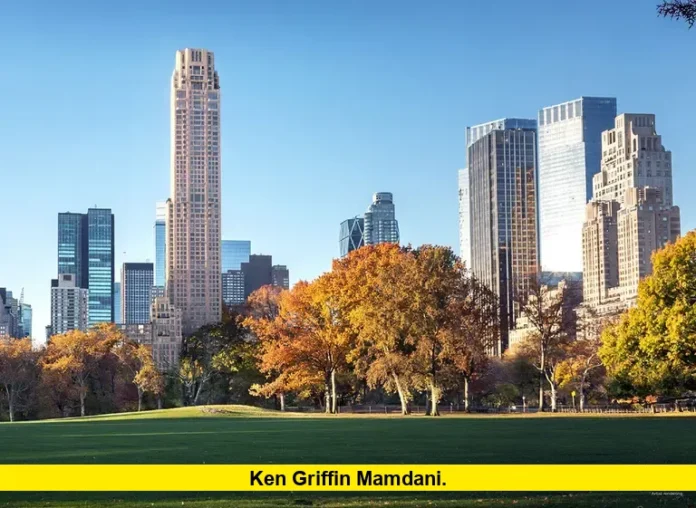

Ken Griffin Mamdani tensions remain a closely watched New York business and political story after a public dispute over taxes, Griffin’s Manhattan property, and Citadel’s major plans for the city.
The dispute began after New York City Mayor Zohran Mamdani used Griffin’s $238 million Manhattan penthouse as the backdrop for a social-media video promoting a new surcharge on certain non-primary residences. The confrontation quickly expanded into a broader debate over taxation, business investment, and New York’s relationship with wealthy residents and major financial firms.
Months later, the relationship remains complicated. Griffin has continued criticizing Mamdani’s economic approach, while Citadel has continued advancing a major Midtown Manhattan development. The latest developments show that the public dispute did not result in Citadel abandoning its New York expansion plans.
How the Ken Griffin and Mamdani Dispute Started
The dispute became public on Tax Day in April 2026.
Mamdani released a video outside 220 Central Park South, where Griffin owns a large penthouse. In the video, the mayor promoted a proposed pied-à-terre tax aimed at certain expensive residential properties whose owners do not use them as primary residences.
Mamdani specifically identified Griffin and his approximately $238 million penthouse while explaining the purpose of the proposal. The property became a highly visible example of the type of wealth the administration wanted the new surcharge to address.
The episode triggered an immediate response from Citadel.
Citadel Chief Operating Officer Gerald Beeson criticized the use of Griffin’s home in the mayor’s video. The firm also raised concerns that the political confrontation could affect a planned Midtown development involving Citadel. Citadel said its principals and employees had paid nearly $2.3 billion in New York City and New York state taxes over the preceding five years.
The disagreement therefore moved beyond a personal dispute. It became part of a larger discussion about whether New York’s tax policies could affect investment decisions by major companies and wealthy individuals.
Why Ken Griffin’s Manhattan Penthouse Became Central to the Story
Griffin purchased the four-floor penthouse at 220 Central Park South in 2019 for approximately $238 million. The transaction attracted national attention because it ranked among the most expensive home purchases ever recorded in the United States at the time.
Mamdani used that property to illustrate his argument for taxing high-value second homes.
The mayor and Governor Kathy Hochul had announced the state’s first pied-à-terre tax proposal in April. The measure focused on certain one- to three-family homes, condominiums, and cooperative apartments valued above $5 million when their owners have a separate primary residence outside New York City.
The policy later entered implementation, although its structure is more complicated than the original political messaging suggested. New York City’s Tax Commission says the surcharge for the 2026-27 and 2027-28 property tax years can apply to one-, two-, and three-family homes valued above $5 million and condominium or cooperative units valued at $1 million or more when they are not used as primary residences.
The distinction matters because the tax is not simply a charge on every expensive New York residence. Primary-residence rules and exemption procedures are central to determining whether an individual property is subject to the surcharge.
Griffin’s Response to Mamdani
Griffin strongly objected to being featured in the mayor’s video.
He later described the episode as a personal attack and said the video made him concerned about his personal security. Griffin connected his reaction to the assassination of UnitedHealthcare CEO Brian Thompson in 2024, noting that the killing occurred near his Manhattan residence.
Griffin also argued that New York’s tax burden does not correspond with the quality of services provided by the city.
In May, he said Mamdani’s actions had made it clear that Citadel needed to strengthen its commitment to Miami. Citadel had already moved its headquarters from Chicago to Miami in 2022, making Florida an important part of Griffin’s long-term business strategy.
By July, Griffin was still publicly criticizing Mamdani’s economic philosophy. During remarks connected to a Goldman Sachs event, he challenged socialist politicians, including Mamdani, to study historical examples of economic systems. He also argued that high taxes and inadequate public services could encourage financial businesses to move away from New York.
Mamdani Tried to Keep a Business Dialogue Open
Despite the confrontation, Mamdani did not say he wanted Griffin or Citadel to leave New York.
The mayor repeatedly said that he wanted businesses and business leaders to succeed while maintaining his position that wealthy New Yorkers should contribute more through taxation.
In May, Mamdani said his administration had reached out to Griffin to arrange a conversation. He described the invitation as open and said he wanted to meet with business leaders across New York City, including people with whom he disagreed.
Mamdani also acknowledged Griffin’s importance as an employer and business leader in New York.
That position has remained relevant because Citadel’s business presence in Manhattan is much larger than Griffin’s personal residence. The company has major operations in the city and has committed to a major new office development.
The $6.2 Billion 350 Park Avenue Project
One of the most important developments in the story is what happened to Citadel’s planned Midtown skyscraper.
During the early stages of the dispute, Citadel indicated that the confrontation could put its New York expansion under review. That created uncertainty around the proposed redevelopment of 350 Park Avenue.
The project ultimately continued.
In August 2026, Vornado Realty Trust announced a formal joint venture with an affiliate of Griffin for the development of a roughly 1.9 million-square-foot office tower at 350 Park Avenue. Griffin’s affiliate is set to own 60% of the venture, while Vornado will own 36% and Rudin 4%.
The project’s development budget is expected to be approximately $6.2 billion. A $3.3 billion construction loan is planned, while Citadel Enterprise Americas is expected to sign a 15-year lease covering approximately 1.05 million square feet as the property’s anchor tenant.
That is a significant update to the Griffin-Mamdani story.
The project is not merely still alive. Its formal financing and joint-venture arrangements have advanced.
Demolition at the site also began earlier in the year, further demonstrating that the development was progressing despite the political dispute.
What Happened to the Threat of Leaving New York?
Griffin’s comments about increasing Citadel’s commitment to Miami created the impression that the company might substantially reduce its New York presence.
That possibility remains part of Griffin’s broader criticism of New York’s business environment. However, the available corporate records show that Citadel has not abandoned its planned Midtown headquarters project.
Vornado’s August announcement provides the clearest confirmation. Citadel remains positioned as the anchor tenant, while Griffin’s affiliate is the majority partner in the development venture.
The distinction is important.
Griffin can simultaneously expand Citadel’s Miami operations and maintain a significant long-term commitment to New York. Citadel’s corporate strategy does not require choosing one city to the exclusion of the other.
The latest project structure reflects that reality.
The Pied-à-Terre Tax Adds a New Chapter
The tax issue has continued to develop even after the original Griffin-Mamdani confrontation.
New York City began notifying potentially affected property owners in July. The Department of Finance created a process allowing owners to provide information showing that their properties were primary residences or otherwise exempt.
The administration later extended the exemption application deadline to September 18, 2026, giving property owners additional time to challenge the city’s initial classification.
The rollout then faced legal problems.
A New York State judge ruled in September that the city must redo aspects of the implementation after determining that the process improperly placed burdens on homeowners. The ruling did not eliminate the underlying surcharge but required changes to how the city implements it. The city has indicated that it plans to appeal.
That legal development matters to the Griffin story because his Manhattan property became the most recognizable symbol of the policy when Mamdani first promoted it.
A Striking Development: Griffin Also Funded an NYPD Memorial
The relationship between Griffin and Mamdani has another important dimension that is separate from the tax dispute.
Griffin provided major personal support for a new memorial wall at NYPD headquarters honoring officers who died during the September 11 attacks and from illnesses connected to their post-9/11 service.
Mamdani participated in the September 2026 unveiling at One Police Plaza. During the ceremony, the mayor specifically recognized Griffin’s contribution and described the memorial as an important way to preserve the history of the officers being honored.
The development illustrates why the relationship cannot be reduced to the tax disagreement.
Griffin and Mamdani remain on opposing sides of major questions involving taxation and business policy. At the same time, Griffin continues to have substantial philanthropic and business ties to New York City.
Where Ken Griffin and Mamdani Stand Now
As of the latest confirmed updates, the public disagreement has not disappeared.
Griffin has continued to criticize Mamdani’s approach to taxation and New York’s business climate. Mamdani continues to support higher contributions from wealthy property owners and has defended the surcharge as a way to raise additional city revenue.
Yet the business relationship between Citadel and New York remains substantial.
The 350 Park Avenue project is moving forward under a formal joint venture. Citadel is expected to occupy more than one million square feet of the future building, giving the firm a major long-term physical presence in Manhattan.
The tax itself also remains active despite the legal challenge, although its implementation is being revised following the recent court ruling.
For readers searching for the latest Ken Griffin Mamdani update, the central fact is therefore clear: their political and business disagreement remains unresolved, but Citadel’s major New York development has continued advancing.
The Bottom Line on Ken Griffin and Mamdani
The dispute began with a social-media video and a billionaire’s luxury Manhattan property. It quickly developed into a broader argument over taxation, economic policy, investment, and the future relationship between New York City government and Wall Street.
Griffin’s criticism of Mamdani has remained public, while Mamdani has maintained his support for the tax policy and continued to invite dialogue with business leaders.
At the same time, Citadel’s planned 350 Park Avenue headquarters has moved forward through a formal $6.2 billion development arrangement. That development provides an important counterpoint to speculation earlier in the year that the dispute might end Citadel’s major New York investment.
The latest legal developments surrounding the pied-à-terre surcharge mean the tax issue itself is still evolving. Meanwhile, Griffin’s support for the NYPD memorial shows that his relationship with New York extends beyond the disagreement over taxes.
As the tax fight and Citadel’s Manhattan expansion continue to develop, stay tuned for the next confirmed update in the Ken Griffin and Mamdani story.