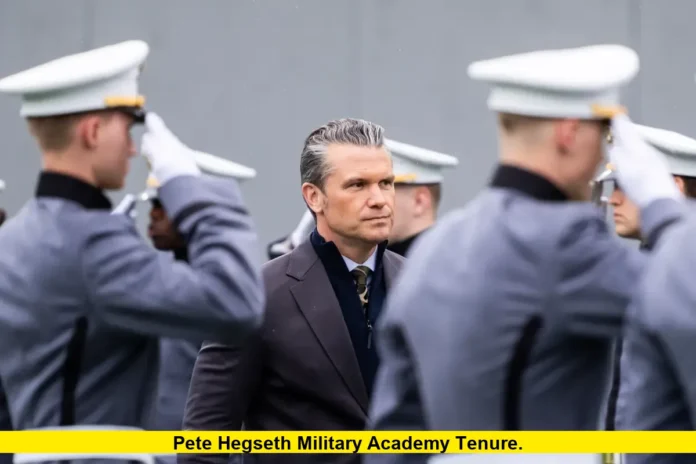

Pete Hegseth military academy tenure has become a major defense education issue after the secretary signed a new directive ending the appointment of civilian faculty to tenured positions at U.S. military service academies.
The policy was signed on September 29, 2026, and immediately changes how the Army, Navy and Air Force may structure future civilian faculty appointments at their service academies. The directive does not announce the removal of tenure from professors who already hold it. Instead, it stops the practice of appointing civilian faculty to new tenured positions and calls for new hiring plans centered on institutional flexibility and the military mission.
The development is part of Hegseth’s broader effort to reshape military education around training officers for operational service. It also follows months of discussion inside the Pentagon about civilian faculty, curriculum and the role of traditional academic practices at military institutions.
What Hegseth Changed on Military Academy Tenure
Hegseth’s September directive applies to the U.S. Military Academy at West Point, the U.S. Naval Academy in Annapolis and the U.S. Air Force Academy in Colorado Springs.
The memo directs the military departments to immediately stop appointing civilian faculty to tenured positions. It also requires the departments to develop hiring plans that prioritize flexibility and faculty contributions to the warfighting mission.
The policy therefore concerns civilian professors, not military officers serving as instructors. Service academies traditionally use a mixture of uniformed personnel and civilian academics. Officers bring military experience and operational knowledge, while civilian faculty provide specialized academic expertise across subjects ranging from engineering and science to history, languages and the humanities.
Hegseth has argued that the existing tenure system can make academic institutions less adaptable. His memorandum states that tenure can contribute to academic stagnation and faculty complacency. It also says the system can allow academic priorities to move away from preparing future warfighters.
The administration’s policy does not establish that all civilian professors will leave the academies. It specifically targets future appointments to tenured positions. Existing tenured faculty members are not identified for automatic loss of their status under the directive.
Which Military Academies Are Affected
The directive focuses on the three major service academies operated by the military departments:
- U.S. Military Academy at West Point, New York
- U.S. Naval Academy in Annapolis, Maryland
- U.S. Air Force Academy in Colorado Springs, Colorado
The Coast Guard Academy and the U.S. Merchant Marine Academy have different federal oversight arrangements. The Coast Guard Academy falls under the Department of Homeland Security, while the Merchant Marine Academy is overseen through the Department of Transportation. The September directive discussed by the Defense Department applies to the military service academies under the Army, Navy and Air Force.
The size of the civilian faculty varies considerably among the three institutions.
West Point’s faculty is roughly 27% civilian, with most faculty positions held by military personnel. The Naval Academy has a much larger civilian component, with 284 civilian faculty members reported in recent academy figures. Of those Naval Academy civilian faculty members, 217 hold tenure and 67 are on the tenure track.
The Air Force Academy has also historically maintained a significant civilian faculty presence. Recent figures cited during the broader debate placed civilian faculty at roughly 30% or more of the institution’s teaching staff, although its employment structure has differed from the other academies in important respects.
Why Civilian Faculty Matter at Service Academies
Military academies are not only military training centers. They are also four-year undergraduate institutions that provide accredited academic programs.
Cadets and midshipmen study subjects that extend well beyond military tactics. Their education includes mathematics, engineering, science, economics, history, political science, foreign languages and other disciplines.
Civilian professors have historically supplied continuity and specialized academic credentials that can be difficult to maintain through short military assignments. Uniformed instructors often rotate through academic positions as part of their military careers. Civilian professors can remain within an academic discipline for substantially longer periods.
That difference became an important issue during congressional discussions about faculty composition.
Congress took action in 1992 to expand the ability of West Point and the Air Force Academy to employ civilian professors, instructors and lecturers. The legislation also called for increasing civilian faculty at those academies while reducing the number of permanent military faculty positions.
The policy debate has therefore existed for decades. Hegseth’s directive represents a new shift toward limiting the role of traditional academic tenure in that structure.
What Hegseth Says Tenure Does
The central argument in Hegseth’s memo is that military academies should remain closely connected to their warfighting mission.
The secretary wrote that the academies exist primarily to prepare future officers to lead service members. His memo argues that civilian academic norms can interfere with that mission when institutional practices place too much emphasis on academic independence or research priorities.
Hegseth specifically identifies tenure as one of those practices.
His position is consistent with comments he made during his Senate confirmation process in 2025. At that time, he said he wanted more uniformed personnel teaching at West Point, the Naval Academy and the Air Force Academy. He questioned the value of relying heavily on civilian professors trained at universities that he characterized in ideological terms.
The September directive converts that broader position into a specific personnel policy.
How Academy Leaders Previously Described Tenure
Military academy leaders have previously presented tenure differently.
During a Senate Armed Services Committee hearing in 2025, West Point Superintendent Lt. Gen. Steven Gilland told senators that civilian faculty provided valuable expertise. He also said tenure helped professors develop within their academic disciplines and assisted the academy with recruiting and retaining qualified faculty.
Then-Naval Academy Superintendent Vice Adm. Yvette Davids described tenure as an important recruiting tool. She said it helped attract highly qualified academics and encouraged them to remain at the academy.
Air Force Academy Superintendent Lt. Gen. Tony Bauernfeind also discussed the role of civilian and military faculty during congressional questioning. The testimony highlighted the different functions performed by the two groups and the academies’ need to maintain academic standards while fulfilling military requirements.
These earlier comments help explain why the new policy represents a significant change in the academic personnel model.
What Happens to Professors Who Already Have Tenure?
One of the most important details in the latest policy is what it does not say.
The September 29 directive does not state that existing tenured civilian professors will automatically lose tenure. Reporting on the signed memorandum indicates that the immediate change concerns the future appointment of civilians to tenured positions.
That distinction matters because tenure is different from ordinary employment.
A tenured academic appointment generally provides substantial protection against termination without an established institutional reason or process. At service academies, however, tenured faculty have still operated within military institutions with specific rules and employment procedures.
During the 2025 Senate hearing, academy leaders indicated that tenured civilian faculty could be removed through established processes when appropriate. The existence of tenure therefore did not mean that a professor could never be dismissed.
The new policy instead changes the path for future civilian hiring.
What Is Still Unclear
Several implementation details remain unresolved in the latest publicly reported information.
The September memorandum does not establish a detailed replacement system for tenure. It directs the military departments to develop hiring plans, but it does not provide a comprehensive timetable for those plans.
That leaves several practical questions for the academies.
Future civilian professors could potentially work under renewable contracts or another form of appointment, but the final structure has not been fully detailed in the publicly available information reviewed for this article.
It is also unclear how each academy will adjust its recruiting practices once tenure is no longer available for new civilian faculty. That question is especially significant for disciplines where professors with advanced degrees can pursue careers at civilian universities.
The Naval Academy faces a particularly notable transition because of its relatively large civilian faculty. The institution has reported 284 civilian faculty members, including 217 with tenure and 67 on the tenure track.
The Broader Military Education Changes
The tenure decision did not emerge in isolation.
Since taking office, Hegseth has pursued several changes involving military education and training. The Pentagon has reviewed educational programs, faculty policies and relationships between the military and civilian universities.
Earlier in 2026, the Defense Department also moved to end selected senior-service fellowship arrangements at several prominent universities, including Princeton, Harvard, Columbia, Yale and MIT. Those programs were part of the military’s broader system for educating and developing senior officers.
The Pentagon has also undertaken changes involving military-run schools and academic materials.
The September tenure directive extends this approach directly into the employment structure of the service academies. Rather than focusing only on what cadets study, it addresses who teaches them and how civilian professors are appointed.
Hegseth’s Military Background Is Separate From the Academy Policy
The term “military academy tenure” can create confusion about Hegseth’s own background.
Hegseth did not graduate from West Point, the Naval Academy or the Air Force Academy. He graduated from Princeton University in 2003 and was commissioned as an infantry officer in the Army National Guard after completing his undergraduate education. His military career included deployments to Guantanamo Bay, Iraq and Afghanistan.
His military experience and later role as secretary are separate from the civilian-faculty tenure issue.
The current policy concerns academic appointments at the service academies. It does not describe Hegseth as having held an academic tenure position at one of those institutions.
Why the Latest Change Matters
The new policy places the future role of civilian professors at the center of a continuing debate over military education.
Supporters of a stronger military faculty model can point to the need for instructors who have direct experience in military operations and understand the requirements of service life. Hegseth has emphasized that connection between classroom education and battlefield preparation.
Academy leaders and academic advocates have highlighted another consideration: specialized civilian expertise can strengthen subjects that require advanced academic training. Civilian professors can also provide continuity when military officers rotate into and out of teaching assignments.
The service academies must balance those competing institutional needs while maintaining their accreditation and preparing graduates for commissioned military service.
A federal court case involving West Point civilian professor Tim Bakken also illustrates the broader legal debate surrounding academic freedom at the academy. In May 2026, a federal judge granted a preliminary injunction blocking enforcement of certain restrictions on Bakken’s speech while his case proceeded. That litigation is separate from Hegseth’s September tenure directive, but it demonstrates that questions surrounding civilian faculty and academic independence remain active.
What Comes Next for Military Academy Faculty
For now, the clearest confirmed change is straightforward: the military departments have been directed to stop appointing civilian faculty to new tenured positions at West Point, the Naval Academy and the Air Force Academy.
Existing tenure has not been ordered away under the directive. The next major step is the development of new hiring plans that determine how future civilian faculty members will be appointed and retained.
The practical effect will depend heavily on those plans and on how the individual academies balance civilian expertise with uniformed teaching assignments.
The issue is likely to remain important because service academies occupy a unique position in American higher education. They must operate as rigorous colleges while preparing students for military leadership.
For Hegseth, the latest directive reflects his stated goal of putting the warfighting mission at the center of military education. For academy leaders and faculty, the implementation will determine how that goal interacts with recruiting, academic expertise, accreditation and the traditional role of civilian professors.
As the military departments develop the next generation of faculty hiring rules, the details of how the academies implement Hegseth’s tenure directive will be closely watched.