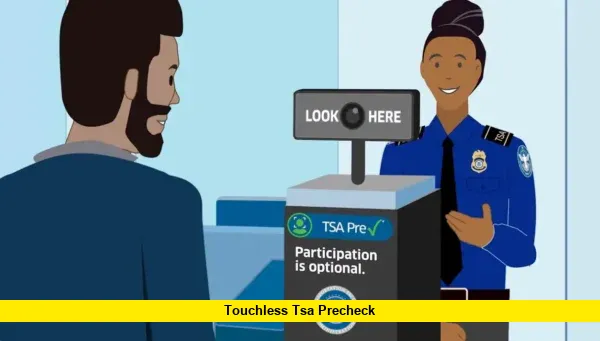

Airport security is becoming faster and more convenient, and touchless TSA PreCheck is one of the biggest changes travelers are seeing at U.S. airports. Instead of handing over a physical ID and boarding pass, eligible passengers can verify their identity using facial recognition technology at participating TSA checkpoints.
The program has expanded significantly since its early pilot phase and is now available at dozens of airports across the United States through participating airlines. While the technology is designed to speed up identity verification, participation remains voluntary, and travelers can still choose the traditional document-check process.
What Is Touchless TSA PreCheck?
Touchless TSA PreCheck is an enhanced identity verification system offered by the Transportation Security Administration (TSA) for eligible TSA PreCheck members.
Rather than presenting a driver’s license or passport at the checkpoint, travelers use facial comparison technology. A camera briefly captures a live image and securely compares it with an existing government-issued photo, such as the one stored in a passport. If the identity is confirmed, the traveler proceeds through the security checkpoint without handing documents to a TSA officer.
The screening process itself does not change. Travelers still undergo standard TSA security screening, but the identity verification step becomes quicker and more streamlined.
How the System Works
Using touchless TSA PreCheck typically involves several simple steps before arriving at the airport.
Eligible travelers generally:
- Enroll in TSA PreCheck.
- Have a valid passport linked to their airline profile.
- Add their Known Traveler Number (KTN) to the airline account.
- Opt into the Touchless ID program through a participating airline.
- Check in for an eligible flight.
- Receive an indication on their digital boarding pass that Touchless ID is available.
- Look into a camera at a designated TSA checkpoint instead of presenting physical identification.
The facial comparison usually takes only a few seconds before travelers continue through security.
Eligibility Requirements
Not every TSA PreCheck member automatically qualifies for the program.
Eligibility generally requires:
- An active TSA PreCheck membership.
- A valid passport.
- A participating airline account.
- A completed Touchless ID opt-in.
- Departure from a participating airport with an eligible flight.
Availability may vary depending on the airline, airport, and specific terminal being used. Even at participating airports, the dedicated Touchless ID lane may not always be open due to operational needs.
Participating Airlines
As of 2026, several major U.S. airlines support Touchless TSA PreCheck, including:
- American Airlines
- Alaska Airlines
- Delta Air Lines
- Southwest Airlines
- United Airlines
Each airline has its own enrollment process within its website or mobile app. Some airlines may require travelers to store passport information before enabling the feature.
Additional airlines may join the program as TSA continues expanding the initiative.
Airports Offering Touchless TSA PreCheck
The program has grown rapidly over the past year.
Initially available at only a handful of airports, Touchless TSA PreCheck has expanded to more than 60 U.S. airports serving participating airlines. Expansion has focused on major hubs and busy travel destinations, with additional airports continuing to come online throughout 2026.
Major airports where travelers may find Touchless TSA PreCheck include:
- Atlanta (ATL)
- Dallas/Fort Worth (DFW)
- Chicago O’Hare (ORD)
- Los Angeles (LAX)
- New York JFK (JFK)
- LaGuardia (LGA)
- Miami (MIA)
- Phoenix (PHX)
- Philadelphia (PHL)
- Denver (DEN)
- Seattle (SEA)
- Salt Lake City (SLC)
- Washington Reagan National (DCA)
Availability continues expanding, so travelers should verify participation with their airline before departure.
Benefits of Touchless TSA PreCheck
The program offers several practical advantages for frequent travelers.
Faster Identity Verification
The most noticeable benefit is speed. Travelers no longer need to search for their ID or boarding pass during the identity verification process.
Less Physical Contact
Since documents are not exchanged with TSA officers, the process becomes more convenient and reduces physical handling.
More Efficient Airport Experience
Many travelers find the experience smoother, especially during busy travel periods when every saved minute matters.
Seamless Integration
Once enrolled and opted in, eligible travelers generally do not need to repeat the enrollment process for every trip with the same participating airline.
Privacy and Security
Facial recognition naturally raises privacy questions, and TSA has emphasized that participation is optional.
According to TSA, the facial image captured during identity verification is encrypted and used only to confirm identity. The agency states that images associated with the verification process are deleted within 24 hours after the scheduled flight departure, and travelers may opt out at any time by choosing the traditional ID verification process.
Travelers who prefer not to use facial recognition can simply present their physical identification as they normally would.
Is a Physical ID Still Required?
Although Touchless TSA PreCheck allows eligible travelers to pass through participating checkpoints without showing their ID, carrying physical identification remains highly recommended.
There may be situations where:
- Technology is temporarily unavailable.
- Random identity verification is required.
- The Touchless lane is closed.
- Additional screening becomes necessary.
Having a REAL ID-compliant driver’s license or passport available can help avoid delays if manual verification becomes necessary.
Touchless TSA PreCheck vs. Standard TSA PreCheck
Although both programs offer expedited security screening, there are important differences.
| Feature | Standard TSA PreCheck | Touchless TSA PreCheck |
|---|---|---|
| Physical ID presentation | Usually required | Usually not required at eligible lanes |
| Facial comparison | No | Yes |
| Dedicated lane | PreCheck lane | Touchless-enabled PreCheck lane |
| Opt-in required | No | Yes |
| Passport required | Not necessarily | Yes |
The screening benefits remain largely the same. The primary difference is how travelers verify their identity before entering the screening checkpoint.
Comparison With CLEAR
Some travelers confuse Touchless TSA PreCheck with CLEAR, but they are separate programs.
CLEAR is a private service that also uses biometric verification but requires a separate paid membership. Touchless TSA PreCheck, on the other hand, is part of the TSA PreCheck experience for eligible travelers and does not require an additional Touchless enrollment fee beyond PreCheck membership.
In some airports, both services may operate alongside one another, while others may offer only one.
Recent Expansion in 2026
The past year has seen the largest expansion since the program began.
American Airlines recently expanded Touchless TSA PreCheck availability across all of its major hub airports and now supports eligible travelers at approximately 60 airports within its network.
Google Wallet has also become the first digital wallet partner for the program, allowing eligible travelers to opt into Touchless ID more easily after adding their passport and boarding pass. This development aims to simplify enrollment while maintaining existing security requirements.
Several airports have also introduced dedicated Touchless ID bag-drop services for participating airlines, further streamlining the airport experience for eligible passengers.
Limitations Travelers Should Know
Despite its growing availability, Touchless TSA PreCheck is not guaranteed for every trip.
Travelers may encounter situations where:
- The airport does not yet support the program.
- Their airline does not participate.
- The dedicated lane is temporarily unavailable.
- Technical issues require traditional identity verification.
- A passport is not linked to the airline profile.
For these reasons, travelers should still bring valid identification even if they expect to use Touchless ID.
The Future of Touchless Airport Security
TSA continues expanding biometric identity verification as airports modernize security operations.
Future improvements may include broader airline participation, additional airport locations, expanded bag-drop services, and deeper integration with secure digital identity platforms. However, any future enhancements will depend on operational testing, privacy considerations, and official TSA announcements.
Travelers should expect the program to continue evolving as more airports adopt the necessary infrastructure.
Final Thoughts
Touchless TSA PreCheck represents one of the most significant changes to airport security in recent years. By replacing manual document checks with secure facial comparison technology, eligible travelers can move through participating TSA checkpoints more efficiently while maintaining existing security standards.
Although the system continues expanding across the United States, availability still depends on participating airlines, eligible airports, and successful enrollment. Travelers who value shorter security lines and a smoother airport experience may find Touchless TSA PreCheck a worthwhile feature to enable on future trips.
Have you tried Touchless TSA PreCheck? Share your experience in the comments and stay updated as the program continues to expand across more U.S. airports.