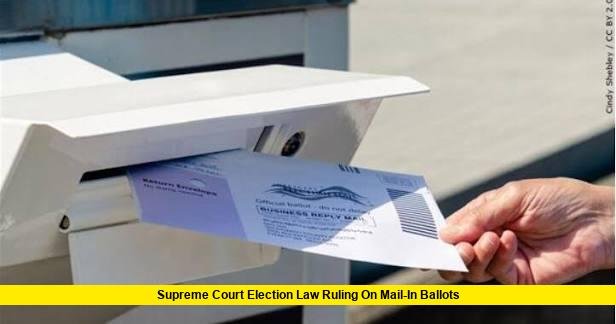

The Supreme Court Election Law Ruling on Mail-In Ballots — June 29, 2026, has become one of the most closely watched decisions of the year, as the justices sided with states’ authority to count mail ballots that arrive after Election Day. In a narrow 5-4 decision, the Court upheld a Mississippi law permitting election officials to count absentee ballots that are postmarked by Election Day but received up to five days later. The ruling arrives just months ahead of the 2026 midterm elections and carries significant consequences for the more than two dozen states that maintain similar grace-period policies for mail-in voting.
A standalone bold closing line encouraging reader engagement will appear at the end of this article, but first, here is everything voters, election officials, and political observers need to know about this landmark decision.
Background: How the Case Reached the Supreme Court
The case, known as Watson v. Republican National Committee, traces back to a Mississippi law passed in 2020 during the COVID-19 pandemic. The law was designed to give voters more flexibility by allowing absentee and mail-in ballots to be counted as valid so long as they were postmarked on or before Election Day, even if they physically arrived at election offices up to five days afterward.
Four years later, the Republican National Committee, the Mississippi Republican Party, a Mississippi voter, and a county election official filed suit in federal court, arguing that the state’s grace period conflicted with federal election-day statutes. A separate but similar challenge was brought by the Libertarian Party of Mississippi. The plaintiffs contended that federal law effectively requires all ballots to be received by Election Day itself, not simply cast or postmarked by that date.
A federal district court initially rejected the challenge, but the U.S. Court of Appeals for the 5th Circuit reversed that decision, ruling that federal statutes do require ballots to be received by Election Day. When the full appellate court declined to rehear the case, the dispute was appealed to the Supreme Court, which agreed to take it up last November.
The Supreme Court’s Decision
On June 29, 2026, the Supreme Court issued its ruling, reversing the 5th Circuit and reinstating Mississippi’s mail-in ballot deadline. Justice Amy Coney Barrett authored the majority opinion, joined by Chief Justice John Roberts along with Justices Sonia Sotomayor, Elena Kagan, and Ketanji Brown Jackson.
The majority’s reasoning centered on a distinction between when voters must make their choice and when that choice must physically arrive at election offices. According to the opinion, federal election-day statutes establish the deadline by which voters must cast their ballots, but they do not set a separate deadline for when those ballots must be received by officials. Because Mississippi’s law requires ballots to be postmarked by Election Day, the Court found that the state’s process satisfies federal law even though some ballots are tabulated afterward.
The opinion also emphasized that questions about ballot-receipt deadlines are matters for elected lawmakers to resolve, not the judiciary. The majority noted that if Congress believes a uniform national standard is needed for when mail ballots must arrive, that decision belongs to the American public through its elected representatives, not the courts.
Justice Samuel Alito wrote a sharp dissent, joined by Justices Clarence Thomas and Neil Gorsuch, with Justice Brett Kavanaugh joining most of the opinion. The dissent argued that historical practice and the plain meaning of “election day” have long required that ballot collection be completed on that specific date, and warned that the ruling could create confusion and undermine public confidence in election outcomes.
What the Ruling Means for Voters Nationwide
The practical impact of this Supreme Court election law ruling on mail-in ballots is substantial. Had the Court ruled the other way, an estimated 14 states, three U.S. territories, and Washington, D.C. would have been forced to overhaul their absentee and mail-in voting procedures just months before the midterm elections. Instead, the decision preserves the status quo, meaning no changes are required to existing state election laws.
Roughly two dozen states currently allow some form of grace period for mail-in ballots, with timeframes that vary from a few days to about a week after Election Day, provided the ballot was postmarked on time. California, for example, allows ballots to be received up to seven days after Election Day as long as they are postmarked by that date, and the state automatically mails ballots to all 23 million of its registered voters.
Election officials across several states welcomed the decision as a validation of long-standing voting procedures. Officials in Los Angeles County noted that between 700,000 and 1 million vote-by-mail ballots are typically returned around Election Day in that county alone during a statewide election, underscoring how significant late-arriving ballots can be in determining final results. Supporters of the ruling also highlighted the importance of grace periods for military service members, overseas citizens, rural residents, and voters with disabilities, groups that are more likely to experience mail delays beyond their control.
Political Reaction and the Push for New Legislation
The ruling immediately became a flashpoint in the broader political debate over election administration. President Trump described the decision as a significant setback and renewed his call for Congress to pass the SAVE America Act, legislation that would impose stricter national voting requirements, including new voter identification rules, proof-of-citizenship requirements for federal elections, and limits on mail-in voting. However, Senate leadership has indicated there is not currently enough Republican support in the chamber to advance the bill.
Mississippi’s own political leaders offered a mixed reaction. While the state’s law was upheld, Mississippi Attorney General Lynn Fitch and Governor Tate Reeves both indicated they would like to see state lawmakers revisit and potentially repeal the very grace period the Supreme Court just upheld, arguing that ballots should be required to arrive by the close of polls on Election Day itself.
Voting rights organizations, by contrast, celebrated the outcome as a win for accessibility and electoral stability. Advocacy groups argued that the decision protects voters who depend on the postal system and prevents a last-minute disruption to established state election procedures so close to the midterms.
This decision also arrives amid a broader pattern of legal battles over federal versus state control of elections. Earlier this year, a separate executive order sought to require states to submit approved voter lists to the U.S. Postal Service as a condition of ballot delivery, a policy that has since been put on hold by a federal judge. Together, these disputes reflect an ongoing tension between efforts to centralize election oversight at the federal level and the traditional authority of states to administer their own elections.
Looking Ahead to the 2026 Midterms
With the Supreme Court’s ruling now in place, election officials across the country can proceed with existing mail-in ballot procedures without the uncertainty of a last-minute legal overhaul ahead of the November midterms. States that offer grace periods for late-arriving ballots will continue to do so, giving voters confidence that ballots mailed on time will be counted even if postal delays push their arrival past Election Day.
At the same time, the decision is unlikely to end the broader political fight over mail-in voting rules. Renewed legislative efforts, potential state-level changes such as those being discussed in Mississippi, and continued litigation over related executive actions all suggest that election procedures will remain a contested issue heading into the fall campaign season.
Final Thoughts
The Supreme Court Election Law Ruling on Mail-In Ballots — June 29, 2026, represents a pivotal moment for how mail-in voting is administered across the United States. By affirming that federal law does not require ballots to be received by Election Day, so long as they are postmarked on time, the Court has preserved a system that millions of voters, particularly those in rural areas, military families, and voters with disabilities, rely on each election cycle. While the political debate over mail-in voting rules is far from settled, this ruling provides clarity and stability for the states and voters preparing for the 2026 midterm elections.
Stay informed on the latest developments in this evolving election law story, and share your thoughts on how this ruling could shape voting access in your state.